
Tabina Tariq
When I first read Ann Petry’s The Street as a young reader, I thought Lutie Johnson was overreacting. She seemed too preoccupied with the attention she attracted, too suspicious of the men around her, too easily frightened by things that might never happen. I wanted her to relax. Surely, I thought, not every glance meant something; not every uncomfortable feeling was a warning. I didn’t understand why she spent so much time anticipating danger when she could simply get on with her life.
I have since become less certain that the ability to get on with your life is entirely your own.
Growing up in suburbia, I exclusively went out with friends or family, and especially in clothes my parents considered “appropriate”—covered enough to feel unremarkable. Full-length pants, full-length sleeves, not too tight around the chest, hips, or butt. Femininity is nonexistent. I am a baggy figure: No one can see where I begin and where I end. A false sense of comfort. There was a certain security in the arrangement. I knew where I was going, who I was with, and roughly what was expected of me. Moving to a city gave me something I had wanted: the freedom to go places alone, to choose my own clothes, to make decisions without having to account for every one of them. I could be more fully myself.
What I had not anticipated was how much moving through the city alone would teach me. I began learning the small calculations that accompany moving through a city alone: which encounters to ignore, when to cross the street, how to respond without encouraging a conversation I never wanted to have. Sometimes I could enjoy an afternoon in an outfit I liked. Sometimes I could feel myself becoming smaller inside it, wishing I had chosen something less noticeable. The unsettling part was not any single encounter. It was the realization that pleasure could be interrupted by the possibility of someone else’s behavior, and that I was expected to anticipate that behavior before it happened.
I find myself wondering whether I have somehow invited an interaction simply by existing in a body someone else has decided to notice.
As a South Asian woman, not quite five feet tall, there is something almost comical about the discrepancy between my size and the amount of thought I sometimes have to give to my presence in public. I want to dress femininely, to wear something pretty, to look in the mirror and like what I see. These are ordinary pleasures, or should be. Yet sometimes, the moment I step outside, an ordinary decision about what to wear acquires a second meaning. A stranger’s gaze lingers. A man makes a comment that assumes a familiarity I never offered. I become conscious of my clothes, my surroundings, the distance to the next open shop. I find myself wondering whether I have somehow invited an interaction simply by existing in a body someone else has decided to notice.
Growing up in suburbia, I exclusively went out with friends or family, and especially in clothes my parents considered “appropriate”—covered enough to feel unremarkable. Full-length pants, full-length sleeves, not too tight around the chest, hips, or butt. Femininity is nonexistent. I am a baggy figure: No one can see where I begin and where I end. A false sense of comfort. There was a certain security in the arrangement. I knew where I was going, who I was with, and roughly what was expected of me. Moving to a city gave me something I had wanted: the freedom to go places alone, to choose my own clothes, to make decisions without having to account for every one of them. I could be more fully myself.
What I had not anticipated was how much moving through the city alone would teach me. I began learning the small calculations that accompany moving through a city alone: which encounters to ignore, when to cross the street, how to respond without encouraging a conversation I never wanted to have. Sometimes I could enjoy an afternoon in an outfit I liked. Sometimes I could feel myself becoming smaller inside it, wishing I had chosen something less noticeable. The unsettling part was not any single encounter. It was the realization that pleasure could be interrupted by the possibility of someone else’s behavior, and that I was expected to anticipate that behavior before it happened.
As a South Asian woman, not quite five feet tall, there is something almost comical about the discrepancy between my size and the amount of thought I sometimes have to give to my presence in public. I want to dress femininely, to wear something pretty, to look in the mirror and like what I see. These are ordinary pleasures, or should be. Yet sometimes, the moment I step outside, an ordinary decision about what to wear acquires a second meaning. A stranger’s gaze lingers. A man makes a comment that assumes a familiarity I never offered. I become conscious of my clothes, my surroundings, the distance to the next open shop. I find myself wondering whether I have somehow invited an interaction simply by existing in a body someone else has decided to notice.
Reading The Street again, I began to recognize this anticipation in Lutie.
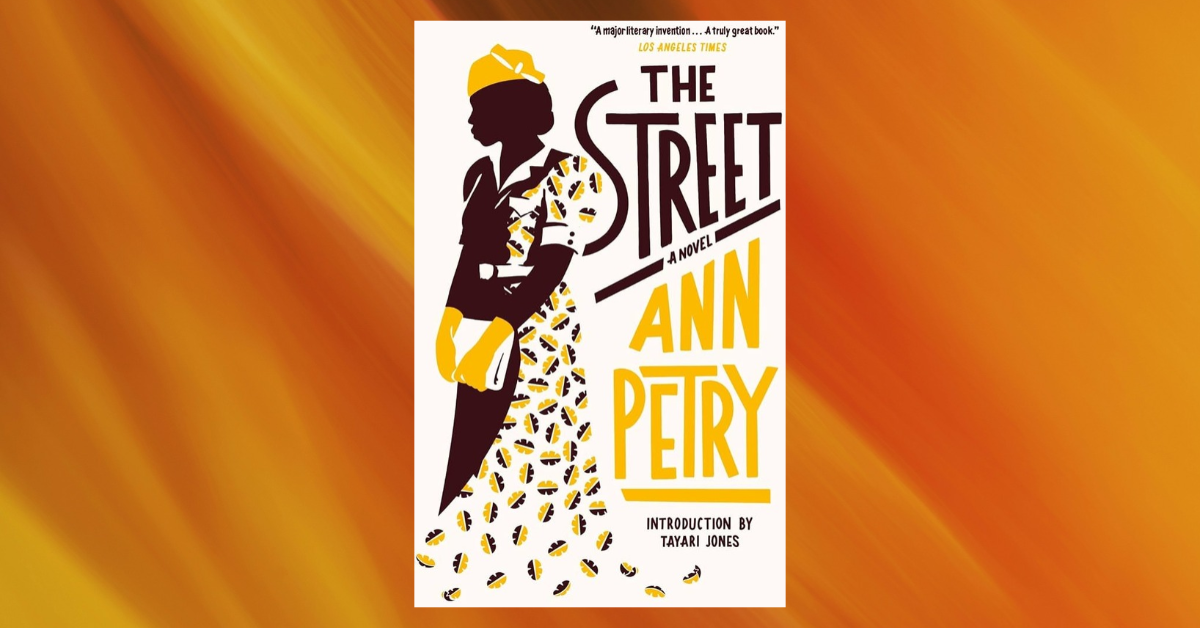
Early in the novel, Lutie Johnson, a Black woman living in 1944 Harlem, visits an apartment building because she needs somewhere affordable for herself and her son, Bub. The building advertises “respectable tenants,” but Lutie understands what that promise means in a neighborhood where Black residents have limited housing options. Petry makes this racial context explicit: The people considered respectable in these buildings include anyone who can pay the rent, because these are among the places where “colored people were allowed to live.” Lutie’s unease, then, exists within a world already shaped by racial and economic restrictions. She is not simply entering an unfamiliar building, she is trying to secure a home within a system that has severely limited where she can afford to live.
The superintendent, William Jones, makes her uneasy. His gaze is not incidental to her experience of him; she feels herself being assessed, her body appraised. Petry describes his eyes as filled with “a hunger so urgent that she was instantly afraid of him and afraid to show her fear.” As he follows her up the stairs to show her the apartment, she becomes increasingly frightened. She can feel his eyes traveling over her, “estimating her, summing her up, wondering about her.” Yet almost immediately, she begins arguing with herself. Perhaps she is tired. Perhaps she is imagining things. Perhaps he is only waiting for her to finish looking at the rooms.
What struck me on rereading was not simply that Lutie senses danger. It’s how quickly she turns against her own suspicion. She feels afraid, then puts herself on trial for feeling afraid. She tells herself, “It isn’t possible to read people’s minds,” trying to convince herself that what she has sensed might mean nothing at all. She even considers whether the superintendent might simply want to return downstairs to listen to the radio. Petry allows us to follow this internal argument as it unfolds, so that we experience not only Lutie’s fear but also the exhausting work of trying to disprove it. She must somehow establish that her fear is reasonable before she is allowed to act on it.
Petry makes the scene especially cruel because Lutie is not choosing between safety and danger in any straightforward sense. She is choosing between two deeply compromised living situations. At her current home, she shares seven crowded rooms with her father, Pop, his girlfriend, Lil, and various tenants. What frightens her most is the effect this environment is having on Bub: Lil has been giving him drinks and getting him to light her cigarettes. The new apartment promises a home of their own, away from that environment. But it also means placing herself under the authority of a superintendent whose attention makes her feel threatened. She needs the apartment for Bub’s sake. She cannot simply leave because something feels wrong. Her circumstances require her to negotiate with the very person she fears.
This is what I had missed as a young reader: vigilance does not always mean having the freedom to escape. Sometimes it means remaining alert because escape is too expensive, too complicated, or simply unavailable. Lutie has to keep thinking, keep calculating, keep imagining what might happen next. The work of anticipating danger falls to her, while the man who makes her afraid is free to regard himself as entirely ordinary.
I think, too, about the novel’s opening. A November wind tears through 116th Street, grabbing at people’s clothes, lifting dust into their eyes, prying scarves from their necks. When it catches Lutie, she feels suddenly exposed. The street is not a neutral backdrop through which she moves: It presses against her body. Petry makes the city feel almost animate, something that reaches for people, interrupts them, and refuses to leave them alone. Even before Lutie enters the building, the world around her is already making demands on her body.
I used to think freedom meant being able to walk down a street without caring what anyone thought of me. Now I wonder whether that definition quietly assumes a world in which other people’s attention is harmless. There is a difference between not caring what people think and having to consider what they might do. One is liberation from judgment; the other is an attempt to anticipate consequences.
The consequences of being seen follow Lutie beyond the apartment building, and Petry shows how beauty itself becomes entangled with power. Lutie wants a better life for herself and Bub, and her beauty and singing voice offer possibilities for advancement. But the men who recognize her attractiveness repeatedly see an opportunity for themselves. Her appearance becomes something they feel entitled to interpret, pursue, and use. When Lutie begins singing at the Casino, for instance, her talent offers a possible means of earning money and escaping the street. Yet Junto, the Casino’s owner, decides that she should not be paid for her performances. Instead, he instructs Boots to give her presents and arrange an opportunity for him to see her. Her voice, which might have given her greater independence, becomes another means through which powerful men attempt to gain access to her. What looks like an advantage from the outside can become another condition she has to manage. She can be admired and still be unsafe; she can attract attention and have less control over what that attention demands of her.
There is a peculiar loneliness in these questions.
I do not want to suggest that my experiences are equivalent to Lutie’s. The racism, economic deprivation, and constrained choices that shape her life belong to the particular world Petry depicts. But the novel has helped me recognize a familiar emotional pattern: how easily a woman can begin to question herself when she is the one left to bear the consequences. Perhaps I misread him? Perhaps I should have worn something else? Perhaps I am being dramatic? Perhaps it would be easier if I simply did not go out alone?
There is a peculiar loneliness in these questions. They make an encounter seem like a private misunderstanding, something to be solved by adjusting yourself. You can spend an entire evening reviewing your own behavior while the person who made you uncomfortable has probably forgotten the interaction altogether. The asymmetry is difficult to explain: One person gets to act without much thought, while the other inherits the task of making sense of what happened.
The problem is not that every man is dangerous, but that a culture of entitlement allows men’s attention and desires to become women’s responsibility. The burden falls on women to anticipate, interpret, and manage behavior that they did not invite and should not have to accommodate. A woman wearing a dress is not making a request. A woman walking alone is not offering an invitation. Being beautiful, being a woman, being human—does not make someone public property; and being small does not make someone available to be intimidated. None of this should require a woman to develop an elaborate theory of self-protection before she can enjoy an ordinary day.
What stays with me about Lutie is not simply that she is afraid—it is that she keeps trying to convince herself she has no reason to be. I used to read those moments as evidence that she was overreacting. Now I see a woman trying to preserve her own sense of reality while navigating a world that gives her very few good choices.
Perhaps growing older has meant learning that fear is not always the opposite of freedom. Sometimes it is the price we have been taught to pay for exercising it. The tragedy is not that women become vigilant. It’s that vigilance can become so ordinary that we begin to mistake it for a personality trait, something anxious women do, rather than a response to the conditions in which they live.
I used to wonder why Lutie could not simply live her life. I am beginning to understand how much effort can go into doing exactly that.
ANN PETRY (1908-1997), American novelist, short fiction writer, journalist, and biographer, is remembered for her depictions of life among the African American communities of New England. Her 1946 novel The Street was the first novel by an African American woman to sell more than one million copies.
The Street can be purchased here.

Leave a Reply