
By Elaine Qiao, Art by Elizabeth Chang
In Much Ado About Nothing, Don Pedro walks Hero down the aisle to give her hand in marriage to Claudio. Prone to theatrics, Claudio makes a show of returning that hand: “There, Leonato, take her back again. Give not this rotten orange to your friend. She’s but the sign and semblance of her honor” (4.1.30) [1]. Having fallen for Don John and Boracio’s cruel trick to convince him Hero was unfaithful, Claudio resorts to humiliating Hero on their wedding day instead of confronting her in private. It’s true that a rational conversation between couples was not necessarily in the cultural code, nor would it make for very entertaining theater. At the same time, it’s also not the first example of Shakespeare resorting to a display of male rage to forward a climax.
Regardless of his ambiguous intent, however, the impassioned display once again validates a masculine performance of anger, gendered and sexual in nature.
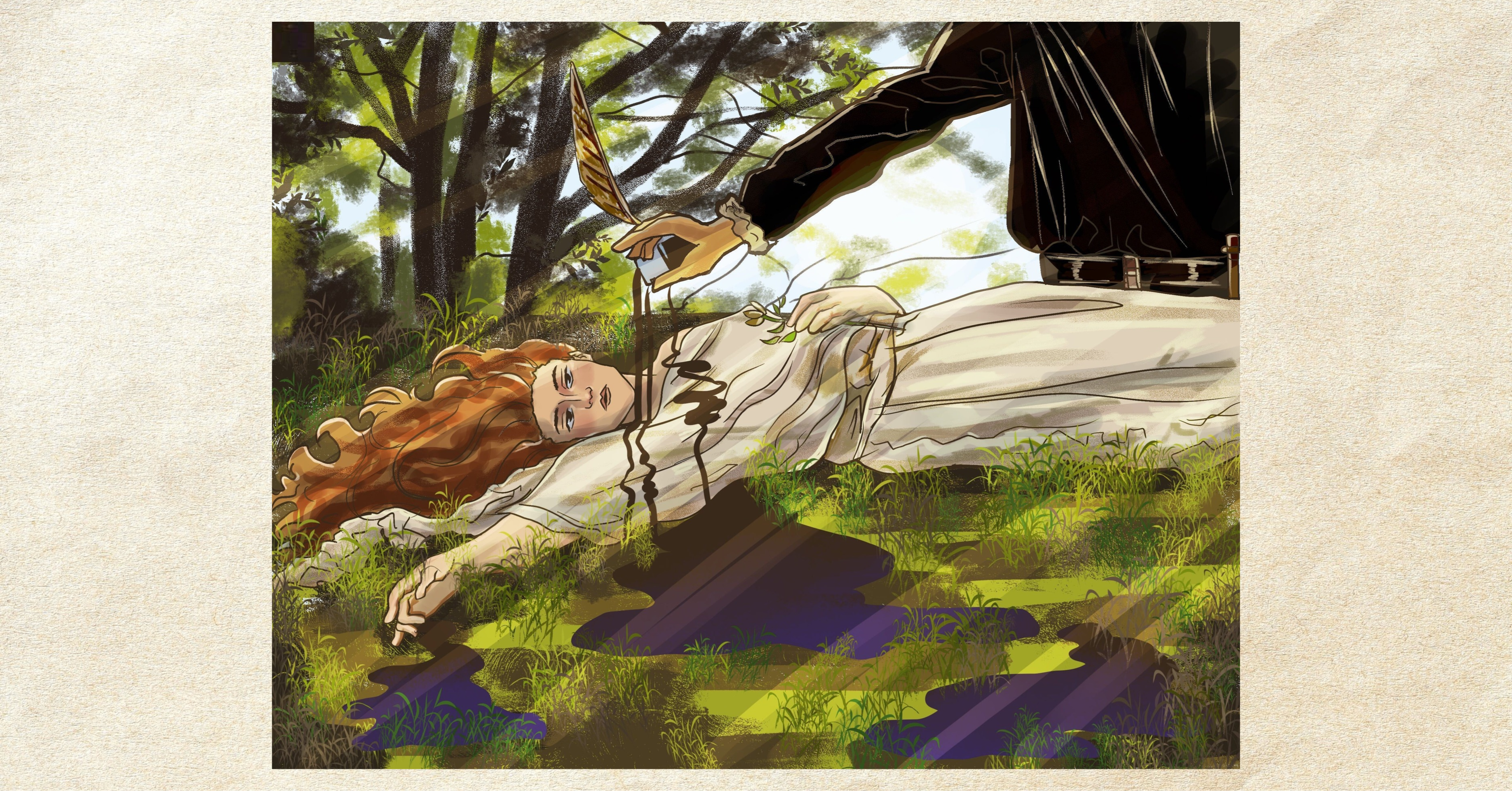
Hamlet, in a more extensive episode, similarly torments his mother Gertrude and love interest Ophelia. Famously proclaiming “Get thee to a nunnery!” (3.1.121) [2], Hamlet shames Ophelia and women as a whole for birthing twisted men like him—for being “breeder[s] of sinners” (3.1.121) [2]. In some adaptations, Hamlet even resorts to violence, choking Ophelia as he projects the weight of his various resentments upon her. This is particularly shocking, as the scene doesn’t necessarily come at a climactic moment in the narrative and Ophelia’s misdeeds are decidedly minor when compared to all who have offended Hamlet.
In other interpretations, Hamlet pushes Ophelia away to protect her from any suspicions of treason that would arise if she continued to be affiliated with him. Some take his nunnery order to be literal, so that she may protect herself in a world of exploitative men. Regardless of his ambiguous intent, however, the impassioned display once again validates a masculine performance of anger, gendered and sexual in nature. Hamlet is a particularly egregious example, as he also does this to his mother. In Zeffirelli’s adaptation filled with explicitly sexual camerawork, Hamlet confronts Gertrude before murdering Polonius, furious at her perceived betrayal of his father in a sort of Freudian self-projection. [3]
As much as the absence or disenfranchisement of Shakespearean women elucidates his views on gender, so does the presence and power of his men.
Shakespeare does tend to punish his male characters for their uncontrolled displays of rage to some extent. Hamlet ultimately dies from his manic machinations and causes the ruin of his nation. Though Fortinbras takes over Denmark, he famously honors Hamlet in his death and validates his vengeance. [2] King Lear is directly punished for his harshness against his daughter Cordelia, though she is also brought down by his vanity after failing to save him against her usurping sisters. [4] Some, like Claudio, however, are not punished at all. [1] The two have a happy wedding despite the irreconcilable damage done to Hero’s esteem and reputation. And whether or not Shakespearean men are held accountable for their wrongdoings, audiences spend much of the play watching thematically significant performances of self-serving male rage primarily used for theatrical effect.
Gender discourse surrounding Shakespeare often circles around his portrayal of his female characters: Is the lack of female presence within Hamlet a meta-commentary on the role of women in royal court? Is Ophelia’s sing-songy madness a reclaiming of power, a display of helplessness under patriarchy, or just patriarchal in and of itself? Is Lady Macbeth unfairly villainized, or granted unprecedented agency? While these discussions are worthwhile, the other half of the binary also warrants conversation. The vast majority of Shakespeare’s repertoire surrounds his often-titular male characters. As much as the absence or disenfranchisement of Shakespearean women elucidates his views on gender, so does the presence and power of his men. Whether or not these performances can be contextualized with key nuances, consequence, or alternative intent, these continual and pervasive displays of male outrage confirm and sanction a certain kind of emotional response.
Hamlet succeeds through failure. Claudio jumps to conclusions. King Lear falls prey to flattery. These men act out of self-importance, a love for melodrama, and lack of foresight, and too often drag down the women near them. Yet their soliloquies are the most recited, their characters most iconic to their namesake stories. The modern landscape increasingly motivates men to question, “What about me?” in a world already designed for them. It’s difficult not to wonder whether these pieces of classical literature played and continue to play a formative role in this egotistical mentality.
It’s fair to question what duty Shakespeare has—past and present—for socializing and conceptualizing gender relations.
Perhaps as much as the next writer, Shakespeare’s work is a product of his time. King Lear, for example, isn’t even Shakespeare’s original work, but a theatrical adaptation of folk legend and prior chronicles. Within his lifetime, all of Shakespeare’s female roles were played by men, as acting was seen as an unrespectable female profession. Yet his work often anticipated feminist concerns, even if he did not explicitly address or conceive of them. Emilia remains the most sane amidst the plottings in Othello, Juliet’s suffering provides commentary on the marriage system, and Cleopatra becomes a symbol of sexual autonomy and political shrewdness. [5, 6] But even his somewhat innovative portrayals of women exist alongside depictions of men normalized even now.
Shakespearean men are allowed to be violent for selfish concerns, act according to whims in service to some ultimately shortsighted scheme, and hurt the women who love them across scripts and stages. As a resonant cultural symbol and the “greatest writer of all time,” it’s fair to question what duty Shakespeare has—past and present—for socializing and conceptualizing gender relations, as well as how much we can expect his massive audiences to pick up on disputable nuance. To what extent can we exonerate his work of feminist responsibility? When we speak of Shakespeare’s innovative handling of women, can we hold accountable his ratification of ill-behaved men?
References
- Shakespeare, William, et al. Much Ado about Nothing. Second edition, Bloomsbury Arden Shakespeare, 2016. The Arden Shakespeare. Third Series.
- William Shakespeare, et al. Hamlet. Revised edition, Bloomsbury Arden Shakespeare, 2016. The Arden Shakespeare. Third Series.
- Hamlet. Directed by Franco Zeffirelli, Warner Brothers, 1990.
- William Shakespeare, and R. A. Foakes. King Lear. Arden Shakespeare, 1997. The Arden Shakespeare.
- William Shakespeare, et al. Othello. Revised edition, Bloomsbury Arden Shakespeare, 2016. The Arden Shakespeare. Third Series.
- William Shakespeare, et al. Julius Caesar. Edited by Richard Proudfoot, Reprinted, Bloomsbury Arden Shakespeare, an imprint of Bloomsbury Publishing Plc – Bloomsbury, 2011. The Arden Shakespeare : Third Series / General Editors: Richard Proudfoot [Und 3 Weitere].

Leave a Reply