
Sakina Leduc-Akbar
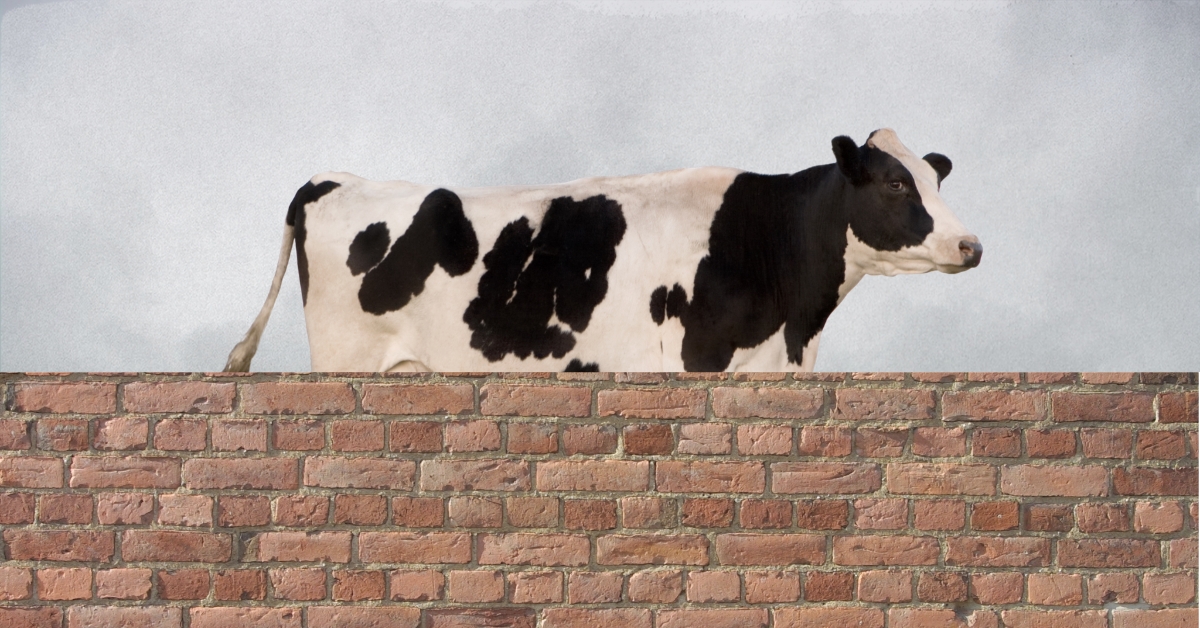
Imagine accompanying your cousin for a vacation in the Austrian mountains, expecting a restful weekend spent among nature and a cozy hunting lodge. In desperate need of a vacation to escape your monotonous life as a wife and mother, you wake up excited for your first relaxing day at the lodge, only to find yourself permanently trapped in a small expanse of wilderness by an indivisible wall with everything outside of it annihilated. For the rest of your life, your sole companions will be your cousin’s dog, Lynx, a cow named Bella, and a feral cat. This is precisely the disaster that befalls the unnamed protagonist of the 1963 Austrian novel, The Wall by Marlen Haushofer, translated from German to English by Shaun Whiteside. At first glance, the novel appears to be the epitome of a terrifying nightmare, with its sudden, supernatural disaster and extinction of humanity, one can scarcely imagine being flung into this alternate universe. However, with society having been cast away in exchange for a life dedicated to the care of nature and animals, the protagonist will find renewed meaning in her life as she learns how to keep herself and her animal companions alive. This new existence proves to be more fulfilling than her previous life and suggests that The Wall isn’t a dystopia at all, and is more akin to a paradise.
I first picked up The Wall as part of my summer reading list and, intrigued by the high-concept premise, I began reading, expecting the story to catalog the narrator’s escape and triumph over the unknown powers that imprisoned her. However, I was left reeling from a very different type of story. The novel makes clear that the protagonist has no chance of escaping. She tells us these facts early on through retrospective narration as she’s writing what we read from three years in the future on her last scraps of surviving paper.
“I can allow myself to write the truth; all the people for whom I have lied throughout my life are dead.”
Our protagonist doesn’t sugarcoat her reality: She has no one to write for but herself and, from the time of telling, she’s recalling her story while encased within the wall. But instead of revealing the reason she’s trapped, the story examines how one must find the will to live on, even when everything appears devoid of meaning. Our main character must come to terms with the reality that she will not be rescued and learn to live in eternal solitude. The effect of this focus causes the majority of the novel to move at a languid pace. The events are encapsulated by the barrier the wall inflicts on our protagonist’s life and, as a result, the story is restricted to the same limitations of space as our main character. The narration constantly circles around the same repetitive notions of daily life, from feeding and milking the cow, to carrying straw to the byre, to burying potatoes for later harvest, to making dinner.
“Like her, I held out hope things would change.”
I realized I was completely immersed in experiencing the protagonist’s problems as she waited around each day to see if something would change, only to become despaired upon realizing the approaching day would be exactly like the last—with no rescue in sight. I was wholly engrossed in her worries over mundane things, like how fast her bean plant would sprout, whether the grass was adequate for Bella to graze, or where her cat went during her nightly excursions. I held my breath with the protagonist each time she tried turning on the radio of the car, only to be rewarded with the static fuzz of lost signal. The suffocation caused by these repetitive motions and daily anxieties did not make the novel drag on, but brought it to life, for it was the everyday troubles that made it so engrossing, and maintained my sense of curiosity about the protagonist’s future. But our narrator isn’t trying to tell a suspenseful story, going as far as to spoil the ending by telling us from the get-go that her closest companion, Lynx, has already passed away. Still, I desperately flipped through the pages to find out what would happen next, even when I knew very well that there was no possibility of the main character’s rescue. Like her, I held out hope things would change.
Given the horror of the situation, The Wall appears to be the farthest thing from an ideal world. Indeed, life inside the wall is a nightmare, but one that forces the protagonist to fend for herself. In keeping her animals alive, she is able to find purpose and the freedom to live off of her own rules. She finds solace in speaking to her cat and its kittens, in exploring the woods with Lynx, and ensuring her cow Bella (and later, her calf) have the best lodgings possible. In the wilderness, the main character is capable and sufficient, so well-adapted that her previous role as a mother and wife seems to have completely dissolved. In fact, throughout the novel, she hardly mourns losing her loved ones. Her lack of attachment to her old life reveals how stifling it was with her lover and children, an existence she says was “unsatisfactory in all respects.” Even in her loneliness, she doesn’t wish for a human companion for fear of being told orders or quarreling with them. The wall is obtrusive and inexplicable, but just as it strips away the protagonist’s former life, it also opens up new possibilities for her to live in a world unburdened by society or expectation, where aspects of her identity, like gender and age, do not figure.
“I could simply forget I was a woman. Sometimes I was a child in search of strawberries, or a young man sawing wood, or, when sitting on the bench holding Pearl on my scrawny lap watching the setting sun, I was a very old, sexless creature.”
Without surveillance from outsiders, appearance ceases to have any meaning and the protagonist can be anyone she dreams of. Her animals cannot judge her looks. Only occasionally does she steal glimpses of her own reflection, making her physical age and identity as a middle-aged woman ripple and change by her own will. Being so utterly and completely alone, there is no one to tell her she cannot simply flow between different genders and ages.
“These unlikely felines and farm animals become the pillars which allow her to maintain stability.”
But the heart of the novel lies in the protagonist’s relationships with her animals—the only companions she will have for the rest of her life. The discovery of the cow, Bella, and her cat (who, like the narrator, is unnamed) is integral to the narrator’s survival by giving her companions to care for. Although her discovery of the animals is accidental—she randomly hears Bella’s mooing in the distance, and is equally surprised by the cat’s sudden appearance at her lodge during a storm—these unlikely felines and farm animals become the pillars which allow her to maintain stability, and give her comfort as she grows to love them.
Luckily, I have not been cut off from humanity by an invisible wall, but I found myself sharing her love of animals. I spent a decade volunteering at the Tilden Little Farm in Berkeley, and many of my tasks mirrored the protagonist’s. We were both responsible for taking care of cows and their calves, cleaning out their byres, bringing in fresh straw, and giving them baths. Much like the protagonist, I struggled at first to complete the labor. Carrying heavy squares of pine shavings, foraging through the drainage system with my shovel to find the source of the barn clog, and holding on for dear life to the goats’ leashes as I walked them around Jewel Lake were jobs requiring much more strength than my eight-year-old arms could handle. I, too, was at the mercy of the elements; so many times I scooped mud under the pouring rain, amid the swell of a heat wave, and even swept clean an enclosure that was, an hour later, destroyed by a eucalyptus falling across the farm from a particularly vicious gust. However, towards the end of my time volunteering, I grew in strength and skill, and spent the majority of my time working on an isolated patch of the farm located at the very top of a hill—the sheep pen—the most laborious of all the enclosures to clean. Many times after I scraped the stone floor of the byre clean and hosed its walls down, I sat on that field and looked across the great expanse of trees and the white dots of sheep grazing below, and I felt like The Wall’s protagonist when she sat beside her cow and dog, and looked up at the stars. Although there were holes in our shoes and straw in our hair, we both understood the great liberation and comfort of caring for animals, and those hours spent scraping at stubborn stone floors seemed worth it.
“It is ironic that she feels most free while being so physically trapped.”
But, unlike the protagonist, I was able to return home after my work was finished. Our main character might never have chosen this life of nature out of her own free will, and it is ironic that she feels most free while being so physically trapped. The daily toll of keeping her animals alive allows her to realize her own strength and grow into herself away from the harshness of society. By the end of the novel, she is a completely different woman: brave and wholly independent. Can a woman living alone in peace really be considered dystopian? This question, which had persisted in my mind, only gained a resolution when I reached the last page. Of the many books which constituted my summer reading list, The Wall was a stand-out, being the first novel that left me so close to tears since Susan Collins’s Mockingjay, which I read as a teen. The ending is shocking and tragic, for the story concludes with a single vignette: Right in front of her, the protagonist sees a man brutally slaughtering her cow’s calf and Lynx. In defense, she shoots him with her rifle. Distraught, she rolls the man’s body down the hill and, unable to move her calf to give him a proper burial, digs a grave and buries her dog. Where did this man come from and why has he done such a horrible thing? Why, after all the protagonist has done to ensure her animal companions are safe and happy, does the novel finish with this merciless act of violence in a world which appeared purged of all human threats? We never find out.
But strangely enough, this ending sealed my love for the novel. Rather than feeling appalled at the absence of an explanation, I wound up distraught after she lost her cherished dog and calf, for I remember the sadness of losing animals at the farm, many of which were attacked by other wild animals or were wiped out by diseases. I mourned alongside her for her companions and felt content to merely share in this feeling of despair.
This novel is neither pure terror nor perfect escape, for the rare moments of peace we find in the story are quickly shattered by intrusion. The protagonist’s world, which once seemed resistant to change, is destroyed in just one scene, as all her beliefs about her freedom and isolation are proved false. However, as much as it may seem that the actual wall is the source of the protagonist’s misfortune, mankind’s violence is ultimately what breaks our protagonist and drives her to grief in the end, a loss which is far more harrowing than losing her past life ever was. The repetitive loop of her routine, which we grow accustomed to experiencing alongside her, is violated by an outsider, and our memories of our main character’s peace are now stained with our knowledge of the future. Yet we are closer than we have ever been to our protagonist, as we’ve reached the present time she is writing. We feel her agony collapse on us, which has haunted her narration from the first line. That is perhaps why the ending of The Wall is so impossible to reckon with. Sometimes compared with Jacqueline Harpman’s I Who Have Never Known Men for its refusal to provide answers, this novel finishes with an ending that leaves readers searching for pages that will provide a resolution, which, of course, does not exist. The Wall is not a novel that wants you to solve the mystery, but instead to bask in this lack of knowledge. The protagonist will never understand why her animals were killed and how this man managed to evade her notice. In this way, readers are thrust into the same despair as the character, and are forced to sit in this discomfort, this darkness, and search for consolation in the unknown.

Leave a Reply