
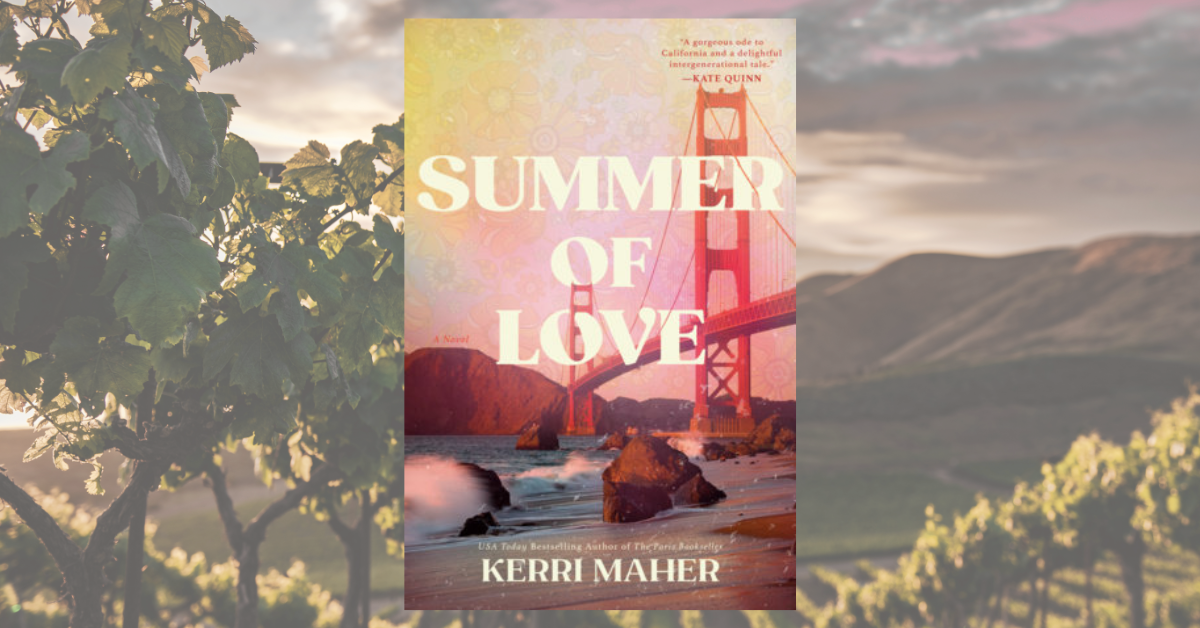
Interview by Ella Kirshbaum
Berkeley Fiction Review: Thank you so much for taking the time to talk to us today about your upcoming book, Summer of Love! How are you feeling about the upcoming release?
Kerri Maher: It’s exciting—you know, it’s not until July, so it’s just far enough away to seem unreal still, but I’m slowly starting to do more interviews so it’s starting to feel like it’s really going to happen.
BFR: Yeah, you have a little bit of time, but do you have any cool stops planned for your book tour?
KM: I live out in Massachusetts now—I am trying to get back to California, but I have a kid in high school, so it’s not going to be for a little bit—and so I’m going to do two launch events near where I live, outside of Boston, and then I’m going to do a week of events in California. I am not, unfortunately, going to be in the Bay Area; I’m going to do one event in Sacramento, and one event in Napa, and one in Santa Barbara, and one in LA.
BFR: That’s too bad you’re not coming to the Bay Area, because this book is so much a love letter to this area!
KM: I know! The thing about book events is that unless the store can bring a crowd for you, you have to bring a crowd for you, and I just don’t know enough people in the Bay Area to feel confident that at least twenty people are going to show up for me, whereas in Sacramento I have more people, and I don’t have anyone in Napa but I’m doing it with a conversation partner who feels like she can get some people. And as you saw, a lot of the book is set in Napa also, so I’ll be able to publicize it on that basis.
BFR: It’s very clear that you have this incredible love for California. Did you spend time living Napa as well?
KM: No, I didn’t—but I grew up spending time in the San Joaquin Valley, in Stockton, which is not Napa, but it is agricultural in a lot of the ways Napa is. And Stockton is right next to Lodi, which is the San Joaquin Valley wine country; it is quite different in a lot of ways, but I feel like I grew up with some of the same qualities that Napa has, just in a slightly different part of the state.
BFR: What gave you the idea for this novel?
KM: So, this book is my fifth historical novel, and it doesn’t have a straight-forward inspiration story. In one of my other novels, The Paris Bookseller, I wrote about Sylvia Beach, who opened the original Shakespeare & Company store in Paris in 1919, and that one had a clear inspiration: I read Beach’s memoir when I was in college at Berkeley, and I sort of knew about her my whole life, and so when I was looking for a subject, there she was.
Whereas with this book, I knew that I didn’t want to write about a real person or people, but I knew a few things: I knew that I wanted to write about California. (Originally I really wanted to write a California Road Trip novel, and it didn’t quite turn out that way; there’s a little bit of road tripping but it’s not a true road trip novel.) I knew I wanted to write about addiction and recovery. And I knew I wanted to write about the Bay Area in the ’60s. My parents met at UC Berkeley in the 1960s, so my childhood was full of stories of the Berkeley of the ‘60s. I just had so many great stories floating around in my mind that that period was very alive in my imagination.
So I had all these ingredients, but they weren’t baking a cake yet [laughs], and—do you know of the book called The Artist’s Way by Julia Cameron? It’s sort of a 12-week course in a book, a creativity course, and I’d been avoiding doing it for years because I knew that the cornerstone of her practice was journaling, and I hate journaling—or I thought I hated journaling, but many people that I really respected were like, “Kerri, you have to do The Artist’s Way, because if you do The Artist’s Way you’re going to figure out what the book is about.” And I was like, “Okay I’ll try it.”
So I did, and it turns out that that morning journaling practice—she calls it Morning Pages—really helped me figure out what this book was about. One day, the three main characters of the book kind of walked on stage in my mind, and were like “Hello! We’d like to introduce ourselves!” [laughs] and I knew then what the story was going to be about.
My childhood was full of stories of the Berkeley of the ‘60s. I just had so many great stories floating around in my mind that that period was very alive in my imagination.
BFR: So I know you’re old hat at writing historical fiction novels, but this book covers so many times and settings: 2015 and 1960s, Napa and Berkeley and San Francisco—what did your research process look like for this book, and how did it differ from the previous books you’ve written?
KM: That’s a great question. So, I already mentioned that I grew up with tons of stories of this place and time, so I felt familiar with it already. But of course, I didn’t want to get anything horribly wrong. There were a couple of books I used—there was a coffee table book called Summer of Love and it was an art exhibition catalogue book that had lots of great articles in it about the art of the time, and the fashion, and the time period, and so I read that in a lot of detail. I talked to the people who had lived through it again.
But the real research that I needed to do had to do with wine making. I really didn’t know very much about wine making, and so I read quite a bit about the history of wine making in California, and also just how wine is made. Now, my book is not super science-y, because I am not super science-y; I take a little bit more of a sociological or social history look at wine making in California, and I just found all of that fascinating. So that was the bulk of the real research and learning I had to do.
BFR: Your book talks a lot about the craft of wine making but also about alcohol addiction. How were you able to find a balance between the beauty of wine country but also the damage that alcohol can do to a person?
KM: I am a sober person; it’s now been four-plus years for me. I started writing this book after more than a year of sobriety, and then was writing it through the second and third years. So I was not worried that researching the wine was going to make me want to drink it—I don’t know why, I just intuited that that would be true, and it was true for me. I knew I was taking a social history look at it, and then I think the fact that I was able to read about it and learn about it as an art and a science helped me understand that that’s really what it is for so many people. For Drinkers, with a capital D, it can be about the science and art of it, sure, and maybe that’s where it starts, but ultimately it’s about what is it in your glass. And I was more interested in how does it even get to your glass, and that somehow separated it for me from the effects of drinking it.
And of course, that is what this book is about. Miranda is the character who is a winemaker who doesn’t have a drinking problem (that’s not a spoiler) but that’s what enabled me, I think, to write her. The other thing that’s important is—and this is another piece of the California puzzle here—is that wine and wine making and all of that in the beauty of those vineyards, on some level, is just visual. [laughs] California is this amazingly gorgeous place, with remarkably varied topology, and you can enjoy looking at a vineyard without needing to partake of it.
One of my first awakenings to that was this movie Bottle Shock, with Alan Rickman. It’s a great movie; it’s from quite a while ago—Alan Rickman was quite a young man, and he plays this British wine snob. He comes to California wine country in the early seventies, thinking he’s going to hate it all—he’s a French, you know, wine guy. And I don’t remember much about the movie except there’s this scene where one of the young, hippie cowboy wine makers sits Alan Rickman, in his three-piece suit, under the shade of a beautiful tree, in a chair, with a cold glass of white wine, and this pulpy mixture that he calls guacamole and chips, and Alan Rickman looks at it and goes, “what is this gross green thing you’ve put next to me?” And they’re like, “Just try it.” And he does. And I was like, “Ohhh. This is about everything.” The wine is just a small piece of what Alan Rickman’s character comes to appreciate about California food and wine, because the wine is so tied to the food, and it’s so tied to the beauty of the state.
BFR: Your novel follows three characters: Dawn, whose story takes place in 2015, and then Winnie and Miranda, whose stories happen in the 60s and 70s. What character out of the three do you relate to most?
KM: You know, I was walking around a few days ago thinking about interviews, and I was like, “They’re going to ask you that, Kerri.” I mean, this is the copout answer but also it’s just the truth: I have something common with all of them. Two of them have a recovery storyline that I can relate to; mine looks a lot more like Dawn’s than the other character. I also have a lot in common with Miranda, though—Miranda is a little bit of a control freak, she holds tightly to things, and I can too.
Wine and wine making and all of that in the beauty of those vineyards, on some level, is just visual.
BFR: Summer of Love has a super interesting structure, with two characters narrating in the third person, and another character’s story told in the third person. Why did you choose to structure your book that way?
KM: I can’t fully answer that question without spoiling the ending, and I hope this is something that book clubs will talk about!
BFR: Your novel also includes innovative formatting of segments of text—story text, email text, and also literal text messages laid out on the page. What went into the process of formatting for this novel?
KM: It’s really the artist who designs the type who gets to decide what the formatting of things like text bubbles and emails looks like. When I turn in a book, I do limited fiddling with formatting; when I turn in a word document, when I do texts, I adjust the margins so it’s obvious who is writing each text. But it was the artist who typeset the book, who added the text bubbles that make it look like it’s in your phone. And that was so fun to see—when I got the sample pages from the book, I was like “Oh! this looks fantastic!” But really to answer your question, I trust that my publisher is going to do a great job with the formatting like this. I’ve done letters in a lot of my novels, all of them I think, and they’ve always formatted them with some kind of difference from the main text. It always does a nice job breaking up the book in a nice way—and I do like to do that. I like multi-media writing in my books. It’s a way of capturing other people’s voices sometimes, voices that aren’t otherwise able to be captured. It’s like dialogue, in some ways; you get to put words in someone else’s mouth. But a letter is a more personal document than spoken words are.
BFR: You’ll have to tell your designer they did an excellent job; the formatting was lovely. Speaking of texts and dynamic texts in books, I was really curious about your embedding of a story—specifically a children’s fantasy book—into your novel. Why did you choose to use this specific kind book?
KM: Because I really want to be JK Rowling. I mean, I don’t want to be JK Rowling, but I want to have written a book like Harry Potter. I mean, these books are more like middle grade novels, but I wrote a young adult novel, I have had a brush with younger age audiences, and it’s really difficult in its own way, and really rewarding. And why specifically for Summer of Love did I write it this way? The character told me to.
BFR: One of the other things in this book that I found really compelling was the way that your book manages to center sister relationships, and mother-daughter relationships, and friendships, as well as romantic relationships, without seeming to prioritize one over the other. I’m curious if you had any thoughts going into this book about the way those relationships are different, and how you wanted to portray each one?
KM: That’s a really good observation, and that may be true of most of my books. My first book, The Kennedy Debutante, has a very strong central romance plot, but even for the main character, Kathleen Kennedy, who was a real person, her relationship with her mother is really important, her relationship with her siblings is super important, her relationship with her girlfriends is super important—I think it’s just something I do. I think in my own life—and this goes back to the fact that we’re always writing about ourselves—in my own life, I’ve had those kinds of relationships, and they’ve all been important to me and continue to be important to me. Maybe the fact that I’m a fifty-year-old divorced mother who has had post-divorce relationships—I might have a slightly different perspective on where romantic relationships fit in a life, which is totally different from what I might have thought twenty years ago.
BFR: That totally makes sense, and it was really lovely to ready. For one final question: Is there anything specific you’d like readers to go into reading your novel thinking about, and then is there anything you’re hoping readers will finish your novel having gained?
A letter is a more personal document than spoken words are.
KM: I don’t think I really want people to go in with any preconceived ideas. I mean, it’s of course nice if they’re excited to read a book that’s set during this amazing counterculture moment in California, but I don’t think you have to want to learn about it in order to enjoy the book. You can enjoy the book just as a book about relationships, just with some history and wine making inserted into it.
I hope that people from California feel that it is authentic, and people who just know California as a tourist, or who might want to come here, leave the book with a stronger sense of what a complicated place it is—big and sprawling and complicated—so there’s all of that. And I also hope that, vis-à-vis the addiction and recovery storyline—I’m going to go back to something that I also said for my last book, All You Have To Do Is Call, which is about an underground abortion clinic in the days before Roe v. Wade. What I said in my author’s note, and in a lot of interviews about that book, is that one of the main messages of the book is that it’s all us here. There is no them. And I think that a lot of times we other people who are on some sort of addiction spectrum—“that’s not me.” We hold it at arms length, and it just doesn’t have to be that way.
KERRI MAHER is the USA Today bestselling author of The Paris Bookseller, The Girl in White Gloves, The Kennedy Debutante, and, under the name Kerri Majors, This Is Not a Writing Manual: Notes for the Young Writer in the Real World. She holds an MFA from Columbia University and lives with her daughter and dog in a leafy suburb west of Boston, Massachusetts
You can buy Summer of Love, which comes out on July 7th, 2026, here.

Leave a Reply