
Tabina Tariq
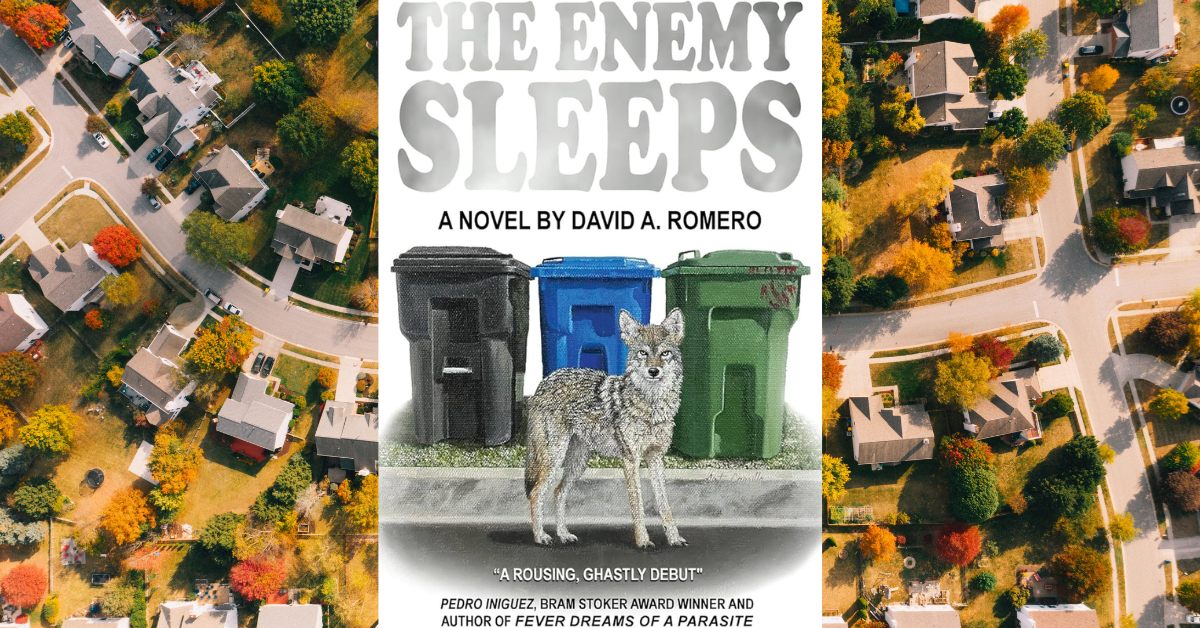
Something . . . is unsettling in suburbia. The way everything looks manicured, predictable, safe—until it isn’t. The Enemy Sleeps leans hard into that unease, peeling back the surface of a Southern California neighborhood to reveal something far darker: racial tensions; buried histories; violence that refuses to stay quiet.
At its core, the novel is a murder mystery—but calling it just that would be reductive; it expands far beyond standard literary tropes. Set in the fictional town of Harper, the story follows a network of neighbors whose lives intersect in ways that are often uncomfortable . . . and occasionally explosive. When tragedy strikes—particularly the disappearance and death of a young girl—the illusion of suburban harmony fractures. What emerges instead is a portrait of a community shaped by fear, prejudice, and the lingering ghosts of displacement.
Romero chooses to address big themes upfront: gentrification, racism, the myth of the American Dream. These ideas are present from the very first page. There are moments—especially in scenes involving the Martinez family and their neighbors—where casual racism is rendered bluntly, almost jarringly so. One character’s offhand comment about immigrant workers lands with the kind of everyday cruelty that feels painfully real . . . and painfully alive in what initially seemed like idealistic suburbs. These are the moments when the book feels most urgent; most alive.
But here’s the thing: the novel gestures toward depth more often than it fully delivers it.
When tragedy strikes—particularly the disappearance and death of a young girl—the illusion of suburban harmony fractures.
The prose is straightforward: clean, readable, and at times almost cinematic—which makes sense, given that the project began as a screenplay. Scenes move quickly; dialogue is clear; the story is easy to follow. For some readers, that accessibility will be a strength. For others . . . it might feel like something is missing. There’s a noticeable lack of linguistic texture—the kind of layered, symbolic, or poetic language that might elevate the material beyond its plot. Perhaps the mundanity of Romero’s language serves a purpose: to force us to engage with the story’s devastation directly, without beautiful or flowery text to distract us.
And that absence is especially striking given Romero’s background as a poet. There are very few lines that demand to be underlined; very few moments where the prose slows down . . . where it breathes. Instead, the novel often prioritizes telling over showing, moving briskly from event to event without fully dwelling in the emotional—or psychological—weight of those moments. Maybe Romero is trying to objectify the failure of the American Dream by sterilizing his novel’s contents, but this decision comes at the risk of reducing its emotional impact. Either way, readers are forced to confront the suburbs’ inherent flaws head-on, rather than being gently nudged toward the realization.
The same can be said for the characters. There are many—neighbors, families, workers—and while the shifting points of view add dimension, they don’t always translate into a deeper connection. It’s not that the characters are uninteresting; it’s that they rarely feel fully inhabited. The interchangeability of the characters can be seen as an attempt to make this story fit ANYTOWN, AMERICA, but by removing their individuality, it reduces their humanity—making it harder to care as personally and deeply as readers often hope. As a result, when violence erupts, the impact is more conceptual than emotional. You understand what’s happening . . . but you don’t always feel it.
Either way, readers are forced to confront the suburbs’ inherent flaws head-on, rather than being gently nudged toward the realization.
Still, the book has its strengths.
The multi-perspective structure works well, giving the narrative a sense of scope and community. The inclusion of Spanish throughout dialogue adds authenticity: it reveals that, despite the suburbs’ attempts to suppress those who don’t fit their narrow vision of the American Dream, they persist. These moments create intimacy for bilingual readers. The mystery itself—especially in its final stretch—manages to hook; the ending avoids predictability, delivering a resolution that lingers in an unsettling way—much like the suburbs themselves.
There’s also a cinematic quality to the project that’s hard to ignore. You can almost see the adaptation: slow pans across quiet streets; distant sirens; a coyote moving through the hills at dusk. Perhaps the emptiness Romero employs through his literary choices is meant to be visualized—not simply read. In that sense, the novel might work even better on screen . . . where its visual instincts could fully come alive.
What ultimately holds The Enemy Sleeps back is not a lack of ambition—but a hesitation to fully commit to its own depth. The themes are there: racism, gentrification, historical erasure—but they often remain just beneath the surface, rather than being explored with the complexity they deserve. The result is a book that feels important . . . but not quite as powerful as it could be.
That said, it’s still a worthwhile read; especially for those interested in suburban Los Angeles, cultural tension, and the quiet violence embedded in everyday spaces. It’s accessible, fast-paced, and occasionally striking in its honesty. And for a debut novel? It shows real promise.
Recommendation:
The Enemy Sleeps is best suited for readers who enjoy socially conscious thrillers and multi-perspective narratives; readers who don’t necessarily need dense, literary prose to stay engaged. It’s a solid, thought-provoking read that opens the door to bigger conversations . . . even if it doesn’t fully walk through them.
And if nothing else, it might make you look at your neighborhood a little differently. Think twice next time you walk those manicured streets.
DAVID A. ROMERO is a Mexican-American poet, novelist, and publisher from Diamond Bar, CA. He is the author of the novel The Enemy Sleeps and the books of poetry My Name Is Romero and Diamond Bars 2.
The Enemy Sleeps can be purchased here.

Leave a Reply