
By Elaine Qiao
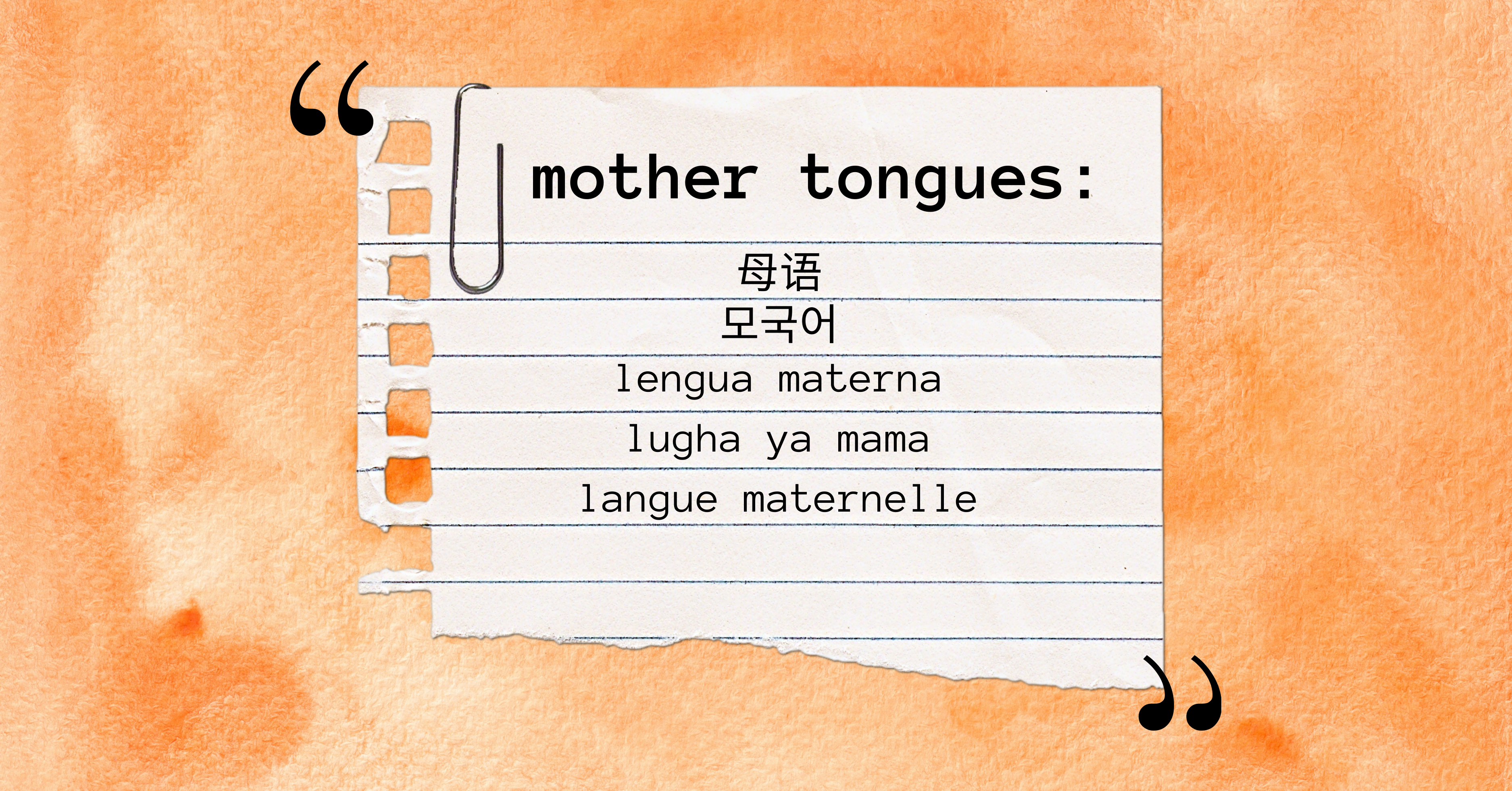
Mother tongue. 母语。모국어. Lugha ya mama. Lengua materna. Langue maternelle. Across the globe, our first language is the mother, the originator, the site of birth. In languages like Spanish and French which hold grammatical gender, mother tongues are, expectedly, feminine. What exactly does such a universal conception of our native tongue say about the relationship between language and mothers?
The “mothering” of language is scientifically informed by language development. Even before birth, babies listen and begin to recognize patterns of language. In that sense, as much as mothers are cultivating the flesh and limb of a person in the womb, they’re also the first point of contact to communication. When conceptualized literally, the term “mother tongue” stands intuitive.
Lauren Elkin, in a 2018 Paris Review article addressing a surge in novels surrounding motherhood, comments: “These . . . books . . . think about the ways in which we are bodies in the world, subject not only to the biology of being born with a uterus but into a particular kind of body, in terms of race, ability, and desire.” This wave of literature, Elkin says, is especially attuned to the “fact that the bodies we live in shape our experiences of the world.” These books demonstrate that our relationship to language—and the substance conveyed through language—is deeply physical.
Perhaps the mother’s role as a creator is also the root of “mother tongue.”
Yet later in a child’s development, perhaps “mother tongue” also alludes to a greater educational burden for mothers. After all, cooing, bedtime stories, and nursery rhymes are a parental responsibility that often falls primarily on the feminine partner. Is “mother tongue” then, a recognition of that burden and a source of credit, or a taking for granted of the driving force behind our first language?
Perhaps the mother’s role as a creator is also the root of “mother tongue.” Under this conception, secondary languages are branches off of a mother, who sprouts additional linguistic affinities. This idea innately validates motherhood as integral to language, instilling a femininity in our linguistic foundation, though that feminine presence isn’t necessarily nurtured in our daily verbiage. Yet “mother tongue” also does not consistently refer to a speaker’s first language, but occasionally points instead to the language of their heritage, especially common amongst Americans of color. A native English speaker may refer to their roots in Mandarin—though I’ve grown up speaking English and my Mandarin fades by the day, by no means do I ever consider English my mother tongue.
I’m convinced I can hear the Asian in my voice when I’m speaking English, and the American when I speak Mandarin.
I often wonder what the significance of first language is. Whenever my mother filled out medical forms or applications on my behalf, she always checked off English as my mother tongue. “You’re American,” she’d say, “Your first word was ‘Volvo.’” Back in the day I never pushed back, but the decision never felt quite right. Though I was born in Boston, I lived in Beijing until first grade. By the time I moved back to Maryland, I didn’t speak a lick of English. Yet language exists so integral to cultural identity that my mother was afraid I’d be less American for not exalting English. I had to reject my affinity for Mandarin to feel my citizenship was real.
In a climate where what it means to be American grows blurred and sinister, I question what role language plays in that definition. I spent years mimicking Disney Princesses and white YouTubers, trying to take the Asian American out of my accent. A study on Asian American speech patterns conducted in 2011 by Queens College professors Michael Newman and Angela Wu concluded there is no quantifiable accent among AAPI. Yet even now, I’m convinced I can hear the Asian in my voice when I’m speaking English, and the American when I speak Mandarin. I’m unwilling to reject my mother tongue now. To turn away from Mandarin out of fear and identity crisis feels as if I am shunning my own mother.
My linguistic roots lie in New York Chinatowns and suburban Chinese churches and air-polluting skyscrapers across the sea.
Beyond the literality of motherhood as it relates to language, perhaps our intuitive association of expression with the feminine accounts for how prevalent parental—particularly maternal—themes are in our writing. Poet Cindy Juyoung Ok spoke on how mothers influence our creative endeavors during Morrison Library’s Lunch Poem series, where she also noted the universal gendering of first languages. In her poems “P.S. Please Forgive Poor Grammar” and “How Is Temperature in the East?,” Ok explores a nontraditional English speaker, omitting prepositions and possessives and experimenting with tenses. Such language was inspired by emails from mother to daughter, envisioning, perhaps, what Ok’s own mother left unsaid.
I’ve often called upon Amy Tan’s “Mother Tongue” in my writing, and it feels remiss to not include her here. In the piece, Tan recounts how she navigated her relationship with her mother’s “broken” English, and how it has influenced her to elevate accessibility in her writing. Figurative “mothers” are not the only maternal presence central to our conceptions of language. It’s fascinating, though perhaps unsurprising, how integral our tangible mothers are to our linguistic command. Ok joked during her Lunch Poem reading that when she mentioned the prevalence of motherhood as a literary theme at a previous event, several audience members argued they don’t feature their mothers in their work at all. Yet deny it or not, family, or at least a metaphorical maternal force, feels inescapable to our linguistic beginnings.
Mother tongue. The language of our mothers? My mother tongue is Mandarin. Though now my understanding of it has dulled, and I would not be able to write this piece in my own mother tongue; my linguistic roots lie in New York Chinatowns and suburban Chinese churches and air-polluting skyscrapers across the sea. This is yet another piece I have written about my 妈妈. I don’t know how I would ever extricate my mother from my words, and like so many authors of this generation, I would never wish to.

Leave a Reply