
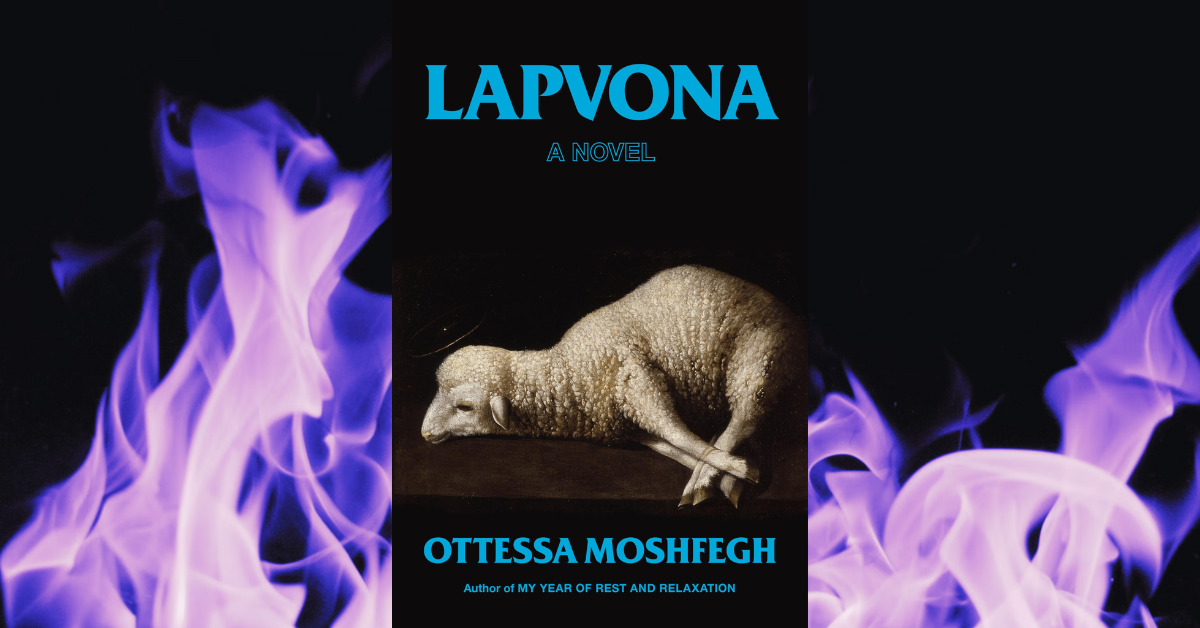
“‘I’m sorry, Father. What ought I say instead of shit?’
‘Excrement, my lord.’
‘Excrement. Is that like sacrament?’
‘It is like sacrament, yes—for the Devil,’ Barnabas replied.”
— Ottessa Moshfegh, Lapvona
Ottessa Moshfegh’s second novel, My Year of Rest and Relaxation, made her a literary sensation. Set in New York City at the turn of the 21st century, it follows a woman in her early twenties attempting to sleep for a year to escape her grief. Witty and irreverent, the novel won Moshfegh a cult following that embraced her dark and oftentimes gross humor. In one scene, for instance, the narrator defecates on the floor of an art gallery. Startling and repulsive, it’s the kind of scene that polarizes her readers: you either laugh or gag. Her fifth and latest novel, Lapvona, is for the former camp, as it is made up entirely of such scenes.
The book follows Marek, a motherless shepherd boy living in the fictional medieval village of Lapvona. He is taken to live with Lord Villiam, the village’s inept leader who lives to be entertained, after impulsively killing Villiam’s son. As Marek adjusts to his new life, Moshfegh introduces a cast of equally twisted characters. Jude, Marek’s father, masks his sadomasochism as piety, while Ina, the village’s wet nurse, wields eerie, seemingly supernatural powers. True to Moshfegh’s style, no character is sympathetic from the outset. Yet as a famine grips the village, each, in their desperation, comes to expose the full extent of their depravity.
True to Moshfegh’s style, no character is sympathetic from the outset.
In Lapvona, Moshfegh’s obsession with the vile and dirty amplifies. Every inch of the town is filthy; corpses decay, feces cake the dirt, and peasants feed on vermin and animal dung. Still, it is Villiam’s luxurious castle that reeks most of all. He and the priest, Father Barnabas, make the peasants’ lives miserable. As their subjects succumb to cannibalism during the famine, the two wine and dine merrily in the castle. What is most repulsive, however, isn’t Villiam’s cruelty; it’s rather a lack thereof. Neither a sadist nor a sociopath, Villain is simply so removed from reality that he can’t begin to fathom—nor really care to fathom—how much suffering he causes.
Moshfegh uses the stark contrast between the castle and the village to highlight the hypocrisy of the ruling elites. She suggests throughout the novel that the town is due for a revolution, but the peasants, immobilized by religion and poverty, never rebel: “The little gift of religion Barnabas allowed the villagers on Sundays … was enough to fool them into accepting their poverty and enslavement.” This observation, seemingly meant to equate Lapvona with our modern day, is thought-provoking but not particularly subtle. In a scathing review for Vulture, book critic Andrea Long Chu argues that Moshfegh’s efforts to “illuminate” her readers are deeply condescending. Illuminating or not, Lapvona is most compelling when it engages in cultural critique; the filth that permeates it, on the other hand, often feels provocative only for the sake of provocation.
Illuminating or not, Lapvona is most compelling when it engages in cultural critique; the filth that permeates it, on the other hand, often feels provocative only for the sake of provocation.
The book functions much like a horror movie keenly reliant on jump scares. Scenes involving breastfeeding, incest, and cannibalism are initially jarring, but, after a certain point, start to feel largely unnecessary and lose their impact. One scene in particular—perhaps the novel’s equivalent to the infamous defecation scene in My Year of Rest and Relaxation—involves a grape, Marek’s ass, and a servant girl who eats said grape. I suspect even Moshfegh’s most devoted fans would find their impulse to laugh stifled by the urge to gag. But maybe humor isn’t the point; perhaps these scenes are really only meant to elicit disgust and discomfort. Still, when nearly every chapter features abuse or degradation, one can’t help but wonder what purpose it all serves.
In the novel, Father Barnabas likens excrement to “sacrament…for the Devil.” Moshfegh expands on this idea, suggesting that human carnality itself is innately sacramental. If so, Lapvona, in all its excess, might be the perfect offering at this unholy altar: a tribute to man at his most primal and grotesque. Whether one considers this vision profound or merely indulgent, Lapvona is an undeniably brutal and unforgettable read—I only wish it was unforgettable despite, and not because of, its perversion.
OTTESSA MOSHFEGH is a fiction writer from New England. Eileen, her first novel, was shortlisted for the National Book Critics Circle Award and the Man Booker Prize, and won the PEN/Hemingway Award for debut fiction. My Year of Rest and Relaxation and Death in Her Hands, her second and third novels, were New York Times bestsellers.
Lapvona can be purchased here.

Leave a Reply