
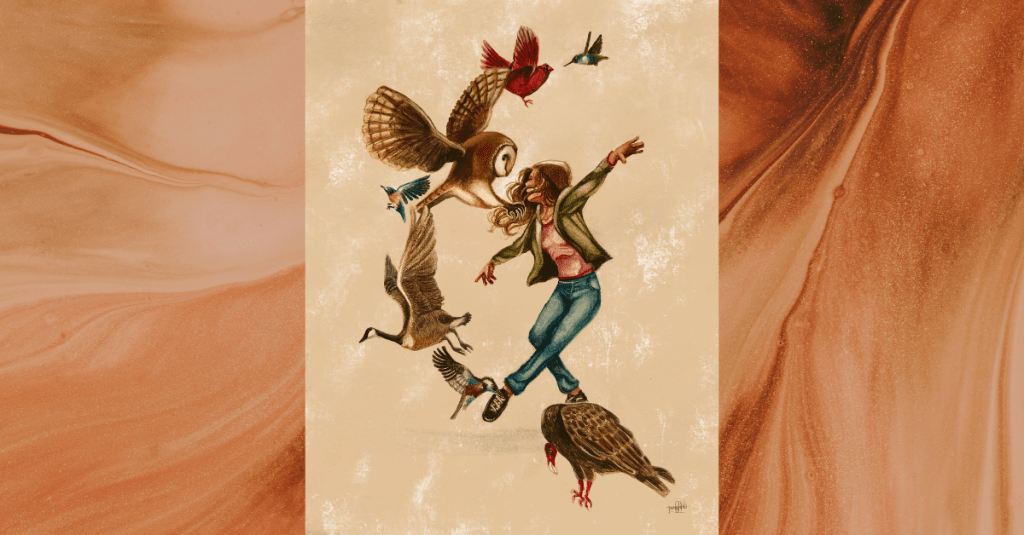
by Jodi Paloni, art by Leslie Pagel
Fay is permitted to sit in the chair by the window to eat her lunch, but she hasn’t yet picked up her fork. She’s watching a cardinal tap his beak against the glass. He thinks his reflection is an intruder, a threat. Tap, tap, tap, every morning, and again every afternoon until her head hurts. Tapping marks the time here.
The day nurse calls the cardinal Reds. She says it’s her dear dead dad come from his grave in the old country to haunt them. She says this in a mimicking brogue. Irene is trying to be funny, so Fay doesn’t tell her the cardinal is merely exhibiting a survival instinct, that it’s basic evolutionary biology. And Fay can’t change who Irene is either, or what she fundamentally believes. She has no control over other people’s narratives. Or that’s what her therapist Joan says, that Fay should focus on the one narrative she can control.
Irene blathers on and on about Ireland, how her great-great-grandparents survived the famine. A trick. She’s trying to shame Fay into eating the mashed potatoes growing cold on her plate, the once-melted pat of pooled butter already re-solidified. Fay’s pretty sure a nearly two-hundred-year, country-wide famine and a Gen Z starving herself are two different things, and what Irene is saying probably isn’t even appropriate here, but she keeps her mouth shut. She knows what is and isn’t appropriate because without any birds around—except the crazy cardinal—she directs her behavioral studies skills to her own species, the human flock sequestered in a fabricated biome, birdlike women pick, pick, picking at their plates.
Fay has them all figured out, even Joan, who will tell her to ignore what Nurse Irene says or doesn’t say. Focusing on the nurse is a distraction.
•
Fay’s other distraction is to turn her mind toward her mother, who left them so long ago she finds it difficult to picture her but who made the best mashed potatoes—or at least that’s what her sister Kitty always said. During the unmothered years, Kitty taught Fay their mother’s recipes as a way to keep the mother-memory alive. In time, Fay could no longer see her mother working in the kitchen, only her sister.
Fay stirs the stiff potatoes with a fork. She licks the tines. These are nothing like the mashed potatoes she is used to, but she only has two days to stop losing, to gain half a pound, or they’ll level her up.
“Leveling up” is more like leveling down—mandatory bed rest, tubal feedings, hydration from a plastic bag dripped into her veins. “Leveling up” is a pile of thin hospital blankets that want to trap her body heat but fail miserably as death breaths down her neck. She has felt the bruise-purple cold of it before. This, she can picture. This, she remembers.
•
She can’t remember the time between when she stopped going to the dining hall to when they found her on the floor of the laundry room in the basement of her dorm. Brain fog is a symptom. She does remember dropping a mustard jar full of quarters, the glass shattering, coins spilling and rolling, and then darkness. She remembers flashing red lights in the street, then the glow of a sterile white ceiling lamp, then darkness again.
She remembers waking up in this hospital, in the wing set aside for women under twenty-five who hurt themselves in some way. There are so many ways. She looks at the mashed potatoes. She sets down her fork. She mostly likes her way.
Sly Irene glances over her shoulder at Fay’s untouched plate while she pretends to take an interest in the cardinal. The nurse has only one job to do. Fay knows how to be sly, too, how to ignore the glances of a nurse. She knows how to look out a window.
Emptying relieved the pain of inhabiting a body.
Outside, the sun glares against a scrim of snow on the wide expanse of the hospital grounds. That morning, there’d been an early fall flurry. Fay squints at the cardinal perched on a spruce near the building. The scene looks like a Hallmark Christmas card. She thinks of roast turkey, glazed ham, cheeses and fruits, lemon cake, and sugar cookies cut into stars. She can practically smell it, the feast the winter she was nine and a half. She ate everything offered. She asked for seconds and thirds. She ate and she ate until she felt she could burst, when all she wanted was her mother.
After dessert, Fay slipped away from the table. She locked herself in the bathroom. She emptied her belly until she felt as hollow as her mother’s chair at the head of the table. Emptying relieved the pain of inhabiting a body.
The glare of memory, like this low autumn light on snow, is too much. She closes her eyes and sees herself here again, now in the middle of a big, sad mess, sequestered in this sterile environment, far too far from her birds. She looks back on that first sick she saw in the toilet and remembers how she ritualized the emptying and became weak and thin. All she wanted to do was sit in the window seat at the lake house and watch the birds at the feeders.
On her tenth birthday, she was given her first pair of binoculars and a copy of Peterson Field Guide to Birds of North America, but the book she liked better was one she found in her grandmother’s old bookcase: a musty, faded red volume that had long ago lost its dust jacket, Functional Anatomy of Birds. From then on, at least until lately, she carried both books in her satchel wherever she went.
Now, her satchel is somewhere in this hospital, along with her cell phone, her field notes, her sketch book, her favorite pen—personal possessions she must earn back.
Mostly, she misses the birds.
•
At thirteen, she wanted to move beyond window seat viewing, beyond the yard, and stalk the marsh birds on Little Island.
“Albert can teach you,” her father said. “He understands more about birds than any of us.”
“I can see that,” Kitty said brightly. “Albert with his beloved birds. You with yours.” She probably just wanted a break. Fay begged Kitty to go with her and the boy who summered in the cabin next door, the boy she didn’t know, to the houseless island in the lake in his canoe. She wanted to do everything with her sister. But Kitty was too busy swimming. Always, Kitty was swimming.
Mornings, Fay watched her sister dive off the dock as if she couldn’t wait to get away. Her sister became a wave, then a ripple, and then a thin line on the horizon—a fish, a mile or more out while Fay waited on the dock, wondering why their mother left them, wanting to ask her if their mother would ever return. Kitty would always swim back before breakfast and rise out of the water wide-eyed and breathless, her pale skin shimmering, and Fay would suddenly feel too shy to ask.
Fay felt suffocated in the water. She liked the breezes, the clouds, the skies. They said Albert could teach her the birds, so she would go with him to the marshes. They didn’t know she would learn how to fly out of her body.
Her tray is gone. Irene is gone. The cardinal is gone. She’s been allowed to stay in the chair. She is alone in her room, but Kitty will come later today. She comes every day, setting aside her own dreams to see Fay through another ordeal, to make sure Fay is meeting her goal. She comes to try to get Fay to acknowledge the past, their mother’s abandonment, their father’s lack, the kinds of things Joan wants her to talk about in group. She comes every day to hint about the midnight trip Fay took in the canoe with Albert.
When Kitty comes today, Fay will tell her to stop. She is unrelenting, like the cardinal who has returned, is back at it, the tapping, head feathers stiff and alert, tapping mightily hard against the glass.
•
Fay can’t get as riled as Kitty about the night with Albert. He was there for Fay all those long-ago summers when Kitty wasn’t, when her mother wasn’t. He was funny, the way he talked about birds with excitement as they paddled from the mainland to the island. Once settled in his bird blind, he would talk in hushed tones as the birds drew near. He would move close to her, sometimes whispering hot breath into the side of her neck. The more often he sat close, the more she felt that what had once belonged only to her, her body, was beginning to belong also to him. She felt jittery, like the baby geese who fluffed and paddled in circles when first learning to swim. It was also a little thrilling. She liked the sugary smell of sweet coffee on his breath, and when she asked, he would offer up the dregs of his beat-up Thermos to her. Albert halved the whole of her pain.
•
Back then, in the fall, when Albert returned to a town down south where he and his family spent the school year, she would sneak instant coffee from the kitchen and mix it with water or nibble a spoonful of dry-roasted granules straight from the jar. She liked the jerky feeling that broke up the monotony, the emptiness of the quieter season. She thrived on the jolt of caffeine.
That second summer, now fourteen, she grew taller. Her legs stretched long, like those of the great white egret, but Al had become fleshy. He had joined the wrestling team. He would take off his shirt and flex his big beefy arms and let her touch the newly sculpted muscles. He’d leave off his shirt and lie down on the ledge. Lying flat, he’d hold the binoculars to his eyes and watch the eagles and osprey and cormorants come to fish in the cove as they circled the sky. He would invite her to try it.
Shoulder to shoulder on the ledges of Little Island, they would lie down together. Sometimes, he would suddenly turn on his side and tickle her, run his hands over her arms and shoulders and chest and down to her belly. He would squeeze her thighs, ask her where her meat was, call her boney. Sometimes, he’d squeeze her too hard and leave bruises, but he would lend her his really good binoculars if while her hands were busy, he could put his hands inside her new summer clothes. It was a game, he told her. She would have to stay still, not giggle, and not flinch. So she would take deep breaths and continue to watch birds. She would home in on their feathers, would think about how underneath were bones that were hollow, making it possible for them to fly. She would give in to his games, spread her wings out under Al as he rubbed his groin against her, his mouth buried in her neck. She would imagine she was up there soaring. She didn’t let him take off her clothes when he asked. She didn’t want him to see her, and he didn’t push. And they’d go back to watching the birds.
And then he was gone, leaving high school early to enlist in the Marines. At summer’s end, when he left without telling her goodbye, she wondered if he was mad at her.
These are the kinds of memories that come back to Fay in group when others tell similar stories. All these girls, these women, the counselors call them, telling stories about the hands and fingers of boys and of men—gentle hands and harsh ones, the violence and the leaving. From hearing these stories, Fay understands she is lucky. Her losses and Albert’s transgressions could have been so much worse. Still, they are asked to try and remember the stories. No matter how slight or how grave they perceive them to be, they are to try and remember the stories their minds are certain their bodies want to them forget. They can judge later. They will judge later.
Joan says it’s important to stick with the process. If they want to feel like they did before, when their bodies still felt like their own. Fay doesn’t know if it’s working, all this dredging dark matter out of the muck, but she misses her dear birds, and she mostly trusts Joan. Joan is steady. Joan is repetitious in her behaviors, so Fay tries.
•
Kitty raps on the doorjamb. There are no closed doors in this place. Today, she has brought Fay a gift: a terrarium, a goldfish bowl planted with tiny mosses and running pine and embellished with pine needles and flat rocks pocked with garnet and mica and quartz. This makes Fay think of her pinewoods.
“I made it myself,” Kitty says. “I took a class at the library.”
Killy is vigilant, thoughtful, loving. And today, she sounds more like a sister than a mother, which surprises Fay. It feels like progress. She needs a sister more than she needs a mother. That’s the suggestion Joan gave her, and she’s doing her best to stick to it, even if it leaves a slight lump in her throat.
They do not know how impossible it can feel to conjure the simple desire to live.
Kitty’s hair is wet under her favorite wool hat. Her flowery maxi dress is damp under a navy-blue sweater speckled with white. Fay has never seen this particular sweater before. Is it a recent thrift shop find? Does it belong to a new friend? Kitty’s life has gone on without her. When she leans over to kiss Fay’s forehead, Kitty smells of sunscreen and sweat glossed over with fruity antiperspirant. She smells of wet wool and lake.
Kitty moves toward Fay’s medical chart tucked in a steel mesh file holder at the end of the bed, and her scent goes with her. Fay pulls the terrarium up to her eyes. She pretends to find great pleasure in the gift as Kitty looks over her numbers.
“Oh, look, an inchworm,” Fay says. “Guess I’ll be getting measured for a new dress.”
The joke isn’t funny; dress shopping would only wreak havoc on Fay’s recovery, and they both know it. Fay also knows the danger in the numbers Kitty is reading. Kitty frowns.
“I do try,” Fay says.
“Try harder.” Kitty sits on the arm of Fay’s chair and strokes her forehead and holds her hand. She isn’t angry. She seems helpless. “Think about getting out of here.”
“I will.”
Kitty looks at Fay, her maternal patience replaced, for once, by a pleading look. “Think of me,” she says.
It’s against the rules for Kitty to say such a thing, and for Fay to agree. Family and friends have been instructed not to make Fay’s eating or not eating about them or what she owes them, the people who love her, who are certain they can’t live without her.
They do not know how impossible it can feel to conjure the simple desire to live.
•
Next, Kitty asks Fay about group, breaking a second rule within fifteen minutes.
“This one girl—woman,” Fay corrects herself, hearing Joan’s voice in her head, reminding her that aging and independence are not bad things. “Alicia. She said something that stuck.” Fay’s lips are parched. She can only drink sugary juices or food replacement beverages, but she only wants water, so she doesn’t mention her thirst. “She said, ‘All the focus here is on making our bodies grow bigger.’ She said, ‘But how do I grow something I don’t really care about?’ ”
Fay pauses to let what she just said to Kitty sink in. Kitty raises an eyebrow.
“Alicia says she only eats so she can paint.”
Kitty squeezes her eyes shut, lifts her chin, and lets out a winnowing breath. She has made it clear in the past she has never been a fan of the group process. She’s read up about it. She says it will only give Fay new ideas. But Fay has plenty of ideas of her own, and she shares them in group, not because she wants to hurt anyone but because she wants to see the other women’s heads nod in understanding, to hear their fingers all snap in a chorus, to bask in the light of their complete meeting of minds. Hearing a new take on a coping strategy feels like someone who gets it has her back.
She wants to say, Don’t you get it?
She wants to say, My body doesn’t feel like it’s mine.
•
Fay snaps the thick red rubber band on her wrist as she thinks about saying she needs to go to the bathroom when she doesn’t so she can burn calories. She watches Kitty suck on her lower lip while she looks out the window. There is a smear of zinc oxide on her sister’s nose, but Kitty’s neck is already red and sore-looking. Unlike the rest of the family, Kitty is fair-skinned. Sometimes she forgets the sun will burn her.
“You’re fried,” Fay says.
“Second summer days all last week. And now this snow. I guess I need you around to remind me.”
Fay doesn’t want to be needed, but she keeps this to herself.
“We want you home,” Kitty says.
First, they wanted her to leave, to go to college, couldn’t wait, and now, they want her back home. She doesn’t want to be wanted.
“I’m not ready,” she says. She’s been instructed on words to use with her family.
She snaps the rubber band to keep her from feeling under her sweatshirt for her bones.
Sometimes, she would slowly lift her arms, look to the ceiling, and think wings.
During those first months of college, Fay would stand in front of the full-length mirror secured to the door of her dorm room, lift the hem of her blouse, set her hands on her hipbones, ledges that stuck out above the waistband of her low-slung jeans. Her fingertips on one hand almost reached the fingertips on the other. Every few days, they came a little closer, thumb seeking thumb behind her back. She’d undo the three top buttons of her blouse and pull at the collar ends to expose her chest. She’d lean toward the mirror, admire the jut of her clavicles. Sometimes, she would slowly lift her arms, look to the ceiling, and think wings.
On fieldtrips—Ornithology 101, a class she had to take but could have taught—the straps of her high-tech binoculars chafed the bones and left welts. People would stare. She wore her blouses buttoned to the neck to cover them, but she hated how her clothing hid her progress.
A kid in her class called her Bird Girl. Hey, Bird Girl. Here comes Bird Girl. He was an idiot, but she liked the name, and she also liked how people assumed she was a dancer.
•
Fay is a dancer of sorts. A bird dancer. Or she used to be. When she was younger, she would mimic the overhead flaps and flights of birds—raptors and other flying fowl, all shapes and sizes, that inhabited her tiny world. Most of all, she loved the slim grace of a great blue heron stalking a fish.
Some nights, when Irene is on break, she creeps out of bed and practices bird dancing in front of the window. There are no mirrors in her room or her bathroom, but the reflection from the glass shows her exactly what she wants to see.
Bird dancing is a remnant of childhood, a game her father taught her so she could learn the differences between species by flight behavior. Her mother was not coming back. Teaching her the names and behaviors of birds was merely a ruse to distract her.
•
“Any word from Mom?” Fay says to Kitty. She can’t help wanting to provoke her sister, who will not let Fay’s illness be caused by abandonment. Kitty wants it to be about men, Albert, and all men only wanting one thing. Fay just wants to keep Kitty invested in this conversation in the way sisters who get to just be sisters might talk.
Kitty doesn’t turn around. She’s here, but she’s not here. It’s as if she’s keeping vigil at the window. “You should be asking me about Dad,” Kitty says.
The cardinal is nowhere in sight.
•
Her father doesn’t come to see Fay in this hospital for women only, but he calls her on the telephone by her bed every evening at five. She pictures him sitting on the gold and tan checkered couch they’ve had since the seventies. He is watching the sun go down as it paints the lake. She pictures the glass of scotch in his hand, two fingers poured over tiny round ice cubes that his fancy new icemaker makes, him clutching the drink like a security blanket, how he is not sipping it over time as their mother did, just as he isn’t eating the small bowl of peanuts on the coffee table in front of him. He will wait until the sun sinks below the horizon and the ice has melted into an inch of water floating on top of the liquor, and only then will he drink the whiskey in three long and loud swallows. After that, he will eat the peanuts. After that, Kitty will call him to the table for dinner.
•
That evening, her father tells Fay about his day at the lab. He describes the colors on the lake, gives her the weather report for tomorrow. Fay asks him if he has heard anything from Mom, just as she asked Kitty earlier—as if it’s normal, her leaving, her potential return—just as she does every day.
“Not yet,” he says.
•
When they hang up, Fay tries to lift herself from the chair. The room spins. Pressing her hands against the wall, she wobbles to the bed. Not calling Irene for help is breaking a rule, at least the third one today. In bed, she looks at the ceiling. She pretends to talk on the phone to her mother. She pleads with her mother to come back to them, or at least to come see her, see her like this. To explain.
If she focuses on her mother, her leaving, her silence, her responsibility to return, it keeps Fay from remembering other things that happened. Things that are coming to her gradually but feel like they are coming all of a sudden and out of the blue.
•
A couple of days later, Fay asks Joan about what Alicia meant when she said she was only eating so she could paint, understanding it has to do with earning privileges. She had read about a snowy owl haunting the marshes near Goose Rocks Beach not far from here. She’s motivated to go see it. She’s been sleeping well, has woken up hungry, has been regularly eating hard-boiled eggs and slices of toast with a smear of blueberry jam for first breakfast. She has gained half a pound, so Joan approves a walk to the north wing of their floor to the art room. She will go with her.
•
Joan is tall, older than the other therapists here but younger than Fay’s mother. Her hair is cream colored and billowy, piled in a loose knot on top of her head. She reminds Fay of a snowy egret. She is Fay’s favorite counselor. She is steady and deliberate, also like an egret. She doesn’t puff up or demure like some of the others.
Fay stands next to Joan at a large window, looking in at the empty art therapy room. It is almost time for regular group, so there are no women here. The walls are white, covered with sheets of paper as tall as Fay. Joan explains that here, in this room, women are encouraged to paint big and bold, to use the full extent of their body’s motions, not just their hand. It’s a form of embodied therapy. There are long white tables where they can sit and play with clay or collage or draw and paint in more reasonable sizes, too.
“Once you have enough points to live in a north wing room, you’ll have free access to this space anytime you want to use it.”
More than Fay wants to get out to see the snowy owl, she is aching to draw. Her fingers itch for a sketchpad and the graphite pencils standing at the ready in a jar. She was sad to have left behind her scientific drawing class in school. Her teacher told the class that the best way to learn bird anatomy was to sketch, but Fay already knew that. Fay loves to draw bird bones, the vertebrae, the digits, the angles of the joints.
This room is the first thing Fay sees here that makes any sense.
I went owling with this boy who lived near us.
A week later, in group, it’s Fay’s turn to speak. Up until now, she has passed, but Joan said that besides eating, she can earn points for taking her turn. This means she thinks Fay is ready.
They ask the women to talk about one clear memory, one event they remember around the time they began engaging in behaviors. They asked them to not get into the weeds of the story but to focus more on the emotion, the urge before the action associated with the event was taken, how it made them feel to use eating and not eating to take control of their lives.
“Only what I remember?” Fay says. All the women ask this, but Fay wants to clarify for her own sake. Like the others, she does not remember much. She remembers raptors circling the sky, Albert’s hands on her skin, the coffee, the loss of her hunger when she drank it. But she has already talked about that.
“Something you remember that you haven’t been told by someone else. If you can.” Joan is patient. “Take your time.”
Silence fills the space between the women in their circle of chairs, but they have all become used to it. Fay is comfortable, too. The great birders, like hunters, will sometimes sit for hours in silence waiting for a rare heron to flush from the sedges or for a mama kingbird to return with food for her young. Albert taught her ways to stay still by relaxing her muscles and breathing. Fay remembers times when she had to pee and wanted to relieve herself behind a tree or felt hunger pangs and craved the peanut butter and jelly sandwich tucked inside her satchel in the canoe, how she wanted to tug on Albert’s sleeve and mouth to him that she was ready to go home but did not act on her desire, not wanting to break the spell of the silence he had cast, waiting to catch sight of a bird.
She would sit crouched next to him on Little Island, listening for the steady click clack of an American bittern, and she would try to pace her breathing with his. She remembers it was near midnight, under a nearly full moon, when Al and she finally breathed together. She remembers the terror she felt.
“There was this time,” she begins, surprising herself, “I went owling with this boy who lived near us. He loved birds like I did. Still do. He knew his stuff. He was older, seventeen. I was in middle school. I was allowed to go out birding with him during the day, but not at night.”
“ ‘Cause nothing bad ever happens during the day,” Alicia says, rolling her eyes.
The other girls click their fingers in agreement. Alicia has shifted out of camouflage, a risk behavior, breaking a rule of survival. She could lose time in the art room for saying this. By clicking their fingers, the others are pulling the attention away from her. This is a type of bird behavior.
Joan shakes her head at Alicia. Joan often uses head movement to communicate, and Fay thinks this is more effective than other therapists who scold. This is also a bird behavior.
“It’s Fay’s turn to talk.”
Fay’s heart speeds up, and it feels like the time she was startled by swallows suddenly flying out of the boathouse. She reaches for her rubber band, but she has forgotten to wear it, so she grabs hold of her thumb and twists the skin as she pulls.
“I remember squeezing out of this tiny window in my room and climbing down the trellis. I didn’t want to crush my mother’s clematis. Hummingbirds love clematis. They feed on the nectar. They nest in the thicker wraps of vine. They line their nests with lichen like it’s lace. It’s the sweetest thing you ever saw.”
Fay closes her eyes, conjures up an image of the hummingbirds zipping away, leaving her completely alone on the still lake.
“I almost climbed back up,” she says. “But I’d never seen an owl up close in the wild. I ran down to the dock. I could only see shadows, so I listened for the sound of Al’s paddles.”
That night, she heard the toot-toot-toot call of a saw whet, then realized it was Al, their secret call. He sounded just like the real thing.
“So, you went owling with this boy,” Joan says. “What else do you remember? Tell us everything you’re thinking if you can.”
“Everything felt different that night. Albert looked bigger in the moonlight. Too big. As if he had grown bigger since the morning. I was wearing these stupid flannel pajamas with Christmas trees on them. I knew it would be chilly. He laughed at me. And when I stepped in the boat, he rocked it, and then he laughed again as I tried to stay upright. He sort of shook his head in disgust the way older kids do to bully younger kids. I would see that happen to other people years afterward and feel so much shame.”
“That’s good,” Joan says.
Joan is pleased when they identify their feelings. She has complimented Fay in the past that it is her strong suit.
“Very good. And what else?”
“As we were moving away from shore, I thought I saw a light on in Kitty’s room, and I was afraid she saw me leave and would tell Dad. But I must have convinced myself she was asleep and forgot to turn off her light. Anyway, I kept going.”
Fay’s stomach roils. She recalls how jerkily Al was rowing that night, as if trying to beat a storm, but the lake that night was like black glass. He seemed angry.
“I thought I had done something to make Al mad. He was digging the oars into the lake, splashing me, and I was soaked to the skin. It was mean. He wasn’t usually mean. I was shivering.” She closes her eyes and cups her hands around her jaw. “My teeth were chattering. They hurt, my teeth, and I remember that the next day, my jaw was one of the parts of me that still hurt.”
Fay pauses and looks around the room. Some girls are nodding. Some are clicking their fingers. One girl cups her jaw too, an echo of Fay’s gesture, and when Fay realizes she’s still holding on, she lets go, and so does the girl. It’s like the mirror game they sometimes play to build trust.
“How about we take a break?” Joan says, then waits.
This is code, or ritual. When it starts to get tough, Joan offers a patient the chance to stop, but it’s up to the patient to call it.
Fay yawns. Others yawn. One of the patients looks over at the snack table. They’re the only person in the room who actually wants the required glass of milk and three cookies at breaktime.
“Give me a sec,” Fay says. She closes her eyes. She sees Al pulling the boat to shore and grabbing Fay’s arm roughly, yanking her out of the boat.
When she had asked him what was wrong, he drew her close from behind, wrapped an arm around her chest, and clamped her mouth shut. He hissed against her neck to stop making so much noise, but until then, she hadn’t said a thing. He said they didn’t have much time. He loosened his grasp on her mouth but left his hand there. He smelled like coffee. His nearness warmed her. She stopped shivering.
“So, we were on the island, and he covered my mouth to make me stop talking. You know, because of the owls. Then, he sort of pushed me along the trail to the tree where the owls were nesting. I thought of how it was like a scene from a Nancy Drew book, only Albert wasn’t a bad guy. He was just Albert. He wanted to call in those owls as much as I did. Have you ever gone owling?”
She looks at the others and at Joan, but Joan holds her gaze, no confirmation or denial. Asking a question in group when it’s your turn to talk is a way to deviate, to feel the relief of distraction. Fay knows the rules.
She takes a deep breath. She crosses her legs, then uncrosses them, knowing her body language is being studied by one of the assistant counselors, a new person whose name Fay has forgotten. She slouches. The chairs are cushioned but grow more uncomfortable with the telling of her story, and she is beginning to feel the ache she felt in her bones of that time. She wants to stand and stretch and circle and sit back down like a dog on a rug. And she can. She can walk around the circle while she talks if she wants, but it’s weird when the other women do it. It’s unnatural to draw this much attention to yourself. It makes her uncomfortable. She tries to concentrate on her story.
“Somehow, Al tugged me along up the hill to the tree, but he didn’t let go. He told me he forgot the pack in the boat. He said he’d get it and asked me if I wanted to stay or go with him. I wanted to go with him. I was wet. I was freezing. I was afraid if he left me, I’d die of exposure. Then he said my name, and he started kissing me on the mouth. He used to touch me in ways I knew were messed up, but it was the first time he kissed me.”
Fay puts her hands over her face. She doesn’t feel sad, but she starts to cry. She wonders if she’s crying because after his roughness toward her, the kiss was tender. It wasn’t jokey like some of the other stuff or mean like earlier that night. It felt a little like love, but now, she only feels shame.
Joan kneels on the floor in front of her. She is there to be quietly present. Though Fay would like to feel Joan’s hands on her knees or hear Joan speak, she understands the way this works. A girl coughs. Another girl shushes her. Fay drops her hands to her thighs and runs them back and forth.
She throws back her head and laughs, and some of the other girls laugh with her. She feels like throwing up, but there is so little inside her to purge. She has the urge to gag, but if she does, then they will all start gagging and the session will end, and Fay wants more than anything to finish, to earn points, to get to that art room and draw. She covers her mouth. Joan has told her in private session that speaking her truth is a form of purging, a healthy version, but that it can be harder than purging food. They have been encouraged to name the difficulty.
“Oh, God. This is so hard.”
Joan nods. “You’re right. This is hard.”
The others snap their fingers. Fay relaxes.
Joan returns to her seat. This signals a show of support, that she believes Fay is ready to continue, that Fay is strong enough to continue, that Fay is stronger than she thinks.
“He raped me.”
Fay has never used these words, not out loud or in her head. The women in her group have used these words, but she has never thought of what happened between Al and her that night as rape, and she is not sure she does now, even as she claims it to be. But she wants to try the words on, so she says it again
And she doesn’t feel low. She doesn’t feel anxious. She feels flat, blank, spaced out. The women are looking at her, watching, waiting.
“He kissed me on the mouth, and I liked it. I kissed back. I could feel his boner on my thigh.” She laughs. “Okay, well, no, not funny. That part was scary, and then we were on the ground.”
Joan looks grave. She keeps her eyes on Fay. “I’m listening.”
“I knew what might be happening. I just didn’t know what would happen next. He had touched me before.”
She feels hot and takes off her sweatshirt, knowing some girls will be triggered by the sudden appearance of the outline of her bones beneath her t-shirt, but she wants them to see how birdlike she is. She is proud of these bones. It’s one of the things Joan said they needed to explore. In time, Joan always says. For now, Fay seeks comfort in exposing the shape of her body, and she finds it.
“Fay, we can stop here and finish up just the two of us. Maybe that’s best.”
But Fay feels numb to it all. She brightens. “Look, most of us have been there, if not all of us, in some weird way, in this fucked-up world we live in.”
The other counselor stands and walks over to the circle and hovers behind Joan’s chair. Has Joan signaled to her? Are they all trained to know when shit’s about to hit the fan?
Fay speaks quickly. “He hurt me, and I cried, and then he cried. He kept saying he was sorry. There was jizz on my leg and snot all over our faces. Somehow, we got ourselves picked up and stumbled back down to the boat.”
Fay stops speaking. She stands up.
“Jesus Christ,” she says. She looks at the doorway, and she sees Kitty standing there, looking in. “My sister.” She points, and they all look toward the door. “I forgot this part.” She feels dizzy, but she doesn’t want to sit. She enjoys the feel of the room spinning, but she can’t think straight. She shakes her hands. “I fucking forgot about my sister. Until now.” She looks again at the doorway. Kitty is not there. She never was. Visitors aren’t allowed anywhere near the group meeting lounge.
“Fay, sit down, please. Girls, it’s breaktime. Get your plates. The sun has come back, so we’re having snack on the patio today. Fay, you stay here.”
Fay is panting, the first sign of her flavor of panic attack. Joan guides her to her seat and pulls up a chair beside her. The support person brings her a frozen orange, which Fay clutches. The three of them sit there together and breathe.
A yellowjacket flies in through an open door. Fay watches as the wasp hovers over the one plate of cookies left, her cookies. She watches it dip inside her glass of milk. She’s so thirsty. And hungry. She is starved. She has not felt this ravenous, ever, and now all she can think about is those cookies dipped in that milk.
“What’s next, Fay?” Joan says after she checks Fay’s pulse and finds it steady.
“I can’t remember. I just know Kitty was there that night on the island.”
“I meant what’s next for you here and now. If you want to talk more, we can go to my office.”
“I’m hungry.”
Joan tries to keep her poker face, but her eyes reveal a question—or shock.
“All right, let’s grab you a snack,” Joan says, pretending she hasn’t missed a beat.
Alicia, who has latticework scars up and down the tops of her arms and doesn’t seem to care who sees them.
Fay asks Joan to tell Kitty not to come in that day, or the next day, or the next. Joan assures her Kitty understands they are working on a breakthrough, but all Fay is really doing is trying to eat a little more every day so she can earn points to make stuff in the art room. She meets up with the woman, Alicia, who has latticework scars up and down the tops of her arms and doesn’t seem to care who sees them.
Fay imagines this is the same as how she likes people to see her collar bones, her shoulder bones, her ropey arms, and her jutting elbows that bend in a jointed M like an osprey when she bird dances, acting out various birds in front of the window in her room that she would never do in this community art space. Here, sitting near Alicia, she is teaching herself scientific drawing, learning how to sketch the feather of the eagle.
Alicia likes to paint. She paints wide, sweeping colors on large pieces of paper taped to the wall. She told Fay she has earned the privilege to use the tools for making marks in the paint. Sometimes, Fay steals a glance and sees Alicia running the dull edge of a clay scoring tool over the tops of her hand. Is Alicia flirting a little with her dear old habit? Makes sense. Sometimes, Fay misses the aftertaste of vomit, the acidic scratch that puking leaves in her throat. Sometimes she misses sore ribs. She snaps the elastic on her wrist. She knows it’s all about wanting to feel.
She and Alicia don’t talk when they are together in the art room, and Fay doesn’t want to, not even to Joan and especially not to Kitty. She can’t remember anything else from that night, but once, years after, Kitty told Fay that she knew what happened to her, that she was there at the island with their father in his boat, that their father didn’t know everything about what happened but that she walked up the trail at the very end of it, too late to stop it. Fay screamed at Kitty when Kitty said this. She ran off and didn’t come back until morning, as she was prone to do, and Kitty never said anything about it again.
Now, she understands that Kitty was probably as confused and frightened as Fay.
She doesn’t have to blame her sister, but she definitely blames her father, and it would break Kitty’s heart that she doesn’t solely blame Al, so she is not ready to see her. So she will finish the drawing and watch Alicia paint.
She will decide what comes next. And she will eat.
•
Each night, Fay is stronger, less wobbly. When the others are asleep and the quiet is palpable, Fay does her bird dancing. One night, it’s an egret slow dancing in the sedges. Another night, it’s an osprey gliding, then all of a sudden diving in a rush and a splash. Still another, it’s an owl, and she stands there in absolutely stillness, and the dance is only the blinking of her eyes.
Irene talks more about Reds, the cardinal, and her dead father than about what is or isn’t left on Fay’s tray. Fay checks off the box for baked chicken, baked potatoes, green beans, a roll with butter, a fruit cup, and ice cream, and she eats exactly half of all of it. She gains enough weight to move to a room in the north wing with a regular bed and eat in the cafeteria. Her heart rate and blood pressure are strong. She’s earned the right to go to the art room whenever she wants and to take walks out of doors unsupervised.
In a private session, Fay admits to Joan how after that night on the island, she began substituting food for coffee and Cokes and chocolate bars during the day—every day—but ate normally at the dinner table in front of her family. After, she would purge if she could. No one seemed to notice how thin she was getting.
They told her Al had decided to get his GED and enlist rather than finish and graduate at the high school. She tells Joan she heard he never did go on to college to become an ornithologist but had come back after serving his time to live in Maine. He worked as a handyman.
She only saw him once, years later, at a neighbor’s Fourth of July party at the lake, but he didn’t seem to see her, or if he did, he didn’t speak. He seemed so much older. Had to have only been in his late twenties but had graying hair. And he’d grown—not fat, not exactly—but softer in the middle.
Joan asks her if she wants to write a letter to him, to send it or write one even if she doesn’t want to send it. It has helped some of the other girls to do this. Fay doesn’t want to, and she’s not sure why. Joan pushes back. She says it’s easier to blame Fay’s mother, of course, and her dad, and even Kitty for all her swimming, and she doesn’t want to write letters to them either. Joan wants Fay to get clear about what happened on the island with Al and how wrong it was for her to be encouraged to spend all that time with a boy his age, sure, but also how wrong it was for the boy to take advantage of her. She calls it sexual assault. Says it was illegal and that it’s not too late to confront him or to press charges.
Now that her brain is working better with food, she thinks she might have been letting Al off the hook. She considers her options as she works on her bird drawings. She tries to imagine what she would write to him. Sometimes, she liked him to touch her, and she liked when he kissed her that night, and she wanted a little of all of it, just not all of it. She didn’t like when he was mean, but she understood now that he was fucked up. She isn’t as angry at him as are the others. She has only ever felt left behind.
She tells this to Joan.
Joan says, focus on that, how alone she felt to suddenly have no mother, no word from her at all, and how she also didn’t have Al. Joan also gives her papers to read about Stockholm Syndrome and trauma bonds, and she reads them. She begins to understand why Kitty is so angry with Al.
•
Fay is close to wrapping up her stay at the hospital and will begin an intensive outpatient treatment. She feels strong. Kitty mailed Fay’s good binoculars to her with a brief note saying she loves her and misses her, and Fay and Joan both think it’s good for Kitty to feel their separation.
Fay’s satchel with her books and supplies and her phone are returned, but she leaves it unopened on the dresser. She enjoys drawing birds with feathers, nesting or in flight, copying from book pages in the art room and memory, but her interest in bird bones is fading. She’d rather take long walks on the grounds.
A bluebird family is nesting in a box in the field connected to the hospital. She stands on a road separating the green from the adjacent property and tracks the parents flying in and out of the woods with bugs stuffed in their bills. The road is a back entrance only used by employees, and no one bothers her here.
She is watching the bluebirds
The day before her discharge date, she is watching the bluebirds when she sees Alicia coming her way. Fay asked Joan if Alicia could join her on a walk, and it appears Joan has finally allowed it.
“Hey,” Alicia says. She is wearing a sky-blue puffer vest. It brings out the blue in her eyes, which look less sad out of doors. She has fixed her hair into a neat bun. She is wearing dangling earrings and shiny lip gloss. She reminds Fay of Kitty.
“Want to take a look?” She offers the binoculars to Alicia.
Alicia focuses in on the birds. “So cute,” Alicia says softly.
“You don’t have to whisper. They couldn’t care less.”
They walk the length of the lane to the road and stand looking both ways as if they’re children about to cross, but the hospital is surrounded by fields that have been sold off to a housing developer. The construction workers have left for the day. There is nothing to entertain them.
“We could take a right and go into town. Just keep walking,” Fay says. She is teasing, but Alicia looks alarmed.
“I’m good,” Alicia says.
As they walk back, Alicia keeps her hands in her pockets, but Fay can see that they are in the shape of tight fists. She feels bad she joked about escaping.
“How much longer do you need to stay?” Fay says.
“They’re not sure.”
“Who’s they?”
“My parents.”
“They’re still together?”
“Yeah, but they shouldn’t be.” Alicia laughs.
“Do they come here?”
“They came once.”
“And what about you?”
“I get to paint.”
Alicia turns and starts to walk backwards, a little ahead of Fay. She is counting her steps under her breath. When she gets to twenty-five, she turns and walks straight again. She doesn’t offer any more information about a departure, and she doesn’t ask Fay any questions about hers. She talks about the clouds, how cold it’s getting, and how she needs to pee. They walk quickly.
At the entrance, Alicia stops. “We’re not supposed to talk about group stuff outside of group, but I’ve been wanting to tell you something. My story is like yours. But also different. The boy was my age, and it was during the day, and I was a colossal flirt, not that he shouldn’t have stopped when I wanted him to. I didn’t want to have sex with him. I wasn’t ready. Anyone could have seen us behind the boathouse at camp, and there was one girl who I think might have seen us and got scared. I don’t know, but I blame her sometimes. When my father blames me, in my head, I blame her. I don’t think I would have left a friend alone in that situation. The guy was an idiot, but a little terrifying, too. And yet, she couldn’t have known what was going on, could she? I have tortured myself with a hundred unanswered what-if questions, as if answers would change a damn thing. Now, I just want to change me. And help others. And make it all stop.”
Fay has never heard Alicia say this much in one afternoon, let alone in one breath, and Fay has never talked to anyone except Joan the way Alicia is talking to her now. She realizes that Alicia might be older than she is, more like Kitty’s age. She seems more grown-up outside than when she’s inside with her untidy hair, wearing her art smock and painting with her fingers like a kindergartener.
“My mother wants the boy’s head on a platter, of course. But it was years ago. He lives on the West Coast. I just think it’s interesting, the way we want to find a place to lay blame, like, on one person, or something. It seems to me that women are victims of something greater than one stupid guy, the perpetrator, or the people who were supposed to be looking out for us. This is an issue of hurt people gutted by their hurt and needing something to distract them or relieve them, bullied people wanting to bully, lonely people wanting to feel less alone.”
Fay knows that Joan would be pushing back on Alicia’s thinking, letting the boy who assaulted Alicia off the hook. She also knows there’s some truth to what Alicia is saying. That hurt runs deep. That hurt settles in and feeds on the marrow of bones. She might never understand why her mother left them, but maybe her mother was hurt and hungering, and maybe it had something to do with her father. Maybe her father knew all along he was at fault for her leaving and was so riddled with guilt he couldn’t get out of his own way to be a show-up dad.
And poor Kitty. Kitty was only a kid. It couldn’t have been fair to her to have to raise a kid sister, and eventually a teenager, when she was barely a teenager herself.
As for Al, he was an oddball, a loner with his birds, the brunt of jokes at school, and then, all of sudden, there was wrestling and muscles and Fay. And yet he was older. He was bigger and stronger, and he had forced her, assaulted her. That part of her story will never change. These are just some of her musings, questions about human behavior that she wants to speak about, but it’s Alicia’s turn to talk. And she’d feel more comfortable discussing this with Joan in outpatient treatment.
“I’m just saying that, for me, it’s been important to focus more on my shame, the purging of that, and less on the distraction of blame.” Alicia lets out a loud breath. “I don’t know if that helps you, but I had this weird desire to tell you. Joan said it was a good instinct. You know, to tell you to not look away.”
“Yeah, I see what you mean. Thanks.” Fay’s thinking about the time she missed a heron consume an entire black snake because a kingfisher was acting up in the top of a pine, and he was louder, so she had set her binoculars on him.
“Well, food for thought.” Alicia says. “It’s cold. I’m going in.”
She gives Fay a quick hug, hands on shoulders, bodies not touching.
•
Fay sits down on the bench in front of the front doors, the place where people who work here and are allowed to leave here wait for the bus. Kitty and her father will be picking her up in the morning. She is ready to go.
She never stays outside quite this long, and she’s sure Joan will make an appearance any minute, but she wants to think about everything Alicia just said. It’s a conversation she wants to continue with herself out of doors. She closes her eyes and tips her chin back. She allows what’s left of the sun to lay a veil of warmth over her face until she senses movement and opens her eyes. A large bird is flying overhead. It has to be an eagle or an osprey, but when she puts her binoculars on the bird, she can see the telltale V-form of a turkey vulture.
•
Years before Albert taught her the names and habits of the birds, her father taught Kitty and Fay the difference between an eagle, long dash; an osprey, M; and the V of the vulture, all large birds of a similar size. He acted them out in the yard and got Kitty and Fay to act them out, too. After he left them for the glass of scotch in his study, Kitty got bored and went back down to the lake to play in the water until their mother came home from work or a friend’s house or the store. Fay stayed out on the lawn. No matter what was happening around her, it always felt good to do bird dances. She liked having the time and space to herself, to feel her wings stretch open, to run as fast as she could, willing her feet to lift off the ground. Again and again, she would practice being those birds. It was what she spent much of her spare time doing when her mother first left. Bird dancing in the yard is one of the last memories Fay has of a time when her body belonged to herself.
•
Another vulture flies in to join the first. Then another. The three of them shift and glide from the hospital green into the neighboring field, where their circle becomes tighter. They fly lower and lower, dipping, lifting, circling, dipping again. This can only mean that something has recently died.
Fay watches their dance as the sun drops behind the trees and the air becomes chilly and the bell rings for dinner. She’s looking forward to the evening meal, her last one here, but now there are five vultures, then six. They swoop and rise, confident in their movements. She wants to move from the bench, strike out to the field. Does she dare?
She stands. She tentatively lifts and lowers her arms the way she did the very first time in the yard, in front of the mirror in her dorm room, and here, upstairs, in the night. She lifts and lowers her arms again and again, moving out into the green, beating her wings faster and faster.
She looks up at the building, at the flat windows of the south wing. They should all be heading to the dining room now, except for the ones who just got here, the ones who will eat in their rooms. Maybe one of them is sitting in her chair, avoiding the food on her plate, looking out the window at Fay.
“Bird Dancing” by Jodi Paloni appeared in Issue 45 of Berkeley Fiction Review.
Jodi Paloni is the author of story collection, They Could Live with Themselves, runner-up for the Press 53 Award for Short Fiction, a finalist for the Maine Book Award, and an Indie Publishers Award silver medalist. Her stories appear in Carve, Contrary Magazine, Green Mountains Review, Whitefish Review, North by Northeast I and I, Short Story America Anthology IV, and other places. She has an MFA from Vermont College of Fine Arts. She lives on the coast of Maine.
Leslie Pagel is a Queer artist from Tijuana, Baja California. She’s inspired by Queer love, her cultural heritage, bright colors, and maximalist compositions. Digital and mixed media are her favorite, but she is always learning new ways to create art.

 Berkeley Fiction Review
Leave a comment