
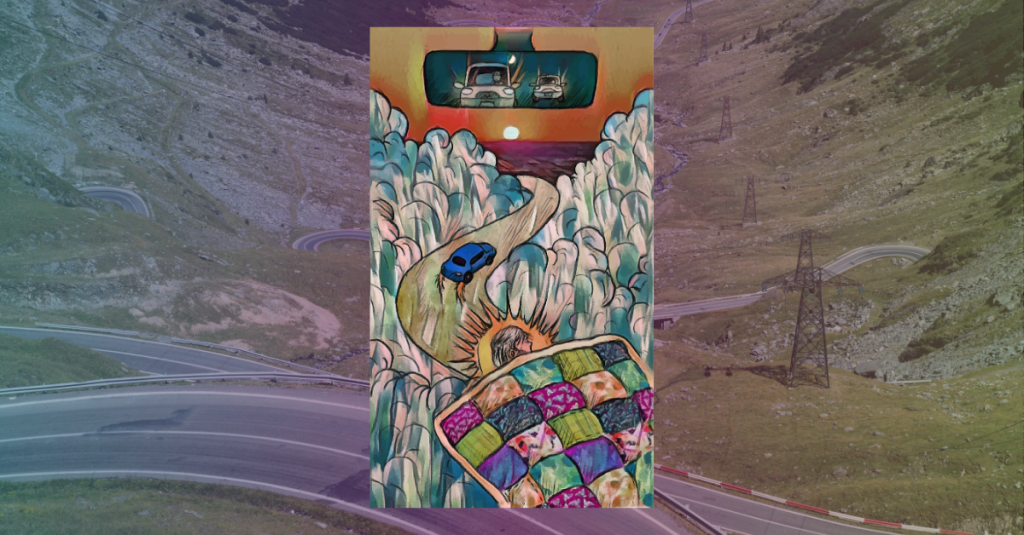
by Amy ROOT Clements, art by Alejandro Gonzalez
I ran the risk of what might be called human scenarios. Each led
to a saturated zone, a plume, water or airborne events.
A brain whose synapses will fire until they’re ash.
—Sasha West, Failure and I Bury the Body
“If we can understand disease,” the huckster says, “we’ll understand love.”
I didn’t choose this show; it’s coming from the next room, where another patient gapes at her television from sunup until signoff. A kaleidoscope of noise emanates from the black-and-white box: theme songs, laugh tracks, shrieks of fright, newscasts, prophecies, promises, smooches, speeches, orchestral flutes conveying whimsy followed by the worry of a cello, twangy singers who make me want to dance. Inventors of ingenious products that make me wish I could still dial a phone. Faith-healing preachers who make me want to wring their necks now that I’ve seen the unseen. Now that I’ve been reduced to little more than a soul.
“Because disease,” the voice continues, “is transmitted when we are unaware. When we’re caught off-guard. And then we pass it on to others who are just as vulnerable. With ease, disease knows how to shut off the alarms. It knows how to infiltrate and replicate. What if the world followed those lessons for a different kind of plague? I want humanity to be overcome by an epidemic of love!” Now he has my attention. “It will only happen if we stop inoculating our hearts against the one thing that will save us: love, sweet love.” Ah, I adore that song. What the world . . . needs now. But, inevitably, there’s a catch. To learn more, I have to pick up the phone and give my address in order to receive my free booklet on human potential. Free with a trial membership. If I act now.
Someone turns down the volume, and I hear my doctor’s voice. He is speaking with his back to me, as if that will keep me from overhearing. He would never believe that I examine my chart every day. But I do, while reading his narrow mind. My room is narrow too, barely big enough for more than two visitors at once. My doctor remarks to the neurosurgeon that it’s my second anniversary, the beginning of another comatose year in a powerless body with a remarkably strong heart but a deeply slumbering brain. Yet my spirit is wide awake, with high-octane perception and full-throttle memories that have nothing to do with cells or dendrites or the vast limitations of anything tangible.
They’ve begun telling AJ to get on with his life. “The chances that your wife will wake up are slim,” they say, “and even if she does, she’s sustained permanent brain damage.” I’ll admit that I should have made up my mind a lot sooner. They talk about their possible courses of action, as if this is somehow up to them. It’s never been their decision. I soon discovered that, as usual, I am expected to do all the planning and sort out all the difficult details. I’m the one who has to choose the next step while the men tell themselves that they’re in charge. Everyone assumes I want to come home to them. They say they miss my meatloaf. And they especially miss my gravy. Little do they know how tempted I am to retire from that life. My life.
What am I waiting for? I’m ordinarily very decisive. By the time I complete a book of Green Stamps, with all the sizes pasted into every possible slot, I know exactly how I want to redeem them. Should I cash them in for a toaster oven or an ice-cream freezer? Easy choice: Ice-cream freezer. Ice cream makes you a better person. And milk is high in calcium.
My teenage daughter says that soon I will have been here for three Thanksgivings. We’re definitely not on the same calendar anymore. Time feels so different to me now. Time and noise. Especially the noise of being busy. Sometimes when people visit me, their voices become muddy with my leftover sounds. My vacuum cleaner blends with the cheers of a high-school football stadium, very old performances from Jack Benny swirled in, along with the sound of road trips in my station wagon, when everyone would talk at once and AJ would turn up the music if he wanted us to shush.
The most beautiful thing I hear these days is the voice of my first husband. His name was Sam. You can’t imagine how it felt to hear him murmuring in my ear again, twenty years after his funeral. I thought I’d recovered from being his widow; I thought I’d done a good job of letting him go. We’d only been married for a year and a half when he died. Yet, all those years later, on that blazing hot afternoon—the exact moment when my aneurysm opened the floodgates—as I knelt down to scrub the girls’ pink bathtub, I heard Sam right behind me. He started singing, “I’ll be seeing you in all the old familiar places.” That song had been a dirty joke for us; we changed the words to “I’ll be feeling you in all the old familiar places.”
I put down my sponge and turned around to see where the singing was coming from. There was a commotion. I could see my mouth producing words, trying to say that I no longer knew how to speak. The door kept slamming because no one wanted the dog to come in. (He’s huge—an earnest golden retriever who cannot bear to be shut out of anything.) The pink mosaic floor felt cold while questions echoed against the tiles. “Did she inhale the bleach?” “Does she have a bad heart?” “How can this be happening? She’s only forty-five years old.” But I was oblivious to them. Sam’s voice was warm. I wanted to find out where he was.
I’ve heard him almost non-stop for months now. He’s right around the corner, but he’s the one thing I can’t see, while the gritty details of my mortal life are spewed at me in perfect focus. Sam isn’t saying anything in particular to me; he’s just there, humming quietly. It’s like a late-night radio show. You don’t care that only five or six other listeners are tuning in. You can picture the DJ perched in the booth with his favorite records, maybe wishing that a few more people appreciated his music. But you don’t turn it off. It almost feels as if he’s right there in your house, dropping by so that you can keep each other company.
Sam sounds so easygoing and suave. He must know I’m here, though I can’t be sure. I need to get to him, but I need to get back to my daughters too. How I wish I could have it both ways.
I don’t know what my place is in Patty’s world now. I was already having a lot of trouble getting through to her before I wound up in the hospital. I want her to go to college, but she doesn’t have the grades. When I was her age, I had the grades (especially in science) but not the money. Or the freedom. I can’t tell if I ever figured out how to be a good parent. Was I strict? I’m glad Patty visits me, but she should be doing her homework. She and I have always been the kind of people who lose track of time. Sometimes Patty will come in after school in the late afternoon, and the next thing I know a nurse appears, or one of the candy stripers (why do they let those children volunteer on school nights?), and it turns out that several hours have passed. That’s when they say it’s way past visiting hours, so “Everyone will have to go.” I sometimes wonder if that means me too.
Patty is failing her classes, but she is helping her little sister, Lynna, make all A’s. Neither one of them can spell aneurysm, and sometimes they tell people that I had a stroke, just because it’s easier to pronounce. They’re not the same thing. Having a stroke sounds elderly and ordinary. A stroke is simply a rupture. An aneurysm is a bulge that can burst. And it’s deadlier, especially if the pressure has built up over a long time. To me it’s an important distinction.
Marrying AJ was comfortable. But marrying Sam was intoxicating.
It took them seven hours of observation to decide that the problem was in my brain. After the surgery, they gave AJ a grim prognosis, saying I had sprung a leak in a “poor cranial location.” The neurosurgeon waded around inside my head until he found the source of all the trouble and dammed the river. It took him most of the night.
“Is Nelda in pain?” AJ asked.
“Not right now, but when she bent over the edge of that bathtub, she probably felt the most excruciating headache of her life.”
He certainly got that wrong. It wasn’t like that at all. When I bent over the edge of that tub, I felt the most exhilarating pleasure of my life: The sudden, unmistakable voice of the first guy I’d ever loved. A man who had cherished me the way young couples cherish each other before the real negotiations of marriage and parenting put a padlock on that hormonal racetrack. Marrying AJ was comfortable. But marrying Sam was intoxicating. So, no. When I bent over to scrub that tub, there was no headache. There was no pain.
I remember nothing about the surgery, but by the time I was in the recovery room, I was no longer in my body. I looked down and saw my own half-dead image staring back up at me. Her eyes were open for what seemed like a full minute, and she couldn’t make a sound. We just looked at each other, body and mind and soul coming face to face. Since then, those eyes have stayed shut nearly all the time, while her lips go slack as she sips the air. I tried to take good care of my lungs. Those lungs: should I say they are hers? Or mine? That broken body with its haywire brain is a thing I only vaguely recognize. And yet I can’t bear to sever my connection to it. I cannot bear to cut the cord.
The figure I saw lying there on that awful day was completely bald, with only a black row of stitches where her headband should be. I’d spent a lifetime trying to restrain that hair. I had started borrowing Patty’s headbands. In fact, I was admitted to the hospital wearing her nicest one. It was paisley, which goes with nothing, but it’s cheerful. Such effort to maintain my mane. Yet there I was after surgery, with no hair at all.
It’s grown back thick. And not just on my scalp—on my limp legs too. I used to love the way my skin would feel after I’d shave my legs. Patty’s legs are hairy, for a variety of reasons . . . all of them having to do with liberating women, including oldsters like me, from having to look like a porcelain doll in order to get anywhere in life. I appreciate her courageous act on my behalf. Really, I do. But truth be told, for me, shaving was the liberating part, a rite of passage that meant I was an adult woman who could be trusted with something as dangerous as a razor blade.
I miss wearing summertime clothing: sandals and homemade sleeveless dresses. At least I don’t have to wear a hospital gown here. Long-term guests like me can wear their own pajamas from home. Right now, Patty has me in a purple polyester long-sleeve nightie with an eyelet bodice that almost comes up to my chin. Hideous. It has a matching robe that uselessly hangs from a hook on the wall next to a plastic angel. Both the hook and the angel are standard issue here, installed in every room.
Why did Patty waste money on that robe? Robes are for people who procrastinate and want to lounge a little longer than they should. “Never waste a day, and never waste a dollar.” That’s what my dad always said. When I was growing up, my mother made every stitch I had on, and those clothes held together better than most of the stuff I see on the racks for ten dollars. My favorite sundress has baby ducks all over it. I found the fabric in the kids’ section of Sew Happy. I was looking for something that would make a nice new dress for little Lynna. She’s growing so fast. I could barely keep up with the constant alterations. I thought those ducks were awfully cute, splashing around on tiny blue puddles. I made matching dresses for us, and we would wear them to the market together. People probably thought I was nuts, a grownup dressed in little-girl fabric. But that was my idea of a good time.
The nurses put lipstick on me sometimes, but it’s an awful shade. Frosted. What’s the point of wearing lipstick that makes your mouth disappear more? I guess the real question is, what’s the point of putting lipstick on a mouth that no longer smiles. People used to tell me I had good teeth. I think that means not crooked and not gray like AJ’s. I’ve never smoked. We almost punched each other’s lights out over the stench of tobacco when we were first married. How is it possible that I turned out to be the invalid? The person who is no longer valid.
I should go. But as soon as I try to leave, I imagine the moment when it’s done, and I think of how the sorrow will sound. At night, when it’s time for the nurses to turn out the lights in my room, AJ says he’s afraid I’ll be lonely in the dark. But I know he’s the one afraid to be lonely. The freeway trip home is hard for him right now; his convertible is in the shop, so he has to take my car. With the foldout benches in the back, it can seat twelve. And it has. I can’t count all the trips we’ve made in my station wagon. It’s a blue Malibu, the color of the ocean, though we’ve never taken it to the beach. AJ says the sand would corrode the chassis. We’ve been to the mountains and the desert and once to New Orleans; that’s where AJ thought it would be neat to go ahead and let Patty have some drinks with us at dinner. Next thing I know, I’m mopping up half-digested pieces of her shrimp étouffée in a motel lobby. He said he wanted to train her to dislike liquor. Sometimes his ideas are positively asinine.
I’ve probably put 100,000 miles on that car. It’s one thing to be out on the highway in a car like that with a bunch of kids. It’s another thing to drive it all by yourself, long after rush hour, past all the half-lit gas stations and abandoned shacks. Everything is usually closed by the time AJ leaves here, and there’s nothing but vacancy signs every now and then to keep him company. As lonely as he feels, he’s not always alone because I’m now able to watch him any time I want to. Which is just occasionally. I seep into that silent car knowing I can’t do a thing for him. He won’t turn on the radio. He’s afraid some of our songs will come on. And if he drives under a bridge while a train is passing overhead, he makes this superstitious little wish: “Nelda will get well.” He should know better than to ask God for anything so specific. “The Creator is for comfort,” our pastor says, “not for cures.”
There’s a limit to how much the insurance company would pay, so eventually they made me leave the hospital, in an ambulance that stopped for red lights and did not blare the siren because what’s the rush when you’re just in a coma? And that is how my body and I came to reside here, a place where every resident is half-alive. I guess it’s okay. No need to spend a fortune like we did on those first nights in the ICU (not the right letters for a place where the patients’ eyes are shut: Eye See You). My body can’t tell the difference between a hospital and a rest home. My visitors can feel the difference, of course. This illness is wearing out a lot of car transmissions. AJ drives all the way out here every day. Every single day.
He does not do well in situations where he’s not in charge. He’s the kind of man who’s always checking up on people: doesn’t trust the men he works with, doesn’t trust the roofer, certainly doesn’t trust the nuns who run this place. But it would be wrong to say he only comes here because he’s trying to take charge of a situation he can’t control. He is capable of kindness. I suppose there’s another reason he never misses a day here: He loves me, and he’s afraid that I’ll think he’s stopped loving me if he doesn’t come here and tell me every night. Love is yet another situation he can’t control.
I love him too, but all the dead who ever meant anything to me are on the other side, not AJ’s side. I can hear them. Not just Sam. My mother is there. Dad. My big brother. I know this. I know that they are as near as a pistil and a petal. Or, I think I know they’re near. That’s another thing that worries me. What if it’s all a trick, and the next realm turns out to be an entrance to another body, and I have to start a whole new life as someone else, and I never get to be myself again after all?
Don’t whistle, AJ. Oh, I can’t stand that—it’s so eerie. Off-key, but he doesn’t realize it. All his adult life, he’s gone around thinking he’s whistling a happy tune, but in fact he sounds more like an unattended tea kettle. I never had the heart to tell him.
“How ’bout that tune, Sugar? One of your favorites, right?” He’s referring to Patsy Cline. Too tragic. Not one of my favorites at all. But I do like being called Sugar. And I like calling him Sugarfoot. Who knows how all that got started.
Thank God for Patty. He can’t talk to her and whistle at the same time.
“Mom looks cold today.” I’m not sure what she means by that, but she draws the blankets to my chin.
He must have left work early and picked her up at school. They try to visit me separately, to increase the number of times a visitor is checking on me. Or maybe this is Saturday.
Well, that’s just like AJ. Can’t bring himself to say anything to her. Let’s not even talk about the obvious. Let’s just shake our heads and leave the room. Patty certainly didn’t get her chatterbox gene from AJ.
“Where are you going, Daddy?”
“I need some coffee, Patty. It was a long week.”
And there he goes. I don’t think he can keep this together much longer. Coffee in the afternoon is never a good sign.
“Sorry, Mom, but I was downstairs trying to park the car. Daddy’s trying to teach me how to parallel, but it’s not that easy in your big blue monster. Daddy gave up and said he’d come in here by himself because he didn’t want to watch me wreck. My friend Beau called the station wagon a hearse today, and then he remembered what happened to you and he felt really bad.”
Yes, her beau is named Beau, and he’s an evil little twerp, descended from a long line of like-minded brats. It scares me to death to think of what can happen to her. She has no idea how dangerous the world is. Or how much fun you can have with a man who takes you seriously and doesn’t lie every time his lips are moving. She would have thought Sam was boring. She definitely thinks AJ is boring. Every ounce of women’s lib she preaches goes right out the window when it comes to Beau, though. And there’s not a thing I can do to protect her. Patty, you’re not going to mention the fact that you let Beau drive my car, are you? And the fact that you couldn’t care less if you’re just a sex object to him, and you’re planning to drop your pants for him any day now if you can just figure out how to fold the seats down?
“Mom, I think I understand how come you got sick.”
Not another hypothesis, Patty. You’re always so sure you know “how come” I got sick. And it’s always because someone did something terribly wrong. When are you going to realize what little influence you have on my fate?
“Sharon’s not going to stay over anymore. I told her I don’t want to be friends.”
I see. Now it’s the neighbor girl’s fault that I’m sick. That’s really a shame. They’ve been close since elementary school, when they hadn’t yet learned how to concoct a feud that lasts an entire semester.
Sharon has always felt like a third daughter to me. I don’t like to admit it, but there were times when I wished I could trade Patty for Sharon. They can both be troublemakers, but Patty is usually the one starting the trouble. Sharon is more sensitive to the needs of others—more concerned about how the fallout will affect the adults. And she’s smarter about the ways of the world. Sometimes I can’t believe that someone as gullible as Patty could be related to me. I know where Patty’s going with this line of thinking, though. The very night before I collapsed, Sharon and Patty took my spare car keys from the shed and tried to drive into town to see Led Zeppelin live in concert. Neither of them had a license. Patty was driving, and she drew attention to herself because she didn’t know how to turn the lights on. A neighbor recognized them, followed them, and eventually called us from a pay phone at the coliseum. We sped down there and pulled them out of the long line of kids waiting to get in to see the show. I made Patty and Sharon ride back to our house with AJ I told the girls that their disobedience and recklessness disgusted me so much I couldn’t stand the sight of them, and that their music disgusted me too, even though I was not disgusted: that’s just the word that a good parent is supposed to use when their daughter has stolen their car. I laid it on pretty thick. But no, I was not disgusted. I was furious and power hungry: rules are rules. And I was genuinely afraid for their safety.
And I was envious. They never have to know the truth, that I used to crank up those albums when I was home alone, and not just when I was doing housework. There was nothing better than the sound of Jimmy Page and his double-neck guitar. Gonna make me sweat. Gonna make me groove. I loved to shake my hair and shake my tail and belt out a few primal screams.
I screamed and screamed after she stole my car: “Doesn’t that band have an ounce of respect for the people who perished on the Hindenburg???” Furthermore, we hadn’t been allowing Patty to go to concerts yet. She was too young because the concerts were too wild. Someone could slip drugs into her soda. Kids are OD’ing all over this town. She could be raped—by someone she knew. She could be killed. Had she not heard of Charles Manson? But she was oblivious, just the way she is now that she has a boyfriend. Reckless. Gullible. She was on the freeway with her friend driving blind in the night. When she left for school the next morning, AJ had to do the talking (which for him meant barely uttering two syllables) because I was still fuming.
It scared me to see her becoming so rebellious. I wanted (and still want) her to take life very seriously. I’ve had a good life, but I want her generation to have an even better one. All these opportunities that I would have relished at their age: college, cars, paychecks. The Pill! Being in charge of a big company, or even City Hall. But they just take it for granted, frittering their lives away on foolish whims. Tuning out, with no clue how easily all that freedom can be taken away from them.
And I wanted Patty and her friends to take me seriously. I felt so insulted. How stupid did those girls think I was? Why did they think I was so gullible? They probably would have gotten away with it if they had turned on the headlights. If I had been a troublemaker when I was their age, I would never have gotten caught because I’m smarter than they are. But I did trust them completely. It never would have occurred to me to check on Patty after bedtime or look in the carport late at night.
I didn’t know it then, but now I realize that Sharon slipped my face powder into her pocketbook after we got back to our house that night. After all the yelling. She is very attached to me (her own parents run a madhouse) and she wanted a memento from what she figured would be her last invitation to my place. Her stepmother doesn’t even buy her tampons, much less makeup. So she went right into the drawer on my dressing table (said she needed my toilet because Patty was using the girls’ bathroom), and she took the little round compact that I used every single day to blot out the imperfections above my neck. On a normal night, I would have given it to her if she had asked. But that was not a normal night. And even if it had been a normal night, she would not have asked. Girls like that are clever enough to know that if you ask, the answer might be no. Now, when she opens my compact and looks in the mirror, her very young and hopeful face, which does not need powder of any kind, has replaced my tired reflection.
My own mother used to be overly kind to my friends too, the ones from broken homes, calling them her “stray cats.” It would make me jealous that she paid more attention to them than to me, and I finally told her so. Without batting an eye, she said I didn’t need to worry. She said I shouldn’t take it personally because she was just trying to make herself feel better (feel superior, in fact) by putting a spotlight on the errors of other kids’ lousy mothers. I had no idea what she was talking about. But there I was, all those years later, history repeating itself, polishing my halo while I made up for all the shortcomings of Sharon’s mother and the father’s second wife. And his girlfriend before that.
If I hadn’t gotten sick, Sharon certainly would have been allowed back to our house after a while. I would have insisted, telling her that I changed my mind because she’s the only one who ever wanted to help me in the kitchen. Not telling her that I changed my mind simply because I missed her so very much. But who knows how it would have unfolded. Girls that age find hundreds of reasons to declare war on each other.
“Beau has decided to be my boyfriend, Mom.”
“Beau is really sweet, Mom. Here, I brought a picture.”
Oh, I don’t need a picture. I know what this con artist looks like.
That’s a strange way to put it. Shouldn’t there be some asking going on? Doesn’t she know that she gets to decide whether she wants to date him? Why is my daughter handing herself over to him on a silver platter? She’s trying so hard to cheer herself up. She thinks that she can hide things from me by not uttering them. She even thinks that if she doesn’t move her lips (which is rare for her) I can’t hear her.
“Beau is really sweet, Mom. Here, I brought a picture.”
Oh, I don’t need a picture. I know what this con artist looks like. There he is, grinning up at the camera with his sharky little teeth. He has a “nice boy” haircut. His sideburns are kind of long, but he knows he can get away with anything as long as he keeps his hair above his collar.
“We’re going to be in a play together. You can meet him when you get out of here. You’re going to like him.”
I can see how they will spend the evening. Patty will wear one of her hand-dyed shirts, smeared with shades of tangerine and pomegranate that resemble blood stains. This Beau person will lift that shirt halfway up while her Levis are tugged down around her shins. All of that denim will be wadded underneath them; she likes wide hems.
Patty will think about telling him no. But she will remember the night when I told her I was disgusted with her. She will tell herself that I am right. She’ll have no way of knowing that I was never disgusted with her. Patty’s thin face will show no happiness or pleasure; no pain either. Her face will be blank, the way mine looks now after a hundred and four comatose weeks. She’ll think of a sensational way to describe this night to her friends. She will not ever admit to its tragedy. She’ll go on about how much fun it was, how “tuff” she was, how liberating it was.
I wish she could find someone like Sam. I wasn’t much older than Patty when I fell in love with him. No one knows how much I’ve missed him. He was not a smoker. The air around him was crystal clear.
In Patty’s mind, it’s as if my life began when her life began. But I had another life. One that has nothing to do with her.
Sam and I only got to celebrate one wedding anniversary. I had chased him all through high school. I was younger than he was. He was the kind of guy who liked to make himself useful. Never let anybody know what he was thinking, but when he did have something to say, it was a stopper. An obscure fact that no one had ever thought of, or a solution—offered gently and politely so that the rest of us wouldn’t feel like imbeciles. I met him when he found out that my brother had been drafted. Sam wanted to know everything about going into the service. He started hanging around our place all the time then. He and I made friends right away.
As we grew up, I thought I was just supposed to be his best buddy, not someone he would ever want very deeply. But the letters while we were separated finally made him come around. I never realized how much he had on his mind until I started getting his notes from Korea. Magnificent penmanship. He said that he had never really appreciated me until he had to live without me, and that he knew it was presumptuous of him, but did I want to meet up with him on his next leave? After that, there was no waffling.
We were married on my parents’ porch after Sam’s second tour was up, and for our honeymoon we went trout fishing. We stayed in a little cabin at a place called Inn O’ Sense. That’s how uncomplicated we were. Two plates and two cups on the drain board. Just enough money from his job at the IGA to keep us fed and sheltered. By then, no amount of money could tempt him to stay in the service; he said the path to a pension would have felt like a prison sentence, now that he knew what it was really like on the frontlines. He was glad to be alive.
We had friendship and peace and quiet. We were trying to start a family. I sometimes imagine what those children might have been like.
He wasn’t sick for very long, unlike me. He just went to bed with a stomach ache one night and woke up a few hours later with what turned out to be a ruptured appendix. It was all over in a couple of days. He was 25 years old. He had survived two tours of duty defending the 38th parallel but was betrayed by his own body. Of course, I told myself that I’d never live in the countryside again; I wanted to be in a town big enough to have a hospital. That was foolish. Look where it got me.
Losing Sam helps me know what AJ is going through. It is such a bitter feeling when you come home to a ghost’s house.
In my case, the ghost’s house is a wreck. You’d think they’ve never heard of scouring powder or Trash Day. Lynna’s clothes don’t match, and Patty is thinking of dropping out of school altogether. The Drama Club is the only thing that keeps her there. I have never, ever let on that I think I’m smarter than she is. All AJ and I ever said was that she’d make better grades if she studied more. But maybe she didn’t study more because it was too hard for her. AJ is up to a pack a day. He has the nerve to smoke in here, as if I can’t tell. The stench is awful, and I swear it’s staining the walls. I wish they’d put me on oxygen, so he won’t be allowed to light up. But everyone says there’s nothing wrong with my lungs. At least, not yet.
My ability to experience their daily life feels smaller and smaller to me as time goes on. It has nothing to do with the fact that their hope is waning. Surely this decision is still completely up to me, with or without their hope. If I do come back, they’ll forget this affection they’re feeling right now, and there will just be another crisis to take the place of this one. And, chances are, I wouldn’t come back in one piece.
I think Lynna is the only one who appreciates what’s left of our little family. I hope they remember her birthday next week. She’ll be eight. Or nine? This is a bad sign; I should know her age. She always recognizes me. She’s the only person in the family who can see me. I suppose that’s because she’s still very young, but there is so much I do not understand. I hope she will not outgrow me. Her imagination is wonderfully colorful, and she thinks I am a figment of it. I keep her from sleeping, but I can’t help it. The only time she’s ever alone is when she goes to sleep. And that way, I also get to see the dog, who makes the rounds and then winds up snoozing at her bedside. He always recognizes me too; a good thing, because otherwise he’d growl.
Lynna is now too worried to have any childish ways. I try to wait until four or five in the morning to see her, when she’s fast asleep, so that maybe she’ll think I’m just part of a dream. She’s little, yet she understands what I tell her. She has no difficulty with words, but she’s not very strong in math. I wish I could go through her flashcards with her. AJ’s mother looks after her, but she is sort of a cold fish.
They’ve never brought Lynna to visit me. I wouldn’t want them to. I wouldn’t want her to see me like this. That would keep her up at night. But last week, half-asleep, she asked me when I’m coming back. Some of the other kids at school have tried to cheer her up. They tell her I am probably just on a really long vacation, and AJ will surprise her with my return. They tell her I’ll have souvenirs and peanut-butter cups for her. For a while, she would ride home from school anticipating the big day of my return, hoping I’d be waiting for her in the living room. I shouldn’t do this to her. She is losing her ability to wish and hope.
“I’m going to go see what’s taking Daddy so long,” Patty says. “You look pretty, Mom.”
You look pretty too, Patty. You’ve got such athletic legs. You look strong in those knee-high boots.
So my daughter is a homewrecker. And how did that jackass man-child manage to become such a heartthrob?
Well, what do you know. “Hi, Mrs. Nash.”
Sharon must have been waiting for Patty to leave. Good thing; I don’t want any catfights in here.
Sharon also looks lovely today. I think she’s been ironing her hair. Hers is the same color as sweet potatoes. Matches her freckles.
“I can’t believe you’ve been here two whole years, Mrs. Nash.” Well, at least somebody besides the doctor is being honest about my anniversary. “You’re a tough lady,” she whispers. She usually whispers everything when she’s in here. Just the opposite of Patty.
Mmm, that’s nice. She always holds my hand.
“I don’t know if you can hear me, Mrs. Nash. But I really miss you. Patty and I had a big fight; that’s why I haven’t been coming around as much. I want you to know I think you’re a great lady, though.”
How does she know just what to do? My scalp itches so; my hair has gotten too long. That’s good. Use the soft brush. No more tangles. Oh, this is luxury. I’ve missed you too.
“I’m going to patch things up with Patty. She doesn’t know it yet, but I am. She’s been my best best friend forever. But I had to tell her to stay away from Beau. She knows I’ve had a crush on him since sixth grade.”
So my daughter is a homewrecker. And how did that jackass man-child manage to become such a heartthrob?
“She said she didn’t care and it shouldn’t matter because Beau doesn’t want to date me anyway, and that maybe we shouldn’t be friends anymore because I’m the one who made you mad and that’s why you got sick. To tell the truth, the concert was all my idea.”
Patty has always known how to stack the cards in her favor.
“I’m sorry if I made you mad that night, Mrs. Nash. I miss you. You know how it is with my stepmom. I wish I could go over to your house and you could teach me how to make something that looks just like the picture in the cookbook. You never got around to showing me why your gravy never has any lumps. I’d promise to leave your kitchen all clean. I want to go over and help, but Patty won’t let me.”
Imagine this little girl trying to take on my trio. And the secret to gravy? Patience.
“I mean it, Mrs. Nash. I don’t know if you can think at all any more. But you’ve always been so good to me. You’re the only one who would take the time to listen to me, and you really understand what it’s like out there. I’m right next door to your house, so I can help anytime. I just don’t want you to worry.”
Truth is, I don’t think you’ll be back here to see me for a while. Whenever you want to stop in, you’ll probably be intimidated by AJ’s car out front, and every time you try to phone my house and check on things or offer to pick up some groceries, Patty will turn you away. At your age, these things can rage on for months. But I’m not afraid for you just yet. I’ll bet that when you leave here today and slide behind the driver’s seat, and fire up those cigarettes I wish you didn’t smoke, you will pull yourself together. You’ll just have to learn how to overlook Patty for a while, how to sidestep her like a mud puddle. And you need to go to college. Or law school. Or flight school. Anything but Home Ec. No more cookbooks. What’s in the bag? Oh, that’s the cutest thing.
“I thought you’d get a kick out of this, Mrs. Nash. I got this for Lynna, for her birthday. I wanted to show you.” A yellow sleeveless dress with a long-tailed kitty cat on the front. I wish I could put my hands on that dress and feel the stitching where the cat is attached. He’s arching his back, stretching. Free to do what feels good to him. No responsibility. I guess that’s why I think it’s a boy cat. And as much as I love my dog, I do admire the cleanliness of cats.
It’s ridiculous for me to even think about what’s clean right now. Who says we have to be washed clean when we die in order for us to be happy? My life won’t be washed clean, ever. There are still dirty spoons in the sink. Sunday comics from last month all over the living room floor.
“Leave it to me,” Sharon used to say when she’d come over. Just like Sam: “How can I help?”
I envy Sharon. Just look at her, gathering her things. Slinging a macramé purse over one shoulder, the shopping bag in the crook of her arm. Looking away from me and feeling so disappointed, but so relieved that she can simply waltz through the doorway on a timetable of her choosing.
She’s driving her dad’s rusty sports car. Stick shift. Attagirl. I watch her coast through the parking lot and gather speed, flicking ashes out of the window. Completely unencumbered in her striped T-shirt and cutoffs. Not even bothering to say goodbye to AJ or Patty. Following arrows to the freeway, where there will be mileage signs and the names of destinations.
She has no idea how much I’d like to drive away with her, hopped up on nicotine and naïve intentions. Wide awake to everything that feels unfamiliar, never conscious of the way things end. Just focused on anticipation, with a system for measuring our progress. A hundred miles from the state line. Historical marker in ten. Gas, food, lodging in five.
Watch me slip out behind her and put my hand on the wheel. I don’t need to steal anyone’s keys. This is a vehicle of my own design. Watch me barrel past the careful people, forcing my way into the far left lane. Immune from fear and fueled to the brim, without a drop of sorrow to gum up the gears. Watch me fiddle with the dial until Sam’s song is clear. Watch me revel in the revelation of my infinite flight. No longer sequestered. Now certain and free.
“Still Time” by Amy Root Clements appeared in Issue 45 of Berkeley Fiction Review.
Amy Root Clements teaches writing at St. Edward’s University in Austin, Texas. Her previous work has appeared in Southern Humanities Review, Bryant Literary Review, Beloit Fiction Journal, and other publications. She holds an MFA in creative writing from The New School.
Alejandro Gonzalez is a Multimedia Artist from Caracas, Venezuela. He was awarded the 2023 Spellbinder Magazine Art Award in 2023. In his best days, his work focuses on themes of societal and psychological unrest through expressive color choices and symbolic imagery.

 Berkeley Fiction Review
Leave a comment