
By Julia Chiappe
“The Obsolete Man”
Confronted by a government with the power to exile readers into obsolescence, one must question: what do books represent that poses such a threat to a governing force? Other than simply generating knowledge, do books have the capacity to bestow power, evoke transformation, or embody hope? In season two of Rod Serling’s The Twilight Zone, the appropriately named protagonist, Romney Wordsworth, is a librarian deemed obsolete and sentenced to death. Mr. Wordsworth grapples with these questions as he defends his occupation in an immovable kangaroo court, unsuccessfully attempting to appeal to their shared humanity. In the imagined reality of Serling’s futuristic (albeit alarmingly familiar) government, society is defined by order and devoid of character.
Other than simply generating knowledge, do books have the capacity to bestow power, evoke transformation, or embody hope?
“A Book is a Loaded Gun”
The opening scene of “The Obsolete Man” depicts the ruling Chancellor sitting behind a towering podium. Rich in ‘60’s-television black and white, every aspect of the courtroom is exceedingly striking and exaggerated, emphasizing the bleak grandeur of modernity. The massive doors open to reveal Mr. Wordsworth, whose unruly hair and wandering eyes immediately set him apart from the robotic jury set to decide his fate. Mr. Wordsworth must state for the record his former occupation, considered “useless,” “anachronistic,” and an “error,” according to the Chancellor. “Since there are no more books,” the Chancellor proclaims, “there are no more libraries, and of course, as it follows, there is very little call for the services of a librarian.” In an ironic twist, he goes on to describe the publication process as “a language factory that spews meaningless words on an assembly line,” when in reality, nothing could be more bureaucratic and authoritatively ordered than the judicial process at hand. He likens the obsolete profession to that of a minister, “since the state has proven that there is no God.” This radical comparison brings into question the threat books and religion have in common with each other. Mr. Wordsworth, as a librarian and a staunch devotee of God, is the embodiment of both of these criminalized offenses. In an argumentative exchange, Mr. Wordsworth emphasizes the everlasting quality of his enlightenment, both literary and religious, to which the Chancellor replies “Delusions!” comparing literature (“the Bible, poetry, essays, all kinds”) to narcotics and to opiates that “make you think you have a strength, when you have no strength at all.” To the Chancellor and the state, it appears as though the threat lies in a book’s potential—to strengthen, empower, and provoke the masses in a way contrary to the expectations of the ruling force.
Rich in ‘60’s-television black and white, every aspect of the courtroom is exceedingly striking and exaggerated, emphasizing the bleak grandeur of modernity.
Conviction and Enlightenment
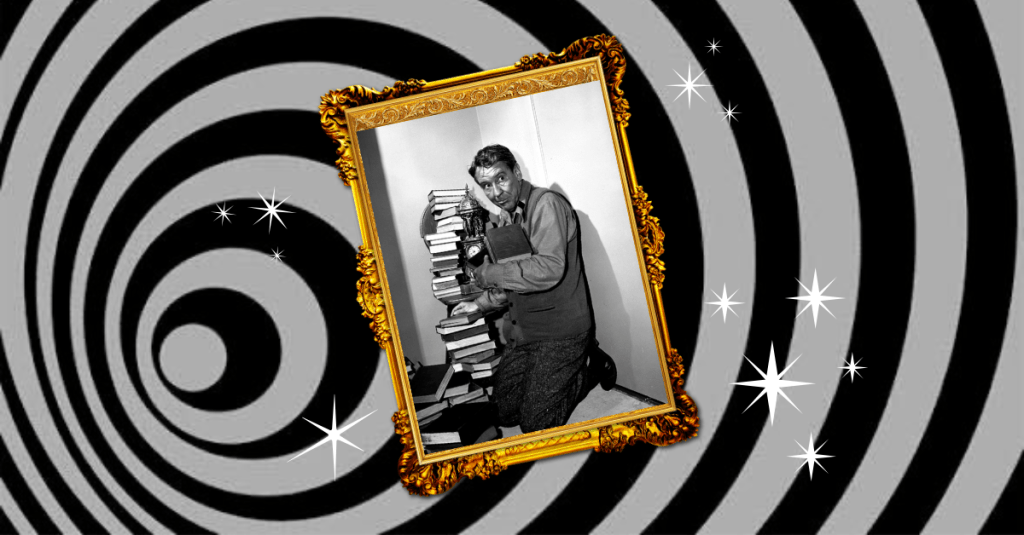
When given the opportunity to choose the dwelling place of his final moments, Mr. Wordsworth settles on his home, where we are provided a stark visual contrast from the previous courtroom scenes. Scattered lamps suggest a warm ambience, and stacks and stacks and stacks of books depict a sense of liberty-driven boundlessness interrupted by the librarian’s unjust sentence and imminent demise. The space itself evokes a word—tsundoku—often described as “the art of buying books and never reading them.” Originally enveloped by a negative connotation, the practice has become positively justified, with numerous articles, including Trent Betham’s “Tsundoku and the Benefit of Owning Too Many Books” noting the motivation and curiosity that comes from stacking your surroundings. Not only does Mr. Wordsworth choose to spend his final moments reading his hidden Bible (a double offense of the state) as an act of rebellious enlightenment; his surroundings reinforce his prior argument of knowledge as everlasting. In the face of his life being cut short, he fences himself in with hope, potential, and strength. Towards the end of the episode, his calculated plan to implicate the Chancellor by inviting him over and intimidating him with the threat of a shared death among books could only be afforded by this access to unbridled wisdom. In the confines of his own home, Mr. Wordsworth leverages his library like a forcefield.
Serling’s final remarks underscore the case of the Man versus the State, as illustrated by the minimal ensemble episode and its definitiveness. The real enduring image, however, is one of a political official utterly threatened by a man reading. Romney Wordsworth, so suitably named, dies doing the very thing that provoked his obsolescence, surrounded by physical reminders of his liberated mind, and “a citizen of the State . . . soon . . . to be eliminated, because he’s built out of flesh and because he has a mind,” as per Serling’s opening narration. In a futuristic rendering of government where literacy is being outlawed, words are worth so much more than they’d like you to believe.

 Berkeley Fiction Review
Leave a comment