
Neekta Baghoolizadeh
Between necromancy and sword-fighting, spaceships and crumbling towers, Tamsyn Muir’s Locked Tomb series shoots readers face-first into a richly layered post-apocalyptic universe, ten thousand years in the future. The first book in the series, Gideon the Ninth, follows Gideon Nav, an indentured servant on an outer planet in our solar system, desperate to gain her freedom from the decrepit, bone-loving society she’s bonded to. Instead, she ends up following Harrowhark Nonagesimus, her lifelong nemesis and heir to the Ninth House, to the desolate remains of Earth, serving as Harrow’s cavalier in her quest to attain sainthood. Along the way, the two of them become entrenched in political intrigue, interpersonal drama, and, of course, murderous bone constructs.
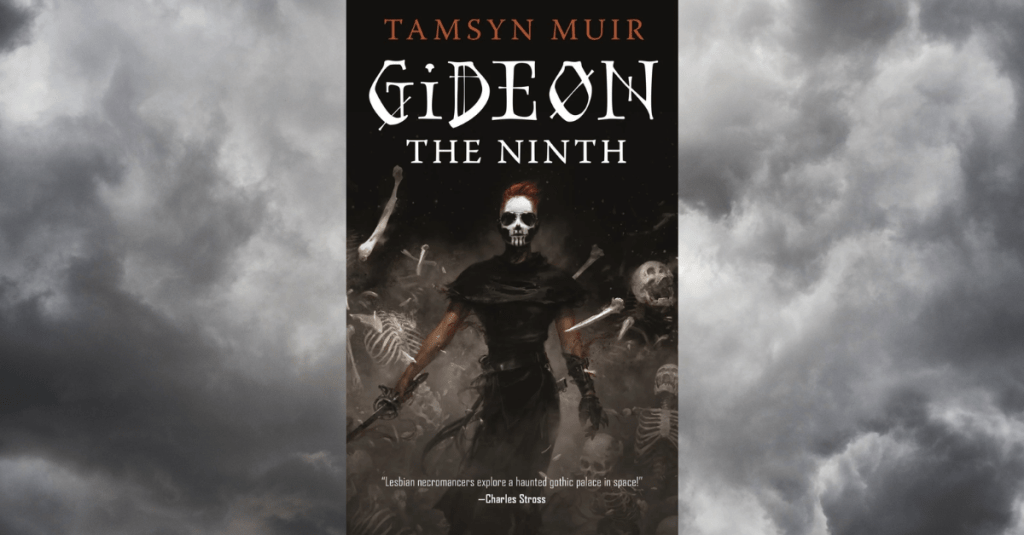
If that premise sounds complicated, well, that’s because it is. The blurb on the cover is somewhat simpler—“Lesbian necromancers explore a haunted gothic palace in space!”—and yet it misses out on so much of what makes Gideon the Ninth compelling. At the heart of this dilemma is, in part, Muir’s complete refusal to adhere to the norms of genre fiction. Instead, she weaves between fantasy and science fiction, gothic horror and murder mystery, romance and dystopia, taking whatever features draw her fancy. Simply put, Gideon the Ninth refuses to be put into a neat box—it strains against whatever labels one might diagnose it with. Genre isn’t the only thing Tamsyn Muir is willing to blend the boundaries of. The series is filled with references stretching from the Bible and the Iliad all the way to Internet memes, refusing the dichotomy of “high art” and “low art” which is so often imposed on allusions. To quote the Bible is often seen as “literary,” whereas to quote, say, the “none pizza with left beef” meme would be gauche. However, Tamsyn Muir readily blurs this dichotomy, drawing on both with ease. In the context of a world 10,000 years in the future, where only a select few have memories of pre-apocalyptic Earth, the similarity of these references makes sense, and, in several points, even strengthens both the plot and thematic elements of the story. In many ways, The Locked Tomb is “shoring fragments against [its] ruins,” to quote T.S. Eliot’s The Waste Land—and those fragments could come from anywhere. Ten thousand years in the future, after all, almost all of human culture has lost its significance—a fragment is, with few exceptions, nothing more than a fragment.
If that premise sounds complicated, well, that’s because it is. The blurb on the cover is somewhat simpler—’Lesbian necromancers explore a haunted gothic palace in space!’
Just when you might have gotten the hang of Gideon the Ninth’s strange melange of genres, the novel comes to a close, and the series shifts its focus to Harrow the Ninth. Here, everything we believe we understood is upturned, as the sequel picks up with a new protagonist, a baroquely grotesque tone, and—seemingly—a recollection of the events of Gideon the Ninth, which doesn’t quite line up with the reader’s memory. The third book, Nona the Ninth, similarly leaves the reader with a slew of questions, as we meet a new, surprisingly cheery protagonist, enjoying domestic life on a war-torn planet of refugees. Again, Tamsyn Muir refuses to be bound by any constraints—including those of the expectations she herself set up in previous books. The people we think might be antagonists in one book become sympathetic central characters in the next, as Tamsyn Muir complicates the question of morality within a colonial structure time and time again. Instead of sticking to Gideon’s quippy narration for three books, or following any set path, each novel is an opportunity to explore new facets of her rich universe, while putting everything the reader once believed in—including, at times, their sanity—into question. The result is an incredibly rich world and immersive experience, even as Tamsyn Muir pulls us through different frames of reality. Each book reframes the last, as we uncover more about Muir’s world, lending the series near-infinite potential for re-readability.
The people we think might be antagonists in one book become sympathetic central characters in the next, as Tamsyn Muir complicates the question of morality within a colonial structure time and time again.
Muir’s deconstruction of norms is present not only at a metatextual level, but rather baked into the thematic DNA of the series. Just as Muir refuses to play by the rules of genre, characters constantly refuse to stay put in their predetermined societal roles. Nowhere is this more present, perhaps, than with the foundational relationship between necromancer and cavalier. Necromancers, naturally born with the “aptitude,” are individuals able to manipulate bone and flesh, life and death energy. Sworn to each necromancer is a cavalier, a swordsperson meant to represent them in duel—or aid them in military battle. While it seems classical gender roles have more or less been dismantled in this future, Muir recreates them through the dynamic between necromancer and cavalier, complete with their own set of taboos and complex power dynamics. These relationships are, of course, ultimately complicated and queered by the narrative, as time and time again we see pairs of necromancer and cavalier fail to conform to societal expectations. Characters break the romantic and familial taboos associated with the relationship, transform the hierarchical structure into an equal partnership, and even invent new ways to achieve the “final objective” of their relationship.
Muir’s criticism of these oppressive social structures goes beyond the interpersonal, replicating itself all the way to the colonial scale. The first book takes place within the empire of the Nine Houses, narrated by a character almost wholly uninterested in politics. The sequel, however, takes the reader closer to the core of the empire—in fact, within the Emperor God’s very orbit—raising further questions about the sustainability and integrity of the empire’s upkeep. Nona the Ninth takes these criticisms and blows them up to full scale, as the novel takes place on a planet “shepherded” by the Nine Houses, as a result of a series of violent resettlements. It’s here that we fully see the scale of destruction necessitated by the empire, and the long-running consequences of imperialism on civilian life. Muir’s structural deviances shift into structural critiques, as she questions the very foundation of the series’ central empire and the existence of necromancy itself. Through this, Muir demonstrates a deft understanding of how empires continue to shape our own world. This critique is especially salient in the current day, with imperialistic violence on greater display than ever before, from Palestine to Cuba.
Muir refuses to fall into the trap of ‘fantasy escapism’: The Locked Tomb is political on every level, and for the better.
Muir refuses to fall into the trap of “fantasy escapism”: The Locked Tomb is political on every level, and for the better. At every turn, The Locked Tomb is irreverent, unconventional, insistently teaching its readers to continuously question the structures superimposed by author and authority alike, from genre and gender to colonial realities. Each novel in the series gives the reader a progressively deeper look into both The Locked Tomb’s universe, and, reflexively, our own.
TAMSYN MUIR is the bestselling author of the Locked Tomb Trilogy. Her short fiction has been nominated for the Nebula Award, the Shirley Jackson Award, the World Fantasy Award and the Eugie Foster Memorial Award. A Kiwi, she has spent most of her life in Howick, New Zealand, with time living in Waiuku and central Wellington. She currently lives and works in Oxford, in the United Kingdom.
The Locked Tomb series can be purchased here.

 Berkeley Fiction Review
Leave a comment