
Giselle lipsky
After months of torrential promotion and a whirlwind global press tour, director Emerald Fennell’s long-awaited adaptation of Emily Brontë’s seminal 1847 novel, Wuthering Heights, was released on Valentine’s Day. The lead-up to the film left fans of the novel confused; photos dropped online of Margot Robbie in increasingly outlandish and inaccurate period dresses, as well as one image in which she leaned against a wall seemingly made of her own skin. Could this be a faithful version of Brontë’s gothic, windswept masterpiece? How, when Margot Robbie was seen wearing a sheer pink dress with a giant bow, more akin to 2023’s Barbie press tour than anything worn on the moors in the 19th century? Theories online began to circulate as people tried to justify how this could still be a faithful adaptation of the novel.
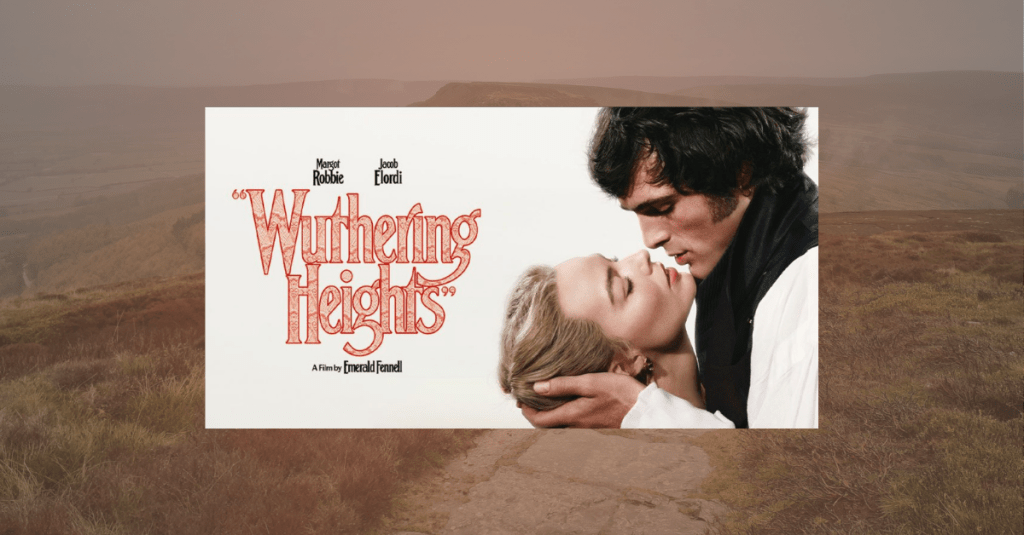
Catherine (Margot Robbie) and Heathcliff (Jacob Elordi) are both too old, too beautiful, and too famous to convincingly play these impetuous teenagers.
Dear reader, I regret to inform you that Emerald Fennell’s “Wuthering Heights” is not a faithful adaptation of the novel. What makes the jump from page to screen so exciting for fans of literature is getting to see their favorite characters and scenes dramatized, with rich cinematography heightening a world of the story that has only existed in the reader’s mind. In that respect, Fennell pays homage to the Brontë home, sweeping the camera over lovely scenes of the gloomy moors. But that is where any consistent effort to engage with the source material ends.
At the center of this utter misfire is the casting, or rather miscasting, of the two leads; Catherine (Margot Robbie) and Heathcliff (Jacob Elordi) are both too old, too beautiful, and too famous to convincingly play these impetuous teenagers. In order to justify their casting, Fennell must upend the entire story. Gone is Cathy’s brother, Hindley Earnshaw, the character most responsible for spewing racist vitriol toward Heathcliff. I guess when you cast a white man to play that role, it only makes sense to cut the character that’s racist toward him. And to make the dynamics between the characters more confusing, Fennell cast British Pakistani actor Shazad Latif as Edgar Linton, thereby reversing the roles that both men play in Cathy’s life: When Linton, and not Heathcliff, is a person of color, Cathy’s begrudging marriage to him loses what would have made it socially acceptable in the 19th century. Thus, voila! The imposing Elordi becomes the “perfect” Heathcliff, only stripped of everything volatile, cruel, and “other” about him. And yet, Fennell still tries to position him as a minority figure, abused by Cathy’s father as a young boy (Adolescence’s Owen Cooper) and spending his life pining over a woman he can never have. The narrator-housekeeper Nelly Dean (a pensive Hong Chau), like Linton, is a racialized other in Fennell’s selectively white-washed film. Her character is also altered, becoming a woman scheming to keep the doomed lovers apart.
Much of Fennell’s doomed-lovers narrative manifests in her signature brand of over-the-top sexuality.
And that is exactly the problem: Fennell’s insistence on Cathy and Heathcliff’s doomed romance, to the point of insinuating that they are akin to Romeo and Juliet, reveals her fundamental misreading of the novel. Therefore, it results in a botched adaptation attempt. The novel, Wuthering Heights, while romantic, is ultimately about two terrible, self-destructive people, ruining their own lives as well as the people around them out of pure selfishness. The novel emphasizes this by spending the entire second half focused on the next generation, the children of Cathy, Heathcliff, and Hindley, in order to highlight the cyclical nature of this kind of destruction. This fundamental theme of the novel is sidelined from Fennell’s adaptation, which spends its entire two-hour and sixteen-minute runtime on the first half of the novel.
Much of Fennell’s doomed-lovers narrative manifests in her signature brand of over-the-top sexuality. In addition to the sexed up relationship between Cathy and Heathcliff, Fennell mutilates the character of Isabella Linton, who, in the novel, suffers abuse at the hands of Heathcliff and flees to London, a decision that would have been unprecedented for a married woman at that time. The film not only arbitrarily changes her from Edgar’s sister into his ward, it also turns her relationship with Heathcliff disturbingly sexual in an attempt to replicate the shocked reactions to the perverse sex scenes in her 2023 film, Saltburn. This kind of psychosexuality runs through Fennell’s burgeoning filmography, except here it is forced upon a sexless story in order to develop her signature style; this is perhaps an attempt in helping future film students study what makes a film Fennellian.
Ultimately, Emerald Fennell’s so-called adaptation of “Wuthering Heights” is barely that. Instead, she presents audiences with a tragically romantic story between two people who happen to be named Cathy and Heathcliff and just so happen to live at a house in the Yorkshire moors that, in a total coincidence to Emily Brontë, is called Wuthering Heights. Separating the film from its novelistic counterpart, it is heartbreaking that the pair cannot be together in the end, an opinion shared by the woman sitting to my left, who cried in the film’s final moments. I only wish that Fennell, clearly seeking to make a brightly colored, highly stylized doomed love story, would have created an original story for the source material, sparing all of us Brontë fans from an anticipation that only ended in disappointment.

 Berkeley Fiction Review
Leave a comment