Evan Gold
Books are finally losing to BookTok. This is the age of abundance in which we are experiencing the truncation of everything. Despite this, we do everything we can to maintain our status as readers. We crave that literate look but can never seem to make the time, so we listen to podcasts on 1.3x and read performatively at coffee shops.
One day, we will live in a post-literate society, one where video renders the written form obsolete, and reading becomes a cool skill to have, like knowing Morse code. As we gear up for our deliverance into the WALL-E world of abundance, the written word itself has come to be understood as a sort of fiber, better off fed to the Large Language Algo-Blenders to produce short-form sugar smoothies of information. Books, in a sense, have been broccoli-ized: Good for you but skippable; the “here comes the airplane” prelude to the iPad that is dessert.
With reading, as with exercise, there will always be a trendy new shortcut. We think of books as medicine and reading as the prescription for brain rot. It’s not. Reading, in its pure coffee + couch + rainy day form hasn’t changed; it’s just that as we move further away from long form text as our primary form of information, reading is being tokenized. Books are becoming retro, like digital cameras or Chelsea boots. I offer that this tokenization sucks. It sucks for anyone interesting enough to read a literary magazine—and it sucks for reading as a passion.
As we gear up for our deliverance into the WALL-E world of abundance, the written word itself has come to be understood as a sort of fiber, better off fed to the Large Language Algo-Blenders to produce short-form sugar smoothies of information.
A post-literate society is one in which writing is no longer the primary source of information for a majority of people. Where we currently stand is open to research and interpretation, but as to where we are going I have no doubt: Readers are becoming the consumers of feeds and people who view posts, not paper.
The worst part is I think we understand who is responsible: us. The problem is multifaceted, but ultimately the blame lies with individual choices culminating into a cultural shift away from reading as a pastime. We are the propagators of this shift. To some extent, we are moving from being people who enjoy a chill afternoon with a book to becoming a new type of people. They are the LinkedIn aura-farming, nootropic-supplementing, vest-wearing conversationalists who read one law of Robert Greene’s The 48 Laws of Power per day. The people who are excited by summaries of great books so that they might get all of the takeaways without doing any of the work, and who must start playing Meditations by Marcus Aurelius through their bone-conduction headphones before they can commence the construction of dinner. These people hunger for the sex appeal of literature; they read for results.
There is unspeakable sadness at the thought of someone reading Of Mice and Men for “maximum gains.” One of my favorite parts of the book is when Lennie accidentally kills a bunny he was playing with—the implication being that sometimes we fail to recognize our own excess. How can anyone learn from Steinbeck’s imagination while just repping pages? It is natural to want everything we do to be productive, but ultimately our productivity is our own undoing. Reading is a good thing, but to force it is to kill the gift. For those who view reading as a completionary activity, there will never be a sufficient impetus to read for reading’s sake. Indeed, books read for pleasure offer the last vestige of hope for reading done in depth. I reiterate: for reading to stand a chance in a post-literate world, it will need to be a pursuit like exercise, not a pill like medicine.
At this point, I should acknowledge the flaw in my line of argumentation: Yes, people go to the gym just so they can look sexy on Instagram. But people who have been working out three times a week for the last five years derive joy from the act itself, just as people who read regularly enjoy the act of reading itself. To apply this heuristic to society, for literature to survive in a post-literate world, reading must be pleasurable, not simply prescriptive.
Indeed, books read for pleasure offer the last vestige of hope for reading done in depth.
Take it from me: I used to hate reading. Although my mom tore through books at a PTA-topping rate, and my grandmother taught kindergarten, I was objectively a below average reader throughout elementary school. My vibes were dyslexic, my distaste for books was real, and I much preferred Minecraft.
Then, in high school, I learned: Good books make reading a hobby, not a pill-swallowing contest.
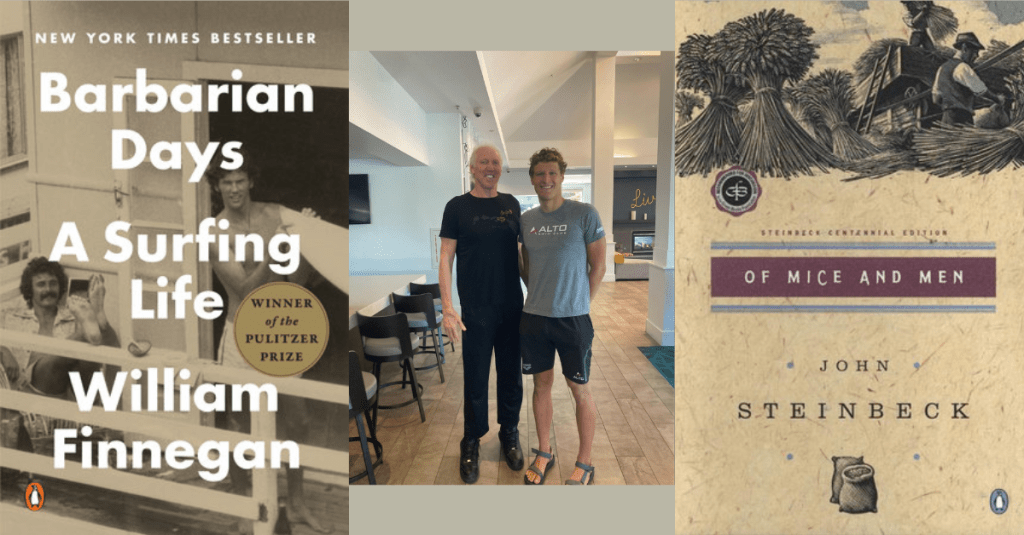
My status as a reader changed after having lunch with the late great Bill Walton (NBA legend—I recognize this is a fiction magazine). To keep a long story short, Bill Walton agreed to have lunch with me while I was a sophomore in high school. At the time, my dad was doing research on the cartilage in the knee joints of NBA players, and Bill Walton was somehow involved and offered to take his son to lunch (Bill Walton, I should add, was a notoriously good person). I met him at his hotel, and we walked across the street to get tacos. After buying lunch for me and a fire crew who happened to walk in at the same time, he patiently listened while I blabbed about my wildly inaccurate hopes for my future. As I ran out of things to yap about, he got down to business.
He instilled in me the importance of hard work and generosity before giving me a book recommendation: Barbarian Days by William Finnegan. To this day, Barbarian Days is my favorite book of all time. We walked back across the street so that my dad could take a photo of us.
Afterward, I opened up my inbox to an email from Bill. The subject line read: great to connect Evan, you’re awesome, I look forward to our futures together, thanks, shine on, BW. He attached four documents: three pieces in which he wrote about what he had learned in life and a book list.
That book list changed my life. While I had read before, it was mainly to help me fall asleep and keep my mom happy. As soon as I ran out of Steinbeck to read, my mom’s taste in fiction lost its appeal. Bill’s list was an epic jambalaya of history, biography, and memoir. It felt real and I was at a point in my life where, with an uncharted future ahead, I wanted something real. Because I happened to share Bill Walton’s taste in books, and Bill Walton had read a lot of books, reading became something I loved. And because Bill Walton kept a list, I now try to make a point of reviewing every book I read, so that, if anyone needs a recommendation, I have some options to choose from. Below are a few of my favorite books from Bill’s list:
The Wizard and the Prophet by Charles C. Mann
The Boys in the Boat by Daniel James Brown
How to Change Your Mind by Michael Pollan
Coach Wooden and Me by Kareem Abdul-Jabbar
I have enjoyed reading every single one of these books. It is because of these books that reading is part of who I am. In a post-literate world heralded by productivity, I offer the pleasure of reading as one last hope for books.
Bill’s list was an epic jambalaya of history, biography, and memoir. It felt real and I was at a point in my life where, with an uncharted future ahead, I wanted something real.
Reading shouldn’t just be comparable to exercise in a going-post-literate world; it should feel like winning. NBA legend or not, we all know that winning feeling: It is the exhilarating satisfaction of having triumphed over friction. The friction makes the achievement great, and honestly, I don’t think it matters where it comes from. As the friction and fiber are removed from every other aspect of our lives, we have more control over where to apply our willpower. Good books might feel effortless once you’re in them, but making the choice to read them is increasing in difficulty.
BookTok’s win doesn’t have to be our loss. Even in a society where reading is exiled from the mainstream, the value of literature is not diminished, only altered. Bill Walton taught me that reading well is living well. Time spent immersed in literature needn’t feel productive, nor is it non-productive. For those who care to engage with them, books can be a meditative practice in an over-optimized world.

 Berkeley Fiction Review
Leave a comment