
Neekta Baghoolizadeh
“She wasn’t interested in telling other people’s futures. She was interested in going out and finding her own.”
– Maggie Stiefvater, The Raven Boys
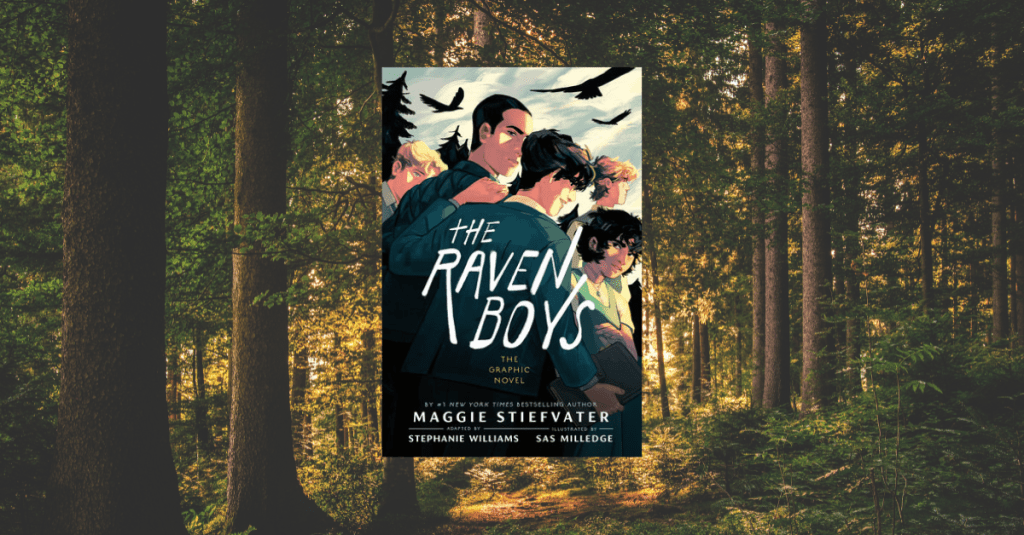
The trees speak Latin. Spirits rise again on ley lines. A long-dead Welsh king sleeps in Henrietta, Virginia. In Maggie Stiefvater’s wonderfully mystical world of The Raven Boys, all of these details—and more—have gripped readers for over a decade. Just this summer, however, the release of a graphic novel adaptation, illustrated by Sas Milledge, has delighted fans anew. As a long-time enthusiast of the series myself, I was enamored by the adaptation, from its gorgeous color palette to the visual realization of characters I’ve long adored. Still, the necessary limitations of the new medium made it harder, ironically, for the characters and their relationships to feel quite as fleshed out as they did in their original form.
At its heart, Stiefvater’s novel The Raven Boys is about a group of friends falling in love with each other on their quest to awaken the Welsh king Glendower. Every moment of the book is informed first and foremost by their relationships: how they laugh together, their clashes as pride and care intersect, their shared accomplishments and setbacks. Though the story is told through multiple perspectives, we primarily follow Blue Sargent, the only non-psychic girl in a household brimming with talented women. Despite Blue’s better judgment, she quickly falls in with a group of “Raven Boys” (students attending Aglionby Academy)—Gansey, Adam, Ronan, and Noah—and accompanies them on their search for Glendower.
The past is directly overlaid with the future; it is outside the box of the current moment but never out of sight.
One arena in which the graphic novel excelled beyond my expectations was its treatment of the story’s few flashbacks, especially in two scenes where characters described past near-death experiences. In each, the current moment is contained within the traditional visual boxes. Meanwhile, the backing expanse is translated into an almost dreamlike visualization of the actual event, with blurred edges and desaturated colors. The past is directly overlaid with the future; it is outside the box of the current moment but never out of sight.
Unfortunately, the format of the graphic novel necessitates cutting down on the novel’s dialogues, diminishing readers’ opportunities to understand the characters’ relationships. Noah and Blue’s relationship, much of which was predicated on marginal lines of dialogue, seemed to fall much flatter in the adaptation. To its credit, the graphic novel does a good job trimming down dialogue overall—there were only a few scenes where the cuts could be felt in the story, and most of the iconic lines were preserved. In one scene, Gansey opens with the line, “What fresh hell is this?” which is transferred to the graphic novel word-for-word. Still, the adaptation misses out on the dialogue tag, “Gansey said pleasantly,” which makes the original line considerably funnier. On a grander scale, the graphic novel misses out on the overall sense of fullness that the original novel benefitted from.
The visuality of the graphic novel only intensifies the story’s connection with its setting, filled with luscious landscapes and decorated bedrooms.
The second great loss of the graphic novel is the lack of narration. Stiefvater’s prose is naturally rich and enveloping, warmly inviting the reader into the novel. The numerous perspectives also gave the reader a peek into the inner workings of each character’s mind, motivations, and insecurities. Where the novel invites us into each character’s body and psyche, the graphic novel asks us to observe from outside, othering us from the beloved characters. Blue’s narration in particular is so full of her own character and specific outlook on the world—her begrudging sensibility, her own conviction in her beliefs, her inner conflict over her involvement with the Raven Boys. While her character still peeks through, aided by the decorations she has on her wall and the dialogue she does vocalize, Milledge isn’t able to fully recreate the spunkiness provided by her inner voice.
Of course, most of these criticisms are limitations of the medium itself rather than a pointed critique of this particular adaptation. As far as graphic novels go, I found it vivid and engaging, a welcome reminder of almost everything I loved about this story. As a novel, The Raven Boys has an overwhelming sense of place: All of the magic and mystery stems from the town of Henrietta and every sublocation within it, from the boys’ residence at Monmouth Manufacturing to Blue’s home at 300 Fox Way to Gansey’s iconic 1973 Camaro. The visuality of the graphic novel only intensifies the story’s connection with its setting, filled with luscious landscapes and decorated bedrooms. A scene where Blue and her mother change a lightbulb becomes an excuse for Milledge to showcase the eclectic architecture of their house, with pots and pans hanging on the walls and crowded bookshelves, all in a soothing palette of reds and blues. Each page is imbued with all the same care and magic as Stiefvater’s writing, wealthy with color and detail. Thanks to Stiefvater’s rich descriptions, too, character and location designs feel not like a revelation but more like remembering, “Oh, of course that’s what she looks like!” With that said, I wouldn’t necessarily recommend this adaptation as a starting point for new readers, but rather as something to be enjoyed as a delightful treat after reading the original novel.
Instead, readers are blessed with two ways to spend time in Henrietta and two ways to fall in love with the story all over again.
For all my criticisms, at no point in my read was I ever in any way upset at the graphic novel’s existence. It may have different strengths and weaknesses than the original material, but that’s the beauty of an adaptation—it doesn’t take anything away from its source. Instead, readers are blessed with two ways to spend time in Henrietta and two ways to fall in love with the story all over again. As a story, The Raven Boys is steeped in both love and magic, no matter how, when, or where it’s told.
MAGGIE STIEFVATER is the #1 New York Times bestselling author of the novels Shiver, Linger, Forever, and Sinner. Her novel The Scorpio Races was named a Michael L. Printz Honor Book by the American Library Association. The first book in The Raven Cycle, The Raven Boys, was a Publishers Weekly Best Book of the Year, and the second book, The Dream Thieves, was an ALA Best Book for Young Adults. She is also an artist and musician. She lives in Virginia with her husband and their two children.
The Raven Boys novel can be purchased here.
The Raven Boys graphic novel can be purchased here.

 Berkeley Fiction Review
Leave a comment