
Mary leung
“He wanted to live perfectly enough to die without creating a ripple of pain behind him, like an Olympic diver knifing splashlessly into the pool. The marvel would be how little the water moved, how the deep seemed to gulp him whole without even opening its mouth.”
— Kaveh Akbar, Martyr!
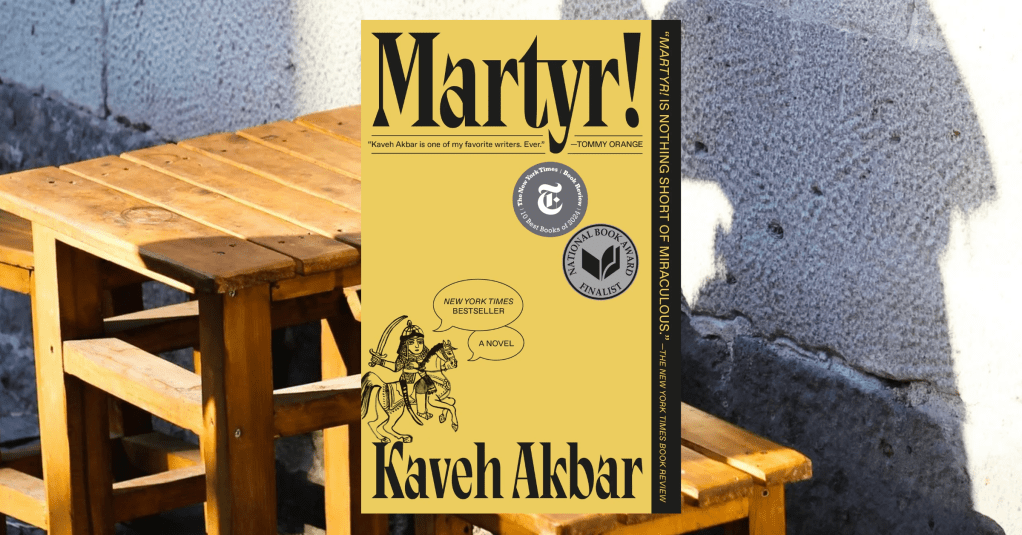
Martyr!, the debut novel by poet Kaveh Akbar, follows Cyrus Shams, a man in his late twenties struggling with a crisis of meaning in his life. Born in Iran, he moved with his father to the United States when he was a baby, not long after his mother’s passing. A US missile cruiser mistakenly shot down the Iranian civilian plane she was on, and his grief over her death contributes to his longstanding depression, setting him on the road to alcoholism and substance abuse.
As Cyrus recovers from addiction, he becomes fixated on the concept of martyrdom. He finds the idea attractive because his greatest fear is dying without having lived a meaningful life, a fate he believes his parents suffered. Confiding in his AA sponsor Gabe, Cyrus tells him: “My mom died for nothing. A rounding error. She had to share her death with three hundred other people. My dad died anonymous after spending decades cleaning chicken shit on some corporate farm. I want my life—my death—to matter more than that.” Although he dreams of dying for a noble cause, he does not want to hurt his loved ones in the process. Aspiring to be like “an Olympic diver knifing splashlessly into the pool,” Cyrus fantasizes about “liv[ing] perfectly enough to die without creating a ripple of pain behind him.” Increasingly obsessed with martyrdom, he travels to New York to interview the dying artist Orkideh, who has turned the last days of her life into an art exhibition. The two develop an intimate bond as they meet daily across a table at the Brooklyn Museum.
Akbar swiftly moves between these different stories without sacrificing their emotional depth and unique insights.
This tender story unfolds with enough levity to balance out the weight of its existential themes. Akbar maintains this delicate balance well by seamlessly transitioning between witty dialogue and philosophical discussions, alongside chapters told from the perspectives of other characters. Cyrus’s veteran uncle Arash has one of the most haunting chapters in the book, detailing his unusual role as an “angel of war,” while Cyrus’s best friend Zee shares amusing college stories that shed light on their complicated relationship. Akbar swiftly moves between these different stories without sacrificing their emotional depth and unique insights.
The most laughable and puzzling scenes in the book are Cyrus’s dream sequences, which come to him during bouts of insomnia. These sequences star everyone from his mother to Lisa Simpson to the Persian poet Rumi. While entertaining, they are often absurd to the point of feeling over-the-top, and their insights on Iranian culture and the transience of life generally lack subtlety. These scenes, which involve Simpson playing the saxophone and Rumi smoking marijuana, make the book’s plot, especially its rather on-the-nose ending, seem even less believable than it already was.
What Martyr! lacks in clarity and believability it makes up for in sincerity.
In trying to be so many things at once—funny and deep, tender and disturbing, fantastical and relatable—Martyr! feels somewhat disorganized. With the central narrative interspersed by poetry, dream sequences, clippings from historical documents, and chapters written from other characters’ perspectives, the book’s structure—or lack thereof—is often difficult to follow. Martyr! still manages to be engaging throughout, but one wonders if it could have explored its themes more effectively with a less experimental structure.
What Martyr! lacks in clarity and believability it makes up for in sincerity. Akbar writes Cyrus as a deeply sympathetic character through whom he explores the heavy themes of grief, sexuality, and the diasporic experience, with immense thought and care. For all its flaws, this funny, inventive, and ambitious debut marks a promising start to Akbar’s career in fiction.
KAVEH AKBAR’s poems appear in The New Yorker, The New York Times, The Paris Review, The Best American Poetry, and elsewhere. He is the author of two poetry collections: Pilgrim Bell and Calling a Wolf a Wolf, in addition to a chapbook, Portrait of the Alcoholic. He is also the editor of The Penguin Book of Spiritual Verse: 110 Poets on the Divine. He lives in Iowa City.
Martyr! can be purchased here.

 Berkeley Fiction Review
Leave a comment