
BY Stella Ho
It’s a hot, humid summer the summer before high school, and I’m back in Guangzhou, a city at once all too familiar and foreign. The perennial hazy sky, green and blue and yellow taxis speeding down the street, laundry airing on balconies. Shops and food stalls fading in and out over the years, just like Cantonese, the vibrant language spoken by locals, are now increasingly replaced with the distant tones of Mandarin.
We arrive in the middle of the night at my grandmother’s place and sleep just for a few hours before joining her on an early morning stroll along the river. Banyan trees line the road, forming a deep green canopy above our heads. Aerial roots dangle from branches and gently sway in the wind—long, thin strands getting tangled up like hair, like all our thoughts and dreams and daily observations.
•
While my parents go out to meet with old friends, my grandmother takes me along to her hair appointment. The salon is small and brightly lit with photographs of striking Asian and European models plastered on the walls. I sit on a couch in the back of the room and pull out a book to read as I wait.
“Look at that girl! Reading in English. You should study hard like her.” A woman sitting on the other end of the couch points to me as she speaks to her son. He looks about seven years old.
I can feel my face growing flushed, butI don’t look up or say anything to indicate that I’ve heard. Sometimes people react strangely if they find out I’m American. They start fawning over me and ask a million questions about America, or they become distant and wary. Like I’ve just pulled a trick on them or something.
After half an hour, my grandmother returns with her hair cropped short, sleek and elegant. She asks if I want to get ice cream. We head to a nearby KFC and order a vanilla sundae with brown sugar, boba, red beans, and mochi toppings to share.
“Don’t tell your parents,” she winks at me. Then, like every summer, she asks me to describe my day-to-day life back in San Jose. What subjects do I like studying the most? What do I do for fun on the weekends? She looks at me intently as I talk. I think she’s trying to reconcile the image of me there with the girl in front of her now.
When we leave, my grandmother takes my hand in hers. It feels smaller than I remembered.
•
“So, how old is she this year?” my grandaunt asks my mother. Even though they’re sitting right next to each other, she has to raise her voice to be heard over the clamor from the other tables around us.
“Fourteen,” my mother shouts back.
It’s loud in here, as all Chinese restaurants are. We wash our plates, bowls, cups, spoons, and chopsticks with hot tea as we wait for the food to arrive. My mother’s aunt and cousins share life updates, and we do the same. Or rather, I doodle in my notebook as the adults talk. No one ever addresses me directly; they probably assume from my quiet demeanor that I can’t understand them. But I’m shy and uncertain in every language, not just Cantonese.
The conversation turns to discussing a neighbor’s daughter who’s moving abroad to study computer science. My grandaunt asks about me: Do I have any thoughts about college? Or my future career?
“It’s still a little early for that…” my mother says.
But I haven’t told her yet, or anyone really, that I’ve actually started to think about filmmaking. I’ve always loved watching movies. Ever since I enrolled in photography as an elective last semester, I’ve become curious about the craft of visual storytelling. How a camera can capture moving images that transcend the limitations of language. It’s like an escape, but it also shows you a kind of truth about the world.
“Evie, what do you think?”
My mother’s voice cuts through my thoughts. I lift my head up. Look around at all my relatives. Teachers, mechanics, accountants. I can’t see how a filmmaker could fit in at this table.
“I’m not sure,” I say.
The conversation moves on. I stare at the open notebook before me. Panels and notes about a boy sitting on one end of the kitchen table with his father on the other end. They’re not speaking. A stack of old newspapers rests between them. A scene, like all my other sketches. Scenes going nowhere.
•
I’m browsing the shelves at the neighborhood stationery store for new pens and notebooks. I test navy ballpoint pens on a notepad and feel a jolt of satisfaction to see my scribble added to the mass of circles and numbers and names already on the page. I was here too.
Two girls walk into the store linking arms. They’re wearing their school uniforms. As I watch them navigate the store with ease and gossip about a celebrity whose name I don’t recognize, I can’t help but wonder what my life would’ve been like if I was raised here instead, if my parents had never immigrated. Maybe in this other life, I would be more confident, more outgoing, more independent.
But deep down, I worry I might be the kind of person who’d be unhappy anywhere.
I make my purchase and start heading back to my grandmother’s place, going past the river on the way. The sun stretches over the surface of the water like a bird’s wingspan. In the late afternoon light, it looks fathomless. Like it could hold all the answers to the universe.
Memories and feelings flash through me, too quick to grasp. It’s getting colder. It’s getting darker. The city tumbles toward autumn, and I know I won’t be here to see it. But there’ll always be other summers.
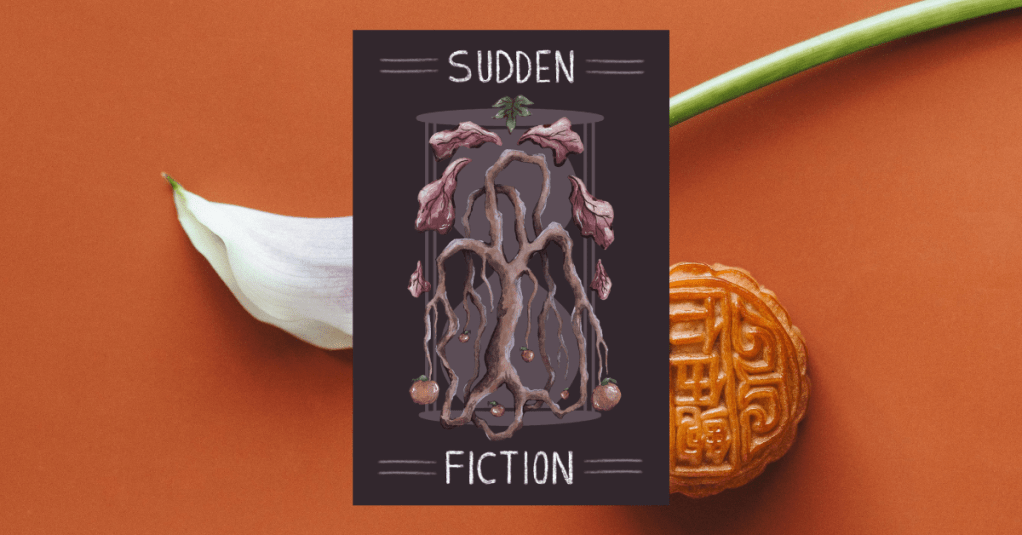
“Variations of Summer” by Stella Ho and the artwork titled appeared in Issue 44 of Berkeley Fiction Review.
Stella Ho (she/her) is a writer from the Bay Area. She writes as a way to experiment with language and explore the unknown. Her work has appeared in Surging Tide.

 Berkeley Fiction Review
Leave a comment