
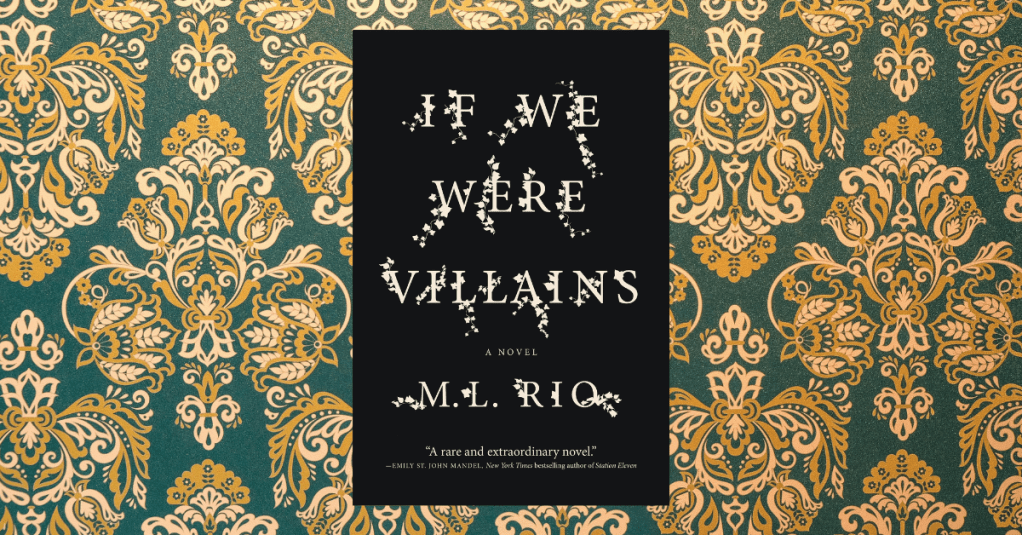
“You can justify anything if you do it poetically enough.”
— If We Were Villains, M. L. Rio
M. L. Rio’s If We Were Villains follows seven fourth-year students majoring in theatre at a small university in Illinois. The book, formatted like a Shakespearean script, is aimed towards an audience of actors: five parts of the novel are labeled as acts, and each chapter is titled with a scene number. Their fall play is set to be Julius Caesar, and the students are typecast in the same roles as they normally are. Though the students are usually content with this expectation, accepting it as inevitable, in the wake of their upcoming graduation, tensions rise. Characters who were previously content with always getting cast in smaller roles feel deprived of a chance in the spotlight, and all eyes turn to Richard, the golden boy who has somehow secured every lead role in the past four years. Richard’s power in the role of Caesar inflates his ego. Mirroring the events of Julius Caesar, his classmates recognize that he has enough strength to physically destroy them, so they formulate a counter attack. In a moment of excitement, the students behave as if they exist within the world of Julius Caesar, and one of their classmates ends up dead.
In a moment of excitement, the students behave as if they exist within the world of Julius Caesar, and one of their classmates ends up dead.
In classic Romeo and Juliet style, overlapping forbidden romantic relations between the inseparable students cause fury to bubble up. Stage kisses breed jealousy from onlookers, and the students are clueless about how to handle it with grace. Staged violence blurs lines between theatre and reality. Regular college romance gets replaced with backstabbing, intense anxiety, and love triangles that result in pools of blood. Nothing feels like a stretch of the imagination, as M. L. Rio has already prepared her readers by setting up their world as frighteningly Shakespearean.
The charm of If We Were Villains lies in its dramatization of mundane life. Failing to be cast in one’s desired role feels insuperable. Two friends up for a lead role are no longer students auditioning for a play but rather exist as two princes fighting for a royal crown. The book pulls struggles for power and revenge plots from plays like Macbeth and Hamlet to establish the stakes of the book. While performing Shakespeare’s plays, the students live as if they star in a tragedy themselves: unimaginable acts become a part of their everyday lives.
The actors devolve into the classic trope of a guilty character in a Shakespearean tragedy: utter insanity. The students craft and uphold a successful series of lies to feed to the university after the accidental murder. Their guilt weighs on them as they venture to lead regular lives. Trust erodes between the peers, and nobody’s stories seem to add up. Like play characters, they grow distant from one another, morphing their lives into intense performances with imaginary audiences. The students quote Shakespeare in casual conversation, applying dramatized quotes to their own situations without questioning why their lives click so well with the lines. They use the parallels between their own lives and Shakespeare’s characters to justify their flaws.
The actors devolve into the classic trope of a guilty character in a Shakespearean tragedy: utter insanity.
The devotion the students have to Shakespeare’s works is intense–so intense that they try to live it. This reflection is subconscious for the students but is vital to the outstanding meaning of the book. The students spend so much time studying Shakespeare, so much time stuck in the theater together, closed off from the outside world, that to them, murder doesn’t seem out of the ordinary. Onstage, they encounter and reenact suicides, murders, and episodes of insanity. They worship the plays they perform, to the point where they are completely thrilled to mimic them. They use them to justify actions that, off of the stage, are utterly intolerable. Obsession–in this case with Shakespeare––has the capacity to corrupt the minds of anyone eager to feed it. I recommend If We Were Villains to the readers who are as obsessed with Shakespeare as the characters in this book.
M.L. Rio has been an actor, a bookseller, an academic, and a music writer. She holds an MA in Shakespeare studies and a PhD in English literature. She is the author of the internationally bestselling novel If We Were Villains, the USA TODAY bestselling novella Graveyard Shift, and Hot Wax. She never stays in one place for long, but keeps her books, records, and four-legged sidekick in south Philadelphia.
If We Were Villains copies can be purchased here.

 Berkeley Fiction Review
Leave a comment