
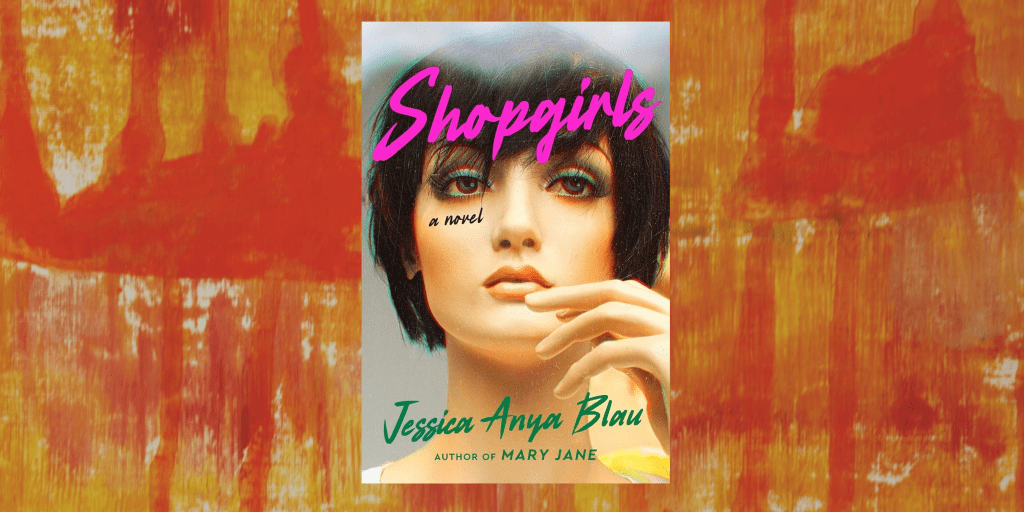
A few months ago, I visited Bloomingdales’ going-out-of-business sale in San Francisco. Remnants of its glory days remained—racks of tights, lacquered checkerboard floors, overly watchful saleswomen—but it was clear that the era of the department store was coming to an end. Jessica Anya Blau, author of Mary Jane, doesn’t want us to forget it, though. In her newest novel, Shopgirls, nineteen-year-old Zippy works at I. Magnin, a renowned department store once situated in San Francisco’s Union Square. Despite living with her best friend Raquel, Zippy feels obligated to help her mom pay the bills, a factor that frequently threatens her beloved (albeit not high-paying) position. When she’s at work and not acting on Raquel’s questionable advice at a bar, a wide array of customers come and go, the most memorable immortalized as paper dolls made by Zippy—a testament to her state of adolescent limbo.
When she’s at work and not acting on Raquel’s questionable advice at a bar, a wide array of customers come and go, the most memorable immortalized as paper dolls made by Zippy—a testament to her state of adolescent limbo.
After my experience walking through Bloomingdale’s as a quasi-abandoned ‘80s time capsule of the city, I was especially excited to immerse myself in a book that illustrates a similar store at its peak and showcases the one-and-done nature of a personalized shopping experience. I appreciate the cast of characters Blau introduces early on that begin to make the setting feel alive: Pablo–the shoe guy, who is always offering to clean Zippy’s flats, Miss Lena–Zippy’s devout coworker who prays for customers, and stereotypical customers such as “Sorority Girl,” whom Zippy envies. My favorite parts of the novel often revolved around the customer vignettes, as I enjoyed witnessing Zippy’s expertise in selecting outfits for a particular event, style, or personality.
Just like the I. Magnin experience itself, Shopgirls covers a lot of ground, traversing a number of departments in Zippy’s life. In just 272 pages, Blau attempts to chart Zippy’s story in the work, friend, and parent departments, while simultaneously setting out to tackle a variety of serious topics, such as eating disorders and the AIDS epidemic. In works of fiction that call back to a particular time period, there is often a fine line between the representation of a sensitive/graphic topic as a tool of awareness and as a set of unsupervised triggers for prospective readers. However, the sheer amount of language and unresolved plot referencing Zippy and Raquel’s “day-on, day-off” eating schedule made it feel more like the latter. It’s undeniable that these topics shaped the ‘80s, and as a young girl working in fashion, it makes sense that Zippy would be influenced by supermodels and diet culture, but perhaps Blau’s approach within a rather short novel is overly ambitious.
In works of fiction that call back to a particular time period, there is often a fine line between the representation of a sensitive/graphic topic as a tool of awareness and as a set of unsupervised triggers for prospective readers. However, the sheer amount of language and unresolved plot referencing Zippy and Raquel’s “day-on, day-off” eating schedule made it feel more like the latter.
Around the halfway point, I found myself waiting for something to happen. In a more nuanced, suburban-centered coming-of-age story, that anticipatory feeling could be written off as purposeful. But here, the eventual “twists” felt like less impactful payoffs. In some ways, Shopgirls evokes a similar coming-of-age experience to that of The Buddha of Suburbia by Hanif Kureishi. Kureishi’s protagonist, seventeen-year-old Karim, lives in ‘70s London with his dubious father. The novel is divided into two parts and covers a lot of ground, but in a way that provides each side character with adequate time for development. Raquel, for example, felt one-dimensional in her plot development despite being a central character and having several interesting details only briefly mentioned. Both Zippy and Karim are at odds with their childish parental figures as they navigate their own set of issues. Kureishi, however, presents Karim’s story with a layered account of immersive collage and a unique set of vibrant, multi-dimensional characters, something Shopgirls ultimately lacks.
In a more nuanced, suburban-centered coming-of-age story, that anticipatory feeling could be written off as purposeful. But here, the eventual “twists” felt like less impactful payoffs
Even in the post-apocalyptic vacancy of Bloomingdale’s, I could picture the store booming with patrons. It was easy to imagine the now-faded and scuffed mannequins as once outfitted by the very clothes Zippy would have been in charge of selling, but Blau’s novel doesn’t immerse readers in I. Magnin’s legendary luxury in the same way as even a desolate store could aid my visual reference. I appreciate the Bay Area name drops and fashion nostalgia, namely Jessica McClintock and Betsey Johnson, but Blau’s attempt to summarize the ‘80s extends far beyond her references. In the present day, it’s evident that the department store, an artifact of the 80s, is on its way out, and despite the nostalgia it may provoke, it’s okay to leave some things in the past.
JESSICA ANYA BLAU’S novels have been featured on The TODAY Show, Good Morning America, CNN, and NPR, and in Cosmo, Vanity Fair, Bust, Time Out, Oprah Summer Reads, Oprah Daily, and other national publications. Jessica’s books have been translated into many languages and have been optioned for film and television. Her short stories and essays have been published in numerous magazines, journals, and anthologies. Jessica sometimes works as a screenwriter, a ghost writer, and has taught writing at Johns Hopkins University, Goucher College, and The Fashion Institute of Technology. Jessica grew up in Southern California and now lives in New York City.
Shopgirls can be purchased here.


 Berkeley Fiction Review
Leave a comment