
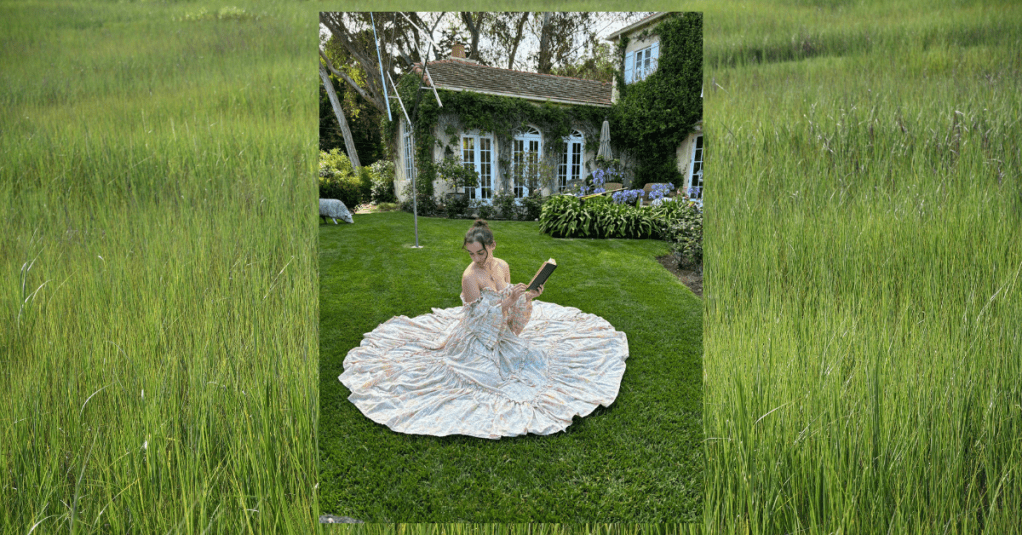
Frank was standing on a rickety chair in the grass, tilting the camera to get the angle just right while Zoe ran through the house to get a book. I lay down in the grass, trying with little success to artfully throw the long skirt of my dress to sit naturally. We were shooting a short film at my grandparents’ house in Santa Barbara: my contribution to the cinematic catalog of Jane Austen. My little movie was an entry into a short film contest hosted by the Jane Austen Society of North America. Because we can’t let the Brits enjoy Jane all by themselves.
I found out about the competition from an English professor last spring and was immediately captivated. As a longtime Jane Austen lover (dare I say a Janeite), I knew that if anything could get my creative juices flowing and motivated to undertake a short film, it would be Jane. I began the process with a Pinterest board, collecting images and ideas that evoke her early 19th century world. Shying away from the big-budget Hollywood adaptations and their period-accurate gowns and manor houses, I tried to cultivate an aesthetic sensibility of my own: a wistful, romantic green space reminiscent of Jane’s aesthetic. I wrote an original screenplay about two young friends torn apart and brought back together again; their only communication was through the writing and sending of letters. The (extremely) short five-minute time constraint proved difficult to work around and I was forced to sacrifice plot beats for an atmospheric, emotional tableau. A beginning, conflict, and resolution were all tightly packaged in a little envelope.
Shying away from the big-budget Hollywood adaptations and their period-accurate gowns and manor houses, I tried to cultivate an aesthetic sensibility of my own: a wistful, romantic green space reminiscent of Jane’s aesthetic.
As my friends-slash-loyal-crew came outside, we realized that if I sat up, my skirt could fan around me perfectly, forming a complete circle. That picturesque princess-like image of me in my mom’s old prom dress perfectly encapsulates the creative project I undertook last summer. I am by no means an expert in filmmaking, even asking Frank to help because of his particular cinematic inclinations, and decided to try my best and make the most out of my available resources. We were filming as my grandfather sat outside and watched us and I wore my mom’s dress with its eighties kitschy floral pattern and very un-Austenian silhouette. I just hoped the long skirt would be enough.
After editing it together and adding the original score that Zoe’s brother composed, I felt proud of my project. I had a vision for a new Austenian world, executed with speed and Frank’s camera mastery. And although my film was one of the finalists, I did not end up placing. The judges cited my film’s “vague attempt to appear Regency,” “somewhat outre costumes,” and “confusing” costuming and setting that “did not look like England: London or the country” as feedback. For a young filmmakers competition, I was frankly surprised that the judges held such high expectations for what amateur filmmaking would look like. Their hope that young people across North America would fly to England in pursuit of winning the small contest and achieving maximum regency accuracy is both absurd and elitist; excluding those making their films with limited or even nonexistent budgets, like I did. In the feedback I received, there is little appreciation for aspirations at even somewhat period accuracy, which for me meant making a homemade wax seal that I found in my grandfather’s office. While I recognize that historical accuracy is important or even essential when the contest centers around an incredibly specific period of history and literature, I hope future judging panels will look more at the spirit of the projects and the love for Jane that shines even in a 1980s dress as opposed to an 1880s one.
If I were to make my film over, or even to enter again, I would first spend time thinking about each of Austen’s six narratives and what stories she is truly telling.
This semester I am taking a class entirely dedicated to Jane Austen. Now having officially read all six of her novels and bits of her juvenilia, I can look back on my film with the benefit of distance and education. My simplistic love story and passing of letters was trite, an Austen for those who have “maybe heard of Pride & Prejudice” but haven’t read it. My version of Austen last year was a picking and choosing of her Romantic aesthetic without any of her bite and pressure on economic systems, class dynamics, or women’s roles.
If I were to make my film over, or even to enter again, I would first spend time thinking about each of Austen’s six narratives and what stories she is truly telling. Yes, all of them have a central marriage plot, but Jane’s protagonists’ inner lives are often much more enticing. Last summer, I wrote my short screenplay attempting to blend Pride & Prejudice’s Elizabeth and the love story at the heart of Persuasion. I wanted a fierce, witty protagonist who could challenge the norms of the world she was living in, matched with a passionately yearning romance through letters. Captain Wentworth’s love letter to Anne Elliot at the end of Persuasion, when he tells her that she has “pierced [his] soul” and that he “is half agony, half hope,” is one of my favorite moments in all of Austen’s canon and one of the most powerfully romantic.
Looking back, I don’t think I achieved the compelling protagonist, both due to the five-minute time constraint and my overwhelming desire to create the Austen aesthetic as opposed to diving into what makes her heroines compelling in the first place.
I encourage anyone even remotely interested in filmmaking or Jane Austen to enter the contest.
Jane Austen’s catalog is a work of singular literary genius, a collection of stories that put women at the forefront in the early 19th century, a period not particularly known for its celebration of women’s rights. I encourage anyone even remotely interested in filmmaking or Jane Austen to enter the contest. It is an opportunity to engage in the art and technique of literary adaptation, bringing the written word into a distinctly visual medium. And even though I got a strange bout of feedback, the judges did accurately pinpoint problems with my project, allowing me to look back with greater clarity and motivating me to strive towards a more honest Austenian vision in the future.

 Berkeley Fiction Review
Leave a comment