
“I am writing all this down in blue ink, so as to remember that all words, not just some, are written in water.”
— Maggie Nelson, Bluets
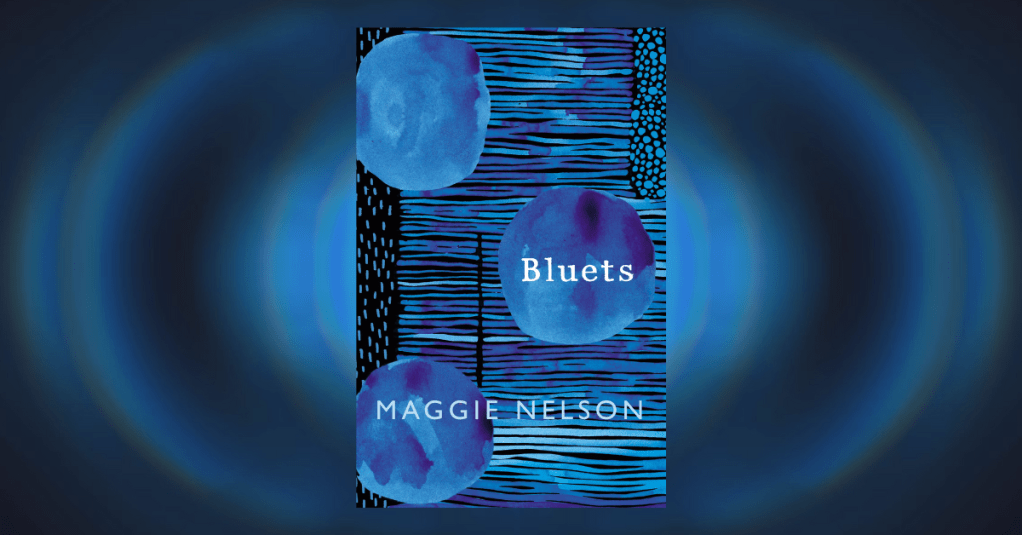
In Bluets, Maggie Nelson describes how she fell in love with the color blue. “It began slowly,” she writes. “An appreciation, an affinity. Then, one day, it became more serious.” She began collecting blue amulets, examining the color in artworks, and studying philosophers similarly obsessed with color. The result of her love affair is Bluets, a genre-bending work halfway between a philosophical tract and a lyric poem.
The book is structured in 240 prose fragments—or what Nelson calls “propositions”—that weave into one another, offering thought-provoking reflections not just on color but on life. Blue essentially becomes a medium for Nelson to contemplate love, longing, grief, pleasure, and pain. Her reflections are both deeply introspective and intellectually ambitious, drawing on writers such as Wittgenstein, Goethe, and Emerson. She often invites readers to think with her, but at times, these references feel sudden and dense. Bluets shines in its more personal moments, particularly Nelson’s reflections on a breakup and her experience caring for a friend after an accident.
Blue essentially becomes a medium for Nelson to contemplate love, longing, grief, pleasure, and pain.
Her reflections on heartbreak produce some of the most poignant lines in the book. She directly addresses her ex-lover—a figure she calls the “prince of blue”—and recounts how they met, slept together at the Chelsea Hotel, and how he then left her. Turning to blue to rationalize her loss, she discovers in an encyclopedia that the eye “make[s] colored forms” out of objects, as colors only result from the reflection, refraction, and transmission of light. In other words, the “systematic illusion of color” arises from our tendency to equate an object’s experiential quality with an intrinsic one. Nelson turns this into a metaphor for human suffering, that is, our inclination to confuse where reality ends and our projections begin. But, as she confesses to her ex-lover, such knowledge offers no real consolation: “Perhaps it is also that of love. But I am not willing to go there—not just yet. I believed in you.”
Nelson also explores grief through her experience taking care of a friend left paraplegic after an accident. Like Goethe and Wittgenstein, who wrote about color in times of crisis, Nelson turns to blue to reflect on mortality and the capriciousness of life: “When I walked into my friend’s hospital room, her eyes were a piercing pale blue and the only part of her body that could move. I was scared. So was she. The blue was beating.” In recovery, her friend describes her grief as “bottomless,” struggling to articulate it beyond a recurring line in her letters: “I continue to suffer.” Nelson ruminates on her words without offering any easy answers. Instead, she reflects on the transience of writing, subtly comparing it to the transience of life itself: “I am writing all this down in blue ink, so as to remember that all words, not just some, are written in water.” If life is fleeting, as she suggests, hopefully suffering is too.
While her references are not arbitrary, their open-ended nature leaves some passages difficult to decipher. Still, Nelson’s writing is lyrical and beautiful, even when she turns to cliches.
Beyond heartbreak and grief, Nelson also meditates on everything from sex to loneliness. Yet, the fragmented nature of her propositions makes her writing hard to follow at times. She moves swiftly from blue in the Bible to blue in pornography, from discussing Van Gogh to Leonard Cohen. While her references are not arbitrary, their open-ended nature leaves some passages difficult to decipher. Still, Nelson’s writing is lyrical and beautiful, even when she turns to cliches. “Perhaps, in time, I will also stop missing you,” she writes. Such sentences can feel lazy when writers hide behind them. Nelson, however, bares herself through them: “This is the dysfunction talking. This is the disease talking. This is how much I miss you talking. This is the deepest blue, talking, talking, always talking to you.” The intensity behind her words makes even her most cliche statements moving.
Above all, Bluets is a work of love. By the end, Nelson returns to this centerpiece, seemingly less bitter toward her ex-lover: “When I met you, a blue rush began. I want you to know, I no longer hold you responsible.” Through her love affair with blue and her meditations on pain, grief, and longing, she arrives at the understanding that love is the most powerful force. She closes with a line from Simone Weil, who writes that love is not consolation, but light. “All right then,” Nelson concludes, “Let me try to rephrase. When I was alive, I aimed to be a student not of longing but of light.”
MAGGIE NELSON is the author of several books of poetry and nonfiction, including Something Bright, Then Holes and Women, the New York School, and Other True Abstractions. She has taught writing and literature at The New School, Wesleyan University, and Pratt Institute of Art, though currently teaches at CalArts.
Bluets can be purchased here.

 Berkeley Fiction Review
Leave a comment