
Spoilers ahead for Elena Ferrante’s Neapolitan Quartet series
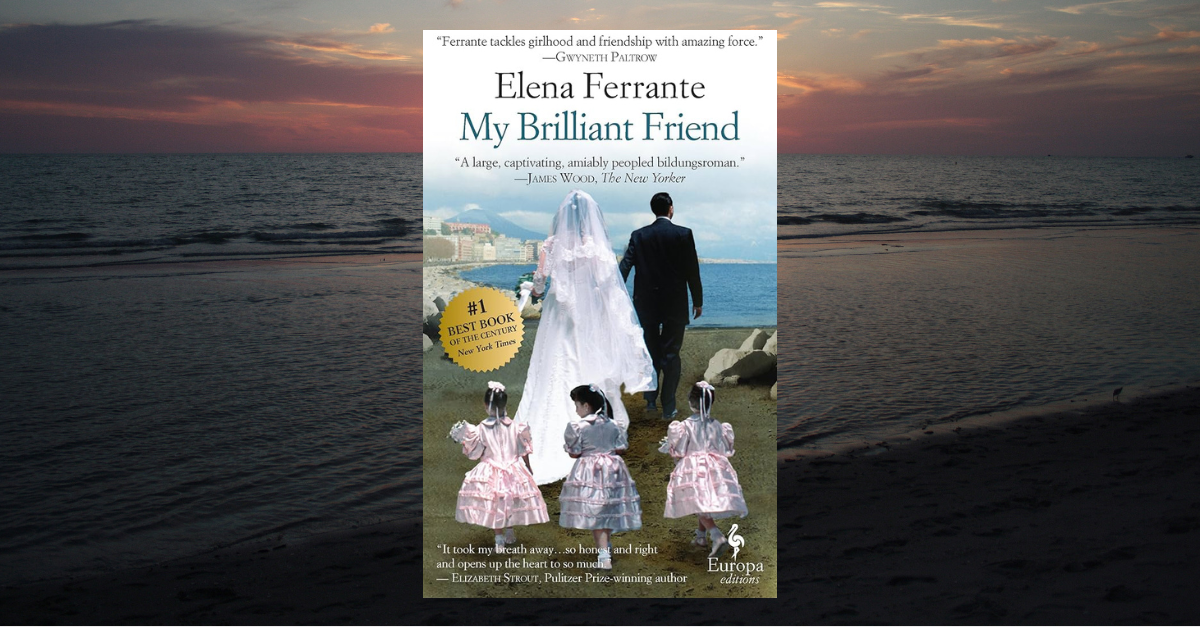
In July of last year, the New York Times ranked Elena Ferrante’s 2011 novel, My Brilliant Friend, as the best book of the 21st century, voted on by over five hundred writers and the Times team. The novel is likened to reading the novel to “riding a bike on gravel: It’s gritty and slippery and nerve-racking, all at the same time” (New York Times). When the article came out, I was well in the middle of the sequel, the second out of Ferrante’s Neapolitan Quartet, four books that miraculously trace the lifetimes of two young women growing up in Naples. I was both shocked and amazed by the ranking, simultaneously unable to fathom how out of ostensibly every book written in the past 25 years, this tale of two young women’s adolescence was the single best. But I was also incredibly proud: having already read the book, I was in on Ferrante’s genius, part of a fan club willing to read anything she’d put to print, someone so wowed by her grip not just on femininity and womanhood but larger themes of political change, socioeconomic dynamics, and growing up.
By now I have read the entire series and followed the lives of Elena and Lila to the end, ready to give this series the retrospective it deserves and try to unpack what makes it the best book of the 21st century (at least, so far).
Thus, Ferrante challenges readers to compare the lives of the friends laid out before us and to try to decipher who lived a better life.
Each book tracks roughly 10 years, while the final novel traverses 30, in the lives of Elena Greco and Lila Cerullo, two women born into similar low-class families in 1950s Naples, Italy. The central arc of the novels relies on the disjunction between Lila’s halted education after elementary school and Elena’s graduation from university, resulting in two drastically different life paths. Lila, whose parents refuse to send her to middle school, ends up working in her father’s shoe factory before getting married at seventeen. In the later books, Lila leaves her husband and opens a computer business before disappearing completely and mysteriously at age 66. Her disappearance acts as a frame narrative that opens the first novel and becomes a haunting shadow over her entire life, as readers get to watch the reasons for such a disappearance pile up over decades. Elena, alternatively, leaves their small neighborhood for University in Pisa, before marrying a young professor and becoming a successful author. Her adult life is derailed by a decades-long affair with her childhood love, Nino, which wrecks everything she had previously established, including her marriage, career, and position in an upper-class society.
After the first novel, much of the two women’s stories are separate, only recounted by Elena in brief moments meeting up with Lila again after years apart. Thus, Ferrante challenges readers to compare the lives of the friends laid out before us and to try to decipher who lived a better life. Through this, Ferrante grapples with what even makes a good life and how the repercussions of decisions can follow us for decades down the road. And yet despite the inherent comparative nature of the novels, neither woman ends up living a substantially better life than the other.
If this seems to be at odds with Elena’s storyline promoting the continued pursuit of education, that is because it is. Ferrante simultaneously asserts that for every opportunity Elena has access to as a result of her education, it is not enough to make her a fundamentally honest or kind individual. Elena’s adult life is permeated by poor, thoughtless decisions and her fall from an educated grace secures no remorse for readers. Ferrante does not even provide a wholly positive perspective on higher education systems either, critiquing academia’s elitism and the facade of total transformation thought to be only attainable through education. Despite the years she committed to the study of Latin in elite university settings, Elena is not transformed as an individual. After her divorce, her ex-husband’s wealthy family who helped get her books published want nothing to do with her, regardless of their previously held distinctions for her.
It is tricky to understand what this depiction of men in the series accomplishes. Are they radically feminist and man-hating or simply revealing the realistic nature of life under an oppressive patriarchy?
Ferrante also supports alternative pathways in life. Lila, who never had a formal education past elementary school, educates herself twofold. First, she is exposed to real-world problems, like wealth inequality and poor working conditions in the factories she worked. Secondly, she remains self-motivated and curious throughout her life, reading books, keeping up with world news, and ultimately learning how to work with the emerging technology of computers before opening her own business. Where Elena is often blind to the injustices happening outside the university, Lila becomes a figurehead for her fellow workers in an uprising against the corrupt factory owner.
Another key facet of the series worth examining is the women’s relationship with men. Ferrante is known for portraying men negatively in her books, and the series is no exception: most of the men in the series are abusive, serial cheaters with little respect for the women they lust after. The fathers in town beat their wives and children, and their sons grow up to do the same, reinforcing a violent cycle of misogyny that is learned, not innate. Throughout their lives, both women have a relationship with Nino Sarratore, the son of the town railway worker slash poet. Nino is somewhat of a constant fixture in the series, a black hole that envelops Elena’s adult life. Adult Elena is overly reliant on Nino, easily neglecting her two young daughters to travel with him. It takes decades before she finally rebuffs him, disillusioned by his countless broken promises and failure to go through with his own divorce even after she finalizes hers.
It is tricky to understand what this depiction of men in the series accomplishes. Are they radically feminist and man-hating or simply revealing the realistic nature of life under an oppressive patriarchy? As a young woman, Lila had her own brief affair with Nino that resulted in an accidental pregnancy. Fortunately, Lila spends most of her life with the single kind man in the series, Enzo. But even their informal years-long companionship comes to an end when they reach their sixties. That neither Elena nor Lila have positive, healthy romantic relationships keeps the central focus of the series on the shoulders of their friendship above all else.
All that remains is Lila’s looming disappearance, the rationale behind which becomes clear in the final moments of the last book. I’ll leave that one up to new readers to discover on their own.
By the end of the series, the young girls have grown up, and even their children have become adults. The shining moments of youth are long gone in favor of a painful, difficult adulthood. All that remains is Lila’s looming disappearance, the rationale behind which becomes clear in the final moments of the last book. I’ll leave that one up to new readers to discover on their own. Ultimately, the Neapolitan Quartet reveals itself to be scathing, emotional, and beautiful, ebbing and flowing consistently throughout over sixty years of life. Where I once related to their experiences as young twenty-year-olds in the second book, the women now resemble an older generation, their lives blurred past in the speed at which I devoured the books. Wholeheartedly, My Brilliant Friend deserves its ranking by the New York Times, but the first novel itself does not and cannot stand alone. Following their childhood and adolescence is an entire journey of self-discovery only accessed by later periods in life. The series forces us to reflect on our own lives and ask ourselves if the decisions we’ve made and the people we’ve loved bring us joy and happiness in our lives.

Leave a Reply