
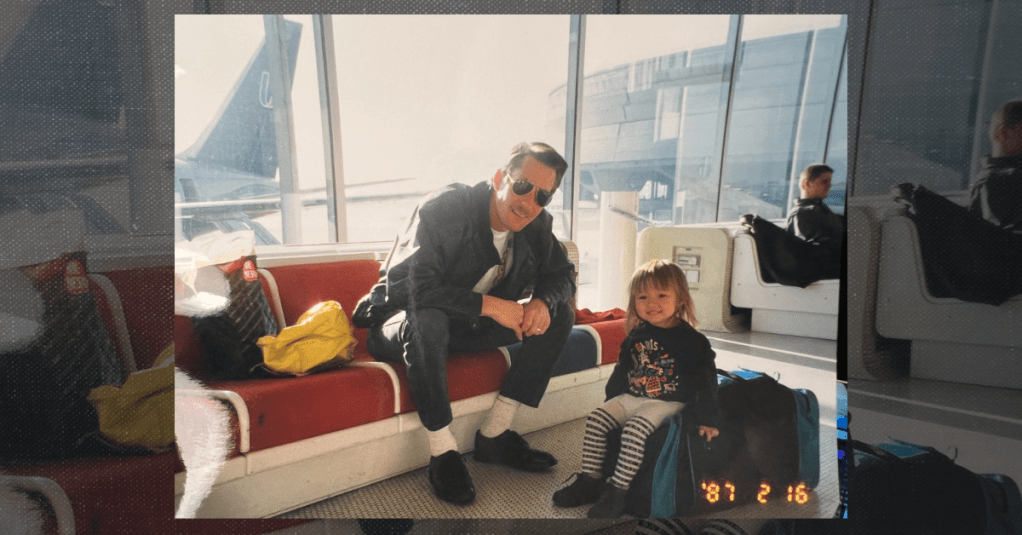
When I lost my father last February, I didn’t cry for three days. And yet, the first thing I wanted to do was write about it for an audience, only I didn’t have anything to share besides my sudden fixation with death. There existed no inspirational triumph or didactic moral for me to bequeath upon my readership.
So, I waited.
Exactly a year later, my bearing blindness remains largely untransformed. Death is as much of an elusive quandary now as it was to me when I first encountered it. All I have are stories of the places I went, not where I stayed, and I still don’t know where I’m headed. Grief is the burden of a journey without end. Today’s guilt might froth into tomorrow’s anger. And just when I think I’ve finally reached the harbor of peace, I find myself drifting right back where I started. Death is one of those things that molds you without letting you mold it back—or squish it down into what feels like meaning. But I’m learning that maybe it’s okay not to have it all figured out before writing about it. So, here. This is me writing about it, about the things I did at the places I went to grieve the death of my father.
I was his only living next-of-kin.
Something about the role into which I was abruptly thrust as a twenty-something-year-old engendered a hyperawareness of what kind of reaction people were expecting from me. Last February, my father was a life-long high-functioning alcoholic entering the final stages of the disease. I knew his sickness would take him within the next couple years or so—and I wanted it to. Or I thought I did. From mini strokes to falls that would land him in the hospital, I lived in horror of receiving the call that his next fall would be his last. I couldn’t bear to watch him wilt. I just didn’t think it would happen four days after my birthday and one month after reconciling with him, and I certainly didn’t expect it to hurt as bad as it did. He was finally free. But my punishment had just begun.
He was finally free. But my punishment had just begun.
As a writer, you don’t wear your heart on your sleeve—you wear it inside your head. And if I’m going to show you how I feel, I need to first run the story by myself over and over, seeing to it that I’ve made sense of the rawness before I can reveal it to the public. From deciding whether to cremate or bury his remains to cleaning out his house and finalizing an ongoing court case with the state, the people around me made it a point to remind me of what your father would’ve wanted.
His mother’s story was that my dad promised to pay her back the $12,000 she let him borrow to pay his rent, meaning I’d have to pursue his ongoing case to honor your father. It’s what he would’ve wanted. His sister’s story was that my dad’s outbursts toward me, a symptom of his late-stage alcoholism-induced personality changes toward the end of his life, were catalyzed by resemblance to my mother, his ex-wife. You triggered your father. And although my dad and I held hour-long conversations in the past about how we’d both want to be cremated without a funeral, his family reminded me how your father would’ve wanted to be buried, and he would’ve wanted a funeral more than anything. You didn’t know him the way we did because your mother kept you from him. We know your father.
Before I knew it, everyone seemed to have their own stories of how to reanimate my dead dad into the version that would provide them with the type of closure that could put their grief to rest. And with my dad having no way to vocalize neither rectification nor direction, I found myself spinning my own stories to resurrect the man who raised me, abandoned me, loved on me, changed before my eyes, and then left me to face the rest of my forever without him.
However, my stories weren’t about envisaging how he would’ve wanted me to handle his postmortem rites, as that would’ve implicated a willingness on my part to put him to rest. I didn’t want my dad dead—I wanted him alive, even if all I could think of was death and the immense guilt I felt in orchestrating his. I was convinced that it was me who killed my dad.
I was convinced that it was me who killed my dad.
The first story I wrote after he died detailed how I imagined the final moments he spent on his emerald boucle couch before his housemate found him sideways and heavy. My father had been trying to contact me for days since my birthday, and when he passed, he had triple texted me without ever hearing back. I even let his call go to voicemail on my birthday because I was busy getting ready to take pictures with my friend. The last thing I messaged him was “Hellooooo may I call you tonight?” to which he responded, “Of course, sweetheart. You never have to ask to call your father.” That was two days after my birthday.
I never did get around to calling him back.
But what if I had? What if I’d traveled the 40 minutes to see him in Santa Cruz and spend the weekend with him? I could’ve saved him. I could’ve stopped him from mixing the benzos with the opioids with the alcohol. Or, even better, what if I’d worked harder and had the money to put him through rehab? What if I’d simply bitten the bullet of debt? What if, what if, what if…
So, I wrote about it. In my story, I painted my dad alive and reclined in the cornflower corduroy La-Z-Boy we’ve had since before I was born, the one that was passed down to him by his grandfather. He was trying to get a hold of me through the wetness of addict-loneliness and cold Budweiser. Sometimes he’d sneak a sip of the gin he’d hid behind his recliner, a new habit he’d picked up during the pandemic, I was sure. I made sure that in this story, he called me and called me and called me and calledmeandcalledmeANDCALLEDME—
—and that I remained unreachable—that I was his final thought before he passed, that his soul would remain restless as he waited for me to call back—
and that’s where I left it. Somewhere along the way, his housemate was supposed to find his body before calling the paramedics, but I didn’t care for that part because, like I said, putting my dad to rest wasn’t something that interested me at the time.
The next short story I began to write was titled “I Killed My Dad.” You can see where this is going. Reliving my dad’s final moments on earth became a way to punish myself for my inability to save him.
When I write, I joke that my best work materializes from anger and unrest. But now I was vacillating someplace between shock, anger—toward myself and my father—and guilt. It was as though I’d been initiated into an exclusive club that I never asked to join and was banned from meeting the members. The call I received from my dad’s number two days after he died made matters worse. I picked up, half expecting to hear his voice. After all, you hear stories of the dead contacting loved ones from the other side or even waking in the morgue. However, the voice that sputtered through the line was thick and groggy, not the sharp timbre of my father’s.
“Huh, funny,” it glugged. “You never called when your dad was alive, but now that he’s dead, you do?… You fucking piece of shit.”
Then it hung up.
It was the housemate who found my father’s body and kept his phone before the police could get a hold of it.
And, so, more stories spun themselves to life—or death—along the outline of my father’s wrath toward me. I stopped writing on paper. Instead, I etched these stories into my skull and the backs of my eyelids.
They bled into my dreams, haunting me with the shapes and shadows of a brooding, sometimes belligerent, mute who didn’t recognize me. I screamed and cried and pleaded with him to forgive me for failing to save him, but he didn’t seem to remember who I was.
And, so, more stories spun themselves to life—or death—along the outline of my father’s wrath toward me.
At least he was alive in these visits. An angry dad was a living, throbbing, churning dad. I think deep down I knew that if I let him forgive me, these dreams would come to an end.
So rotten did my guilt fester by the second week after his passing that I found myself pushing sleep until five in the morning reading on my phone story after story of the afterlife. I’d never been one to put much stock in the spiritual, but it became a new type of story I fixated on to keep alive the stories about my dad—did he love me? Miss me? Was he upset with me? Maybe once someone dies, their struggle is over. And, yet, it feels like their will is still there. We can feel it, no? It’s unmistakable. I wanted to contact a medium. Eventually, my therapist suggested that if I was that curious, it wouldn’t hurt to spend $60 to hear a story that might give me closure whether it was real or made-up.
I found my medium on Reddit. I know, I know—absurd. I had no post history, however, so I figured it would work in my defense if this woo-woo proved to be real. My medium instructed me to provide her with no information. No names, no relationship, and no cause of death, which at the time I didn’t know as his autopsy was ongoing. The medium typed up a string of song lyrics, one mentioning the name Bob, to confirm if she had come into contact with the right spirit. Spooky. My late grandfather’s name was Robert with my dad a junior, so the former went by Bob, while my dad went by Bobby as a kid. Bob was a common name, however, so this could’ve been a fluke for all I knew.
“Does this strike you as a familiar name?” she asked in the chat.
I typed yes.
Then she began asking specific questions. First, she asked if the person I was trying to contact had outbursts of anger. I said yes. My father, once the goofball, had become an angry man by the time he passed away. Next, she asked me whether this person experienced patchy memory toward the end of their life. He’d fallen over 20 times that year from blood pressure issues related to decades of alcohol and opioid abuse. I didn’t tell her this, of course. I simply typed yes.
“Okay. I’m getting a lot of shame from this person… He’s saying he put a lot of pressure on your shoulders with his outbursts. He wants you to know that he’s not angry with you because he would’ve done the same.”
How did she know?
I spent the next five minutes typing then erasing words from the chat box. In the end, I settled on: “Wow, thanks… That’s good to know.”
Was this actually good news? Did this mean I’d no longer see him in my dreams upset with me?
I requested the medium to ask my dad if it hurt when he died. The coroner’s office had notified me of an enlarged heart, a busted artery, and fluid in his lungs.
“No,” she typed. “He’s pointing to his chest… there was…pain in his chest. Maybe a blocked artery? He says not to worry because it only hurt for a second.”
The remainder of the conversation included her passing on messages to my dad and reminding me of details of my childhood I’d long forgotten. My dad’s clunky black police radio that he’d stolen to eavesdrop on local crime, the antique wooden clock on my dad’s dresser growing up, and his jewelry locked inside the mother-of-pearl box from Japan. She told me to keep an eye out for ladybugs and bluejays, critters I hadn’t seen in years, as signs of my dad’s presence. While ladybugs held no significance for me other than creeping me out, bluejays were my dad’s favorite bird when he took me camping as a child.
It could’ve been that I’d never paid attention to them until my conversation with the medium because a few days later, an unusually large ladybug landed on the passenger-side window as my best friend drove me to the funeral home. Then, in the following weeks, I began to spot in the trees multiple bluejays a day during my walks. Mind you, I don’t even like birds.
I think some part of me was expecting what the medium told me to put a stopper to my drifting vacillation between guilt, anger, despair, and momentary peace.
But that’s the point. I can’t tell you whether my experiences with the dead happened in my head or outside of it. What I can tell you, though, is that they were real, but only as sojourns. I think some part of me was expecting what the medium told me to put a stopper to my drifting vacillation between guilt, anger, despair, and momentary peace. I wanted the medium to end my journey and take me to my destination.
Over time, I grew to forgive myself for letting my dad die. Or perhaps it’s that the benefits to the alternative to death—surviving—would have outweighed the drawbacks. Had my father survived his disease, he would’ve had to endure the worst of end-stage alcoholism, from brain damage to dementia to kidney and liver failure. My dad was lucky to have died the way he did.
Today, I finally mustered the nerve to call the coroner’s office to request his death certificate. I feared that hearing the results of his autopsy would kick my story off-kilter. Had it not been substance related, had it been something else entirely, the story I’d spent months crafting would no longer stand.
I think I’ve arrived at a place where it doesn’t matter anymore. After all, mapping your way through grief isn’t about writing a fixed destination but instead the places you visit along the way.
“Cause of death…” started the coroner. “Accident.”

 Berkeley Fiction Review
Leave a comment