
By Peter Hong
Golgori was our god, and for as long as we could recall, we had been under his dominion.
He was a proud god, a commanding god, and for millennia, we had lived each day under his guiding word. As we woke, he would write us his instructions into the sky above, and we would rise and work faithful to the night following his every sentence. Day by day, we rose and slept, breathed and died, worked and worked by his word. Each century went by the same as the last: his command, waking the morning skies of each and every generation.
Then one day, we woke and looked to the sky, and found his word written in the clouds: giant letters spelling out an enormous “WHOOPS.”
We were dumbstruck. None of us knew what this “WHOOPS” could refer to. For thousands and thousands of years, we’d been living and dying by his words, and there’d been no precedent of anything like this before.
Without an answer, each of us came to our own theories. Some of us believed he’d made some deep mistake back in creation. Others feared that he had regretted creating us. And millions more found some other factor to blame: the immorality of our souls, the new generation, the realities of our time.
Whoever we were, whatever we thought, we all refrained from our work that day. We had no instructions to follow, no idea what to work on. It was a deeply unsettling experience. None of us had ever known a day without instruction. We went to bed at our own time that night and were nearly sleepless.
The next day we woke, and we looked again to the sky. New words had been written: “I AM SO, SO SORRY.”
We were more dumbfounded than ever. Some reaffirmed their own theories, others frantically wrote new ones. Many of us wondered if we might never receive an instruction ever again. Those five words loomed over the world, casting their letter-shaped shadows over everything.
As another day went by without instruction, anxiety boiled in us. To fill the day, some of us looked for our own ventures, finding our own duties to work on or even searching for something beyond work. And whatever we did, we all scolded one another—fearing we’d each violated some holy command none of us had received.
That night, we all went quick to sleep, hoping that the words would return tomorrow, and all this uncertainty might die with the night.
On the third day, we woke and looked up. We saw those same five words, “I AM SO, SO SORRY” written in the sky. But underneath those words, a new sentence had appeared: “WILL YOU FORGIVE ME?”
Now, we were faced with a question. It was a question we did not know the meaning of, a question we had no idea how to answer.
But we had to answer it. That day, all of us gathered into one place to determine what we should do. For hours, we debated, discussed, and argued with one another. Finally, when night had struck, we’d all managed to agree on one response, and went home to rest in preparation for the next day.
On the fourth day, we woke, and the words Golgori had given us on the third day remained there in the heavens, unchanged.
We got to work immediately. We gathered up our old things, our forgotten tools, our broken charms, our torn clothing, and put them into one pile. With all our hands in motion, we fashioned the objects into fireworks. Then we struck up our matches, and fed the flames to their fuses. All eyes watched sharp as needles as the fire nibbled up the lines bit by bit, bite by bite. And then, with a sizzle, each firework erupted into the sky—flailing, fizzing up into dizzy trails of light—spitting, then bursting into sparks shining every color—spelling “WE FORGIVE YOU” next to his holy word.
Then we waited. We waited late into the night. We sat outside in the dark for a response that might come at any time, or we went back home to sleep, hoping that an answer would arrive in the clouds by morning. We watched as each of our sparks burned themselves back into smoke, and were carried away by the wind. Each star in the sky was like a memory, tracing out the words we’d spelled there hours ago.
The night passed.
On the final day, we woke. We looked up. There were no more words in the sky. There were only clouds, unbroken and blank.
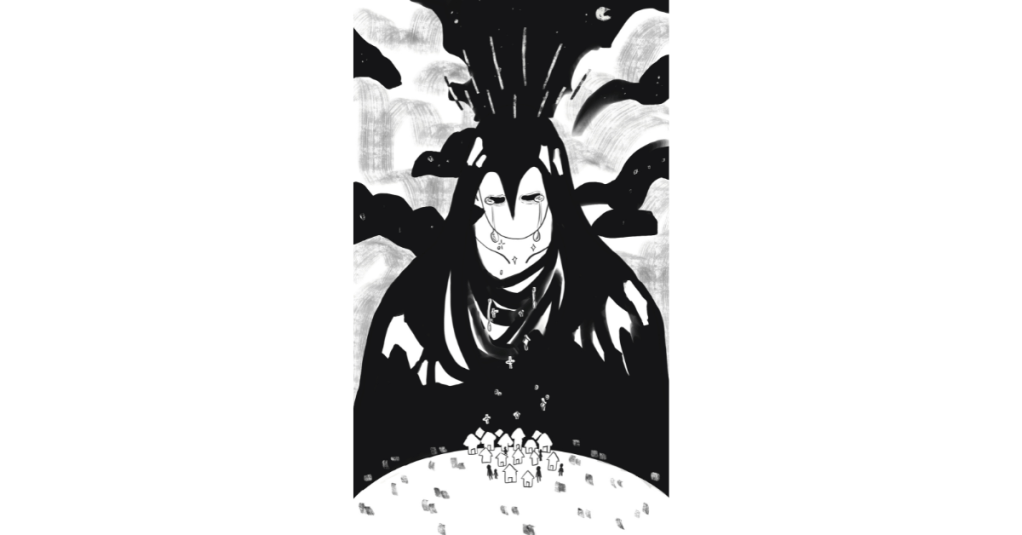
We were speechless. We trembled in our homes. We knitted together in fear. Just then, the clouds shook. And we saw them. Millions of tiny “thank-yous” rained down from heaven. Blanketing the entire world. Washing over the earth. Burying us under their shimmering, gorgeous weight.
“Golgori” by Peter Hong and the artwork titled Forgiveness by Cadence Chen appeared in Issue 44 of Berkeley Fiction Review.
Peter Hong is an emerging Korean-American writer and student from Los Angeles, California. He writes both poetry and prose, and his pieces explore how language can not only reflect, but construct reality.
Cadence Chen is a current UC Berkeley undergraduate studying English. With a lifelong interest in literature and the arts, she thought this would be a fun opportunity.

 Berkeley Fiction Review
Leave a comment