
“He and his brother both wanted their lives to consist of winning all the time and never losing: this is presumably true of everyone. No one ever wants to lose.”
— Sally Rooney, Intermezzo
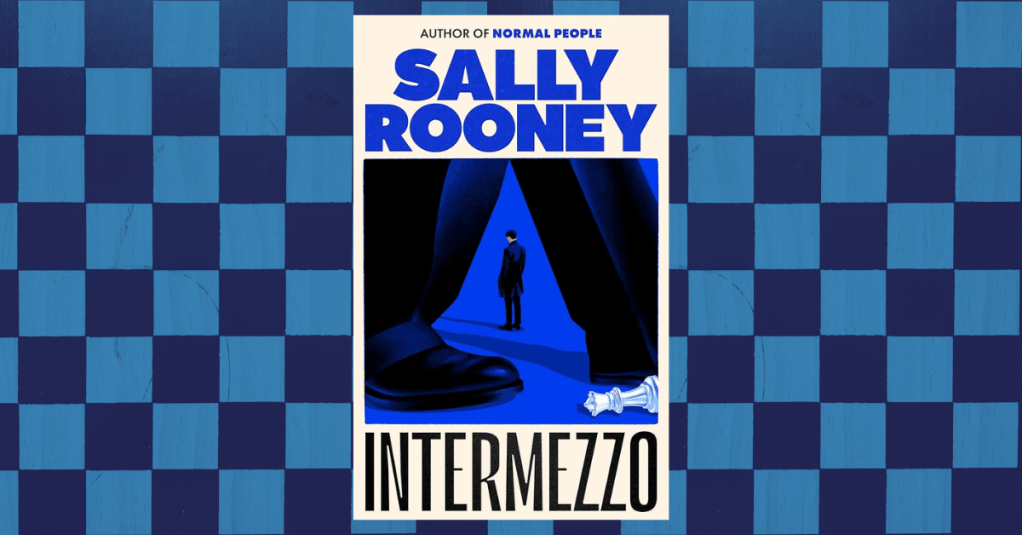
The book follows two wildly opposite brothers after the death of their father. Ivan is a twenty-two-year-old chess player, who feels his career peaked years ago, and has fallen in love with the much older Margaret. Peter, 10 years older than his brother, is a successful lawyer juggling stagnation in his life and romantic entanglements with two women at once: his first love, Sylvia, and the young Naomi. As is standard in Rooney’s novels, miscommunications routinely derail the characters, driving a wedge further between the brothers. They have contrasting financial situations, live in distinct areas of Ireland, grieve in dissimilar ways, and think about life contrarily. Yet, they judge each other most on a feature they each observe in themselves: unhealthy dynamics with the women in their lives.
Both brothers feel isolated in their mourning, and fall into parallel age gap relationships. Ivan’s sanctuary is the stability of the older Margaret. He fears that he is washed up and infantile all at once. He treasures Margaret’s approval; she is an established, successful, divorced woman. In Ivan’s guideless twenties, being loved by someone so mature validates his own maturity. Rooney juxtaposes their relationship with Peter and Naomi, where it is her responsibility to keep him young. As a lawyer, Peter often finds himself in ruts at work, surrounded by gravitas and suits, and Naomi allows him to keep a toe dipped in his youth. The flipped parallels between the brothers’ love lives mirrors their own most prominent flaws and insecurities. Perhaps, instead of off-kilter relationships, what the brothers should prioritize is their sibling bond.
The flipped parallels between the brothers’ love lives mirrors their own most prominent flaws and insecurities.
Though they endure mirrored hardships, they detach further as the book progresses. Peter and Ivan—like most of Rooney’s book characters—are riddled with flaws that make them complex and relatable. While they both, for the most part, have sincere intentions, they cannot seem to understand one another. They are too wrapped up in their exterior differences in lifestyle to dig for emotional similarities. Despite going to dinners and meetings with the hopes of reconciliation, Peter and Ivan always leave hurt and confused.
Rooney’s miscommunication trope manifests uniquely in Intermezzo compared to her previous books, as this novel focuses on a familial dynamic rather than a romantic one. I felt moved by how similar the two were at heart, and by their stubborn refusal to look past one another’s opposing shells. Though they would both likely deny it, Peter and Ivan suffer from the same variety of pride. They each want to appear successful and put together to the other; they each fear being labeled the lesser brother. Their imbalanced power dynamics—due to Peter’s success and wealth and Ivan’s freedom and potential—escalate to violence. The two could complete one another, as both Peter and Ivan crave a friendship with their brother. But insecurity and assumptions dominate both of their minds, stifling their relationship before it can blossom.
Rooney’s miscommunication trope manifests uniquely in Intermezzo compared to her previous books, as this novel focuses on a familial dynamic rather than a romantic one.
The captivating quality of Sally Rooney’s books lie in her characters: raw, flawed, ambivalent, and in many ways relatable. Her tendency to craft emotionally complex characters drives her books. Some might argue that ‘nothing happens’ in Rooney’s character focused pieces, but I would argue that that is the root of their appeal, and the crux of Peter and Ivan’s story. She writes about normal people, for normal people. Readers, irritated and enthralled, witness the clashing brothers endeavors towards a more harmonious future.
SALLY ROONEY was born in the west of Ireland in 1991. Her work has appeared in The New Yorker, The New York Times, Granta and The London Review of Books. In 2019, she was named to the inaugural Time 100 Next list, the award-winning author of Normal People, Conversations with Friends, and Beautiful World, Where Are You.
Intermezzo can be purchased here.


 Berkeley Fiction Review
Leave a comment