On his deathbed, my boyfriend started writing a dissertation. Something about dark matter and complex equations and the fate of the universe. “This is all I have left to give,” was his response to my query about a will.
It’s not that I wanted his belongings. Most of his possessions were textbooks, and his most prized ones were me and a telescope. I suppose I wanted him to do normal dying people activities for my sake. In the sterile white room, I found him more alive than ever, radiating golden passion as he scoured over his draft.
A week before he was transferred to the ICU, I asked if he remembered our Costa Rica trip. He laughed, and the sound was too brittle, like it sucked the air out of him to even try. “How could I forget?” He wheezed, and I rubbed his back. “We had our biggest argument.” He died thinking that I was angry over his reluctance to dine at a restaurant the concierge had suggested. It was actually due to the beach, when I watched him watch the Pacific. How he looked at it with a reverence that he usually reserved for me. I can imagine how absurd that sounds, being jealous of the ocean.
What upset me was how I would never be a mystery he could uncover, dissect, or absorb. I was not a nebulous as the knowledge he was so hellbent on acquiring. What scared me was how content he was by himself. I screamed at him. Asked him why he even bothered to have me around. “You could die alone with a smile on your face,” I sobbed. A rather poor choice of words on my part, since a few weeks later, it was revealed that his body was on a mission to destroy itself.
Yet we had always been a very pleasant, well- to-do couple. He was brilliant in his field, and I never interfered. He spent hours in our spare room, his makeshift laboratory. The rest was with me. At night, he’d trace constellations on my spine. Cassiopeia and Hydra and Leo. Sometimes, I’d kiss the scars his father left behind. On his ribcage and left clavicle and lower back.
He didn’t talk about his family at all, and my family talked too much. My boyfriend didn’t study for money. I think that he unnerved people. “You sure he’snot the type to kill you someday?” my mother once questioned. I requested that she elaborate. “He’s too spacey,” was her warning, and naively, I thought this was a pun about his career.
Eventually, his hands were too shaky to type his work, and he requested that I do the job. As he recited his studies, I recalled how I was jealous of the way he spoke when I first met him. His words were full of soft intellect, and sometimes, I tried to mimic it, throwing in a word like nucleosynthesis to surprise people. The tone was only compelling on his tongue.
I understand yearning for the secrets of our world, but that was all my boyfriend knew. On one of our first dates, he confessed that physics and chemistry and whatever else he mastered had become his coping mechanism from a young age. “I could always get lost in science,” he murmured. I wondered if he’d say some cliché line about getting lost in my eyes. He didn’t, but he did kiss me, and it felt natural, the whole thing.
My boyfriend and I debated on trivial matters, but when it came to big-picture stuff—God and all that— we kept our mouths shut. His views never strayed from hardcore evidence, and mine could change depending on my mood. I was technically raised a Lutheran, but my family never cared too much. My boyfriend used to say I was the closest thing he had to faith. How he never knew kind touch before he met me, and I offered salvation.
Still, he was dying, and I was worried that if there was something truly out there, a force that could reunite us, that chance could not occur due to his stubbornness. I attempted a subtle indoctrination, reciting stories from holy books without saying they were from holy books.
He understood the nature of my actions too quickly and found it quite funny. “It’s a little too late to convert, I think.”
“You don’t need to convert.” Angry tears welled in my eyes. “You don’t need to identify with any one belief. Just believe in something.”
“You know I can’t lie to you.” My boyfriend relaxed on his deathbed, then took notice of my crumpled face. He frowned.
“Why can’t you believe we’ll meet again?” I asked childishly. I turned away. I had never been as composed as him. “It can’t end here.”
My boyfriend laughed. Laughed and laughed and laughed until it came out as broken sobs, rattling against his bones. “I do believe in something,” he said, and he looked at me like he wanted to hold me. He looked like he finally understood what it meant, to die, and the last thing he wanted to be was alone. I realized that it was foolish to ever compare the paper in his hand to our intertwined palms. “I believe we found each other.”
In my boyfriend’s unfinished dissertation, there is a section about the universe’s method of recycling. How, when our loyal sun inevitably explodes, the matter that constituted every living thing on Earth will be expelled into the cosmos. And though consciousness faded, the energy will remain, perhaps drifting to construct another planet, another galaxy, another universe. I imagine two golden lights colliding. I have no evidence to back this up.
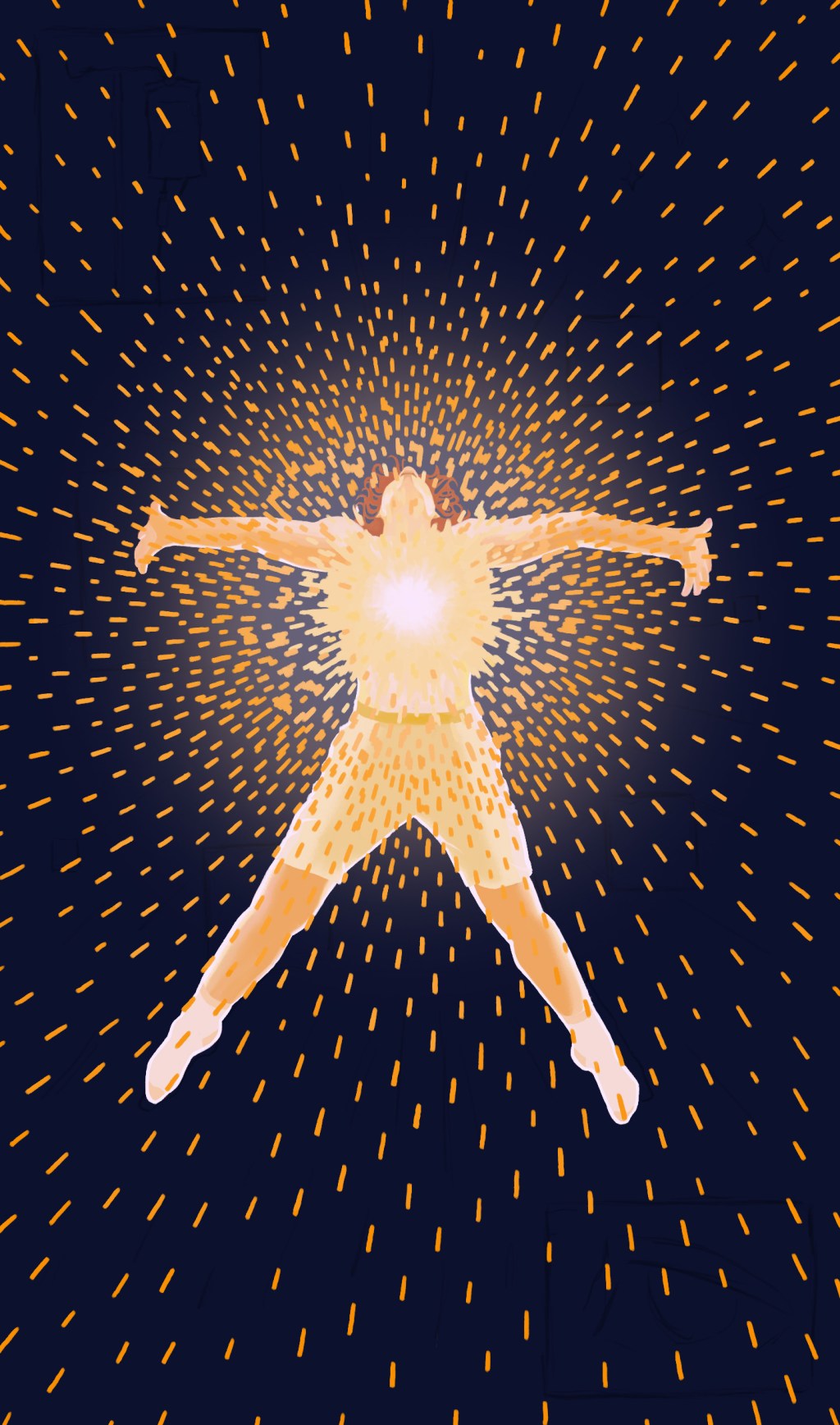
“Recycling” by Ruhabi Chhabra and the artwork titled All I Have Left to Give by Cecil Dean appeared in Issue 44 of Berkeley Fiction Review.
Ruhani Chhabra has been writing since her early childhood and has dabbled in poetry, short fiction, and journalism. She posts her work on her TikTok, @piecesbythestars, to over 15.6k followers, which inspired her to publish her poetry compilation Pieces by the Stars in 2022. Currently, she is a staff writer for the Daily Cal and an editor for the Berkeley Fiction Review.
Cecil Dean is an undergraduate student at UC Berkeley studying Comparative Literature and German. His work is also available online (@sprawlten on Instagram) and in The Daily Californian, where he works as the Editorial Illustrator. In his free time, you can find him reading, drawing, and drinking too much Irish breakfast tea.

 Berkeley Fiction Review
Leave a comment