
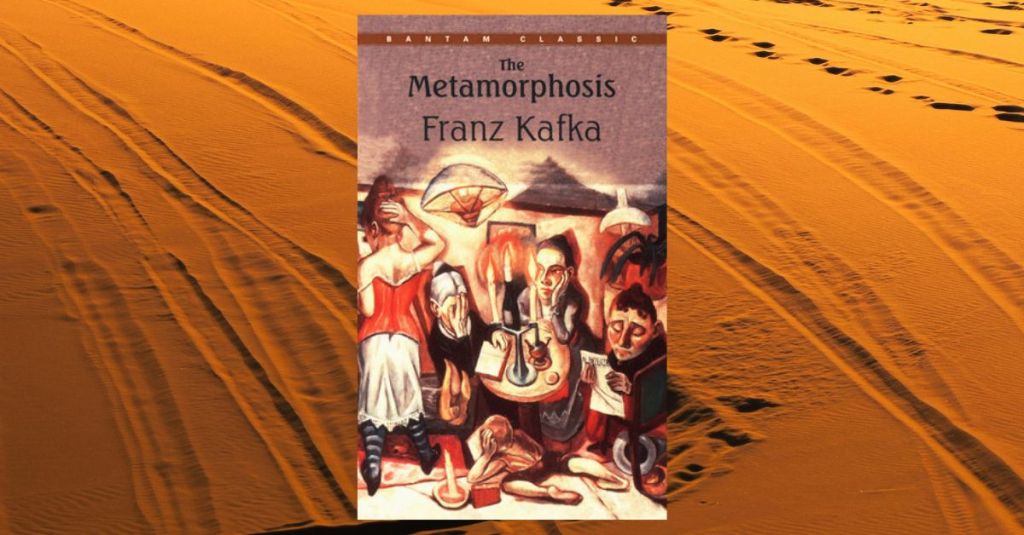
Franz Kafka’s The Metamorphosis follows the grim life of Gregor Samsa, a traveling salesman who bears the sole responsibility of supporting his family. He awakens one morning to find that he has transformed into a giant insect, and although insistent on going about business as usual—annoyed that he’s missed the morning train more than anything—his boss and family see things differently.
Horrified by his appearance, the Samsas lock Gregor in his bedroom and make every effort to tolerate his existence. Forced to take on jobs themselves after his transformation, the family’s tolerance soon turns to seething hatred as they grow desperate to get rid of the insect living among them—a vermin that could never truly have been Gregor. Starving, battered, and heartbroken, Gregor dies in his bedroom, and the Samsas celebrate by vowing to start anew.
When Gregor wakes up to find he has transformed, these true feelings are revealed, represented by Gregor’s insect form.
This novella has been the subject of intense academic analysis for decades, with critics particularly interested in the deeper meaning behind Gregor’s metamorphosis. Popular interpretations view the transformation as either a punishment for his blind obedience to family and work, or as an extended metaphor for psychological issues and their impact on the human psyche. While these interpretations are compelling, they often cast Gregor as the culprit, framing his transformation as a fatal consequence of some sin he’s committed against his family or himself.
Alternatively, Gregor’s metamorphosis might not signify a sudden misfortune, but rather serve as a physical manifestation of an identity that had long been suppressed.
For his entire life, Gregor Samsa dutifully played his part as the family breadwinner and a model employee; a cog in the well-oiled machine of family and work. However, this life was never something he truly desired, as Gregor despised his job, but never quit due to the obligation to support his family. When Gregor wakes up to find he has transformed, these true feelings are revealed, represented by Gregor’s insect form—now made visible and appearing grotesque to his family and friends.
This physical transformation forces Gregor’s true self to the surface, an identity that can no longer be hidden. As his family faces his new form—insectile and incapable of providing for the household as usual—their patience wears thin. Their growing frustration with this inconvenient version of him, so starkly different from the person they expect and demand, leads them to violence and Gregor to his grave.
In the midst of readings that put Gregor on trial, I propose that we approach the novel from a bug’s eye view. From this angle, we see the towering figures of Gregor’s family and his toxic work life as a boot ready to crush the fragile form that represents his true, exposed character—the metamorphosis itself.
Through his tragic end, Kafka delivers a powerful message: rebel against those who would seek to squash the self and fight to preserve your true feelings at all costs, even when the world around you demands submission.
Gregor’s constant compliance and concern for others, even at the expense of himself, ultimately cost him his life. His failure to protect his sense of self serves as a cautionary tale. Through his tragic end, Kafka delivers a powerful message: rebel against those who would seek to squash the self and fight to preserve your true feelings at all costs, even when the world around you demands submission. At least, before it’s too late.
Catastrophic Compliance
Although his new bug body is impossible to conceal, Gregor desperately attempts to hide himself—and the new emotions he’s been forced to lay bare—for the sake of his family. Though aimed at appeasing his parents, Gregor’s efforts fail against his family’s open disgust, who warn that assimilation and self-suppression offer no defense against the weight that smothers authenticity.
After his transformation, he makes it a habit to literally hide his form from the family—hiding under the couch or taking cover behind the door—due to the belief that his true appearance will cause them distress. Prioritizing his mother’s fragile sanity and the well-being of his household over himself, Gregor resolves to endure isolation in order to make the inconvenience of his current existence “as bearable as possible for his family.”
However, hiding who and what he is is undoubtedly painful, as illustrated when Gregor drapes a linen cloth over himself to spare his sister suffering, yet secretly yearns for her to pull it away and truly see him.
“She could have removed it, after all, for it was clear enough that Gregor did not find amusement in entirely closing himself off in this way. But she left the linen cloth where it was.”
At times, his isolation even causes him physical pain. Hungry and dying after days without food he chooses to suffer in silence rather than burden his family further.
“He would rather starve than call her attention to it, although he actually felt an immense urge to shoot out beneath the sofa, throw himself at his sister’s feet and beg her for something good to eat.”
His sense of duty to his family drives him to suppress his true desires, to hide his true self, and it is this relentless attempt at assimilation that ultimately seals his fate. Despite his attempts to hide himself, which bring him nothing but suffering, he faces rejection, growing ostracism, and increasing vilification by his family as the story unfolds.
Literary critic Walter H. Sokel puts it best in his essay “Kafka’s ‘Metamorphosis’: Rebellion and Punishment”:
“Thus, it is his obedience to duty, his cowed compliance with something he deeply hates, that tends to carry him away from the hope of recovery and to involve him even more deeply into catastrophe” (10).
Inconvenience Breeds Violence
As Gregor’s transformation progresses, initial attempts at tolerance spiral into violence and aggression, reflecting the rage that emerges once friends and family can no longer deny the person he is now. This is Kafka’s warning: never doubt that the boot will come to crush you, for it will do so without hesitation.
The breakdown begins when Gregor misses a single day of work. His boss, who once regarded him as a reliable employee, responds with a manipulative and frustrated tirade, attempting to guilt Gregor in response to his failure to fulfill his usual role.
“I’m astonished, astonished. I thought I knew you to be a quite sensible person, and now you seem to want to suddenly start showing off your strange whims.”
The boss’s harsh condemnation signals the shift from respect to resentment, as Gregor, once valued for his diligence, is now dismissed as irresponsible and lazy. This change strikes at the core of his identity, encapsulated in the boss’s assertion that “a season for doing no business at all doesn’t exist, Herr Samsa, cannot exist.”
On the one day he fails to meet expectations, his transformation rendering him unable to continue the job he loathes, Gregor’s very existence is rejected. The declaration that “he cannot exist” serves as a brutal denial of his worth and humanity.
The worst case of this aggression takes place towards the end of the novella, where a meeting with his mother and sister takes a tragic turn, and he leaves his room in a desperate bid for connection. Upon returning home to chaos, his father—once dependent on him—no longer sees Gregor as a person. Perceived as nothing more than disgusting and disruptive to their lives, Gregor becomes the target of his father’s fury, culminating in a violent outburst as the latter hurls apples at him.
It is Gregor’s sister, Grete, who previously brought him food despite his new form, who delivers the final blow to his humanity. In a moment of painful clarity, she calls for the family to rid themselves of him once and for all, saying,
“But how can it be Gregor? If it were Gregor, he would have realized long ago that people cannot possibly live together with such an animal and he would have left of his own accord. We would then have no brother, but could carry on with our lives and honor his memory. But instead this creature plagues us.”
In Grete’s words, the family’s rejection of Gregor becomes explicit. She dehumanizes him completely, reducing him to nothing more than an inconvenient “creature” that must be eradicated for their lives to return to normal.
The family’s treatment of Gregor reflects the deep-rooted expectation that his authentic self should never inconvenience them, and in turn, society. The changes in his behavior, identity, and perceived “capability” shatter their delicate perception of him as someone he is not, sparking a violent, almost primal response.
Gregor’s experience with violence and hostility following his metamorphosis serves as a chilling reminder that others may perceive our authentic identities and emotions as repulsive or disruptive, reacting with conflict and rejection. Yet, Gregor’s story does not have to define our own.
What does this mean for us?
While we may not be bugs ourselves, there is something unsettling—almost grotesque—about our authentic identities and emotions. For those in minority and marginalized communities, Gregor’s story may feel hauntingly familiar, as such identities, when revealed, often provoke rejection or even violence in the real world.
However, The Metamorphosis is not a grim prediction of inevitable doom; rather, it serves as a call to action—a plea to safeguard our sense of self in the face of overwhelming oppression. It encourages us to resist forces that seek to suppress or erase our true identities, and it is a warning we must take to heart, should the boot come to crush us too.

 Berkeley Fiction Review
Leave a comment