
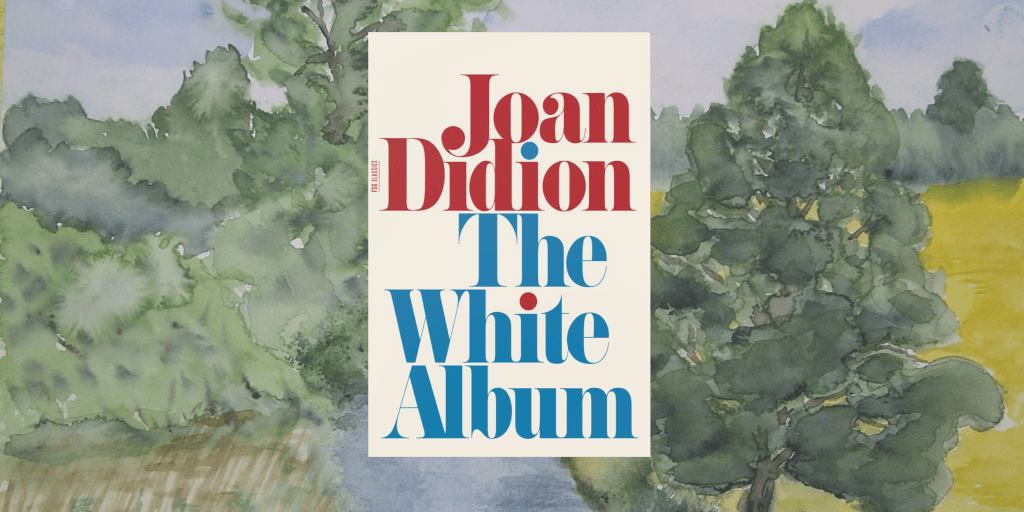
“We tell ourselves stories in order to live.”
— Joan Didion, “The White Album”
Joan Didion’s The White Album is an autobiographical essay that examines a series of snapshots from the author’s life in 1960s California. The topics of these examinations are myriad: band recording sessions, murder trials, politics, journalism, housing, aging. Didion jumps between scenes with very little connective tissue between them, relying primarily on time and place to ground her writing. Nevertheless, the essay is beautiful, and it’s a key example of the art of the personal essay. Didion is a master storyteller who uses wonderfully reflective language and a variety of mediums, from packing lists to interviews to psychiatric reports, to tell her stories about the turbulence of the 1960s.
But those stories aren’t quite what drew me to Didion. In fact, everything I love about her can be found in just the three opening pages of The White Album.
We search for meaning in the random events of our lives and use those meanings to create stories that communicate our human experience.
Serving primarily as framing for the rest of the stories, the first three pages discuss the imposition of a narrative line through one’s life. Didion posits that people, especially writers, look for “the ideas with which we have learned to freeze the shifting phantasmagoria which is our actual experience.” We search for meaning in the random events of our lives and use those meanings to create stories that communicate our human experience. Essentially, we treat life like the books we analyze in English classes, interpreting and inferring meaning based on how we think or want the story to be.
“Or at least we do for a while.”
Didion then focuses on the 1960s, a period of her life in which she lost her sense of narrative understanding. She describes feeling as though she no longer understands the cues and script of her life, and that much like the “photos” in The White Album, her narrative is no longer a movie. Instead, it resembles the cutting room floor, images out of order without rhyme or reason. She ends the paragraph with her own psychological evaluation from the summer of 1968, noting that she was examined following an “attack of vertigo and nausea.” Humorously, she notes that her reaction feels appropriate considering the events of the summer of 1968, creating a perfect transition into the series of memories that occupy the following pages.
When I first encountered this essay in my English seminar, A Literary and Political History of Writing in College, I didn’t really read it. I was in my freshman year, way in over my head with too many English classes necessitating too many readings. I read the first paragraph, more concerned about checking the class off my to-do list than anything. Frustratingly, it was confusing and abstract, which signaled to me it would require time to actually understand, time I didn’t have when three other classes were calling for my attention. Vaguely guessing at what my professor wanted to hear, I wrote up some analytical response that focused on Didion’s word choice, barely skimming beyond the first few sentences. I closed the tab and fully expected to never think about the essay again.
Unfortunately for me then, and fortunately for me now, my professor came to class the next day with a full battalion of questions. She went line by line through the first paragraph, asking us to explain what Didion was saying about narratives and how this essay related to the structure of the personal essay as a whole. I stayed silent, embarrassed at not being able to answer and promised myself that as soon as I got home that night, I’d read the essay again.
Didion’s writing washed over me, her insightful, emotional, yet matter-of-fact tone while relaying the events of the 1960s was intoxicating.
And so I reread it. And reread it again. Didion’s writing washed over me, her insightful, emotional, yet matter-of-fact tone while relaying the events of the 1960s was intoxicating. Her essay was full of fear and anxiety about the random acts of violence all around her, yet, I found something strangely beautiful about her unstructured, analytical approach to narrative writing. I came back to those opening lines over and over. “We tell ourselves stories to live.”
I thought about all the stories I was telling in that present moment; the essays I wrote analyzing, interpreting, and creating narratives around books and dates and facts. The stories I built in these essays were key to my life at that moment, but equally relevant was the story I was telling myself about what being an English major meant. To me, it meant that I read to write essays, constantly searching for the meaning in every line so I could create the narrative that I felt a professor wanted to hear. In telling myself those stories about what I should be, I was slowly losing the meaning I once attributed to the power of literature. My mentality was slowly killing the love I had for reading and writing.
And so I slowed down. I tried to spend time with each book, reading once just for the experience and relying on my sense of what was interesting to pick out moments for analysis. To my surprise, this method was far more enjoyable and efficient. When I actually slowed down to experience and enjoy what I was reading, moments ripe for analysis just jumped out at me. I didn’t need to overanalyze passages I thought were meaningful to create good essays. And far more importantly, I felt that passion for reading and writing returning.
“But writing has not yet helped me to see what it means.”
Didion ends her essay with a rumination on the lives of the many people she describes in The White Album, recounting the unusual ways in which their lives progressed, the connections they shared, and the ways in which she interacted with them. She frequently invokes reflection, talking about how The White Album serves as a form of reflection for her and positing that while she has reflected, she still doesn’t know the meaning of her experiences. In this way, The White Album stands apart from the typical narrative, not ending with a strong resolution or moral to Didion’s anxieties about meaning.
However, perhaps as Didion herself would say, maybe experience can be explored without meaning. The experience of reading Didion’s unfiltered, unstructured experience without the narrative overlay was incredibly altering, and in the year since I read The White Album, I’ve read many other famous works by Didion: The Year of Magical Thinking, Slouching Towards Bethlehem, Why I Write. I can’t recommend any of them enough. I’ve written about Didion, in texts to friends and family, in my own personal writing, in essays, in articles. In many ways, The White Album changed how I experience reading, writing, and storytelling by causing me to reflect on the ways in which I practiced those disciplines. Sometimes, we need to step back and examine things as they are before we attempt to explain them. Through Didion, I learned that while telling oneself stories is essential to life, experience and reflection for its own sake is equally, even occasionally more, important in order to keep those stories alive.

 Berkeley Fiction Review
Leave a comment