
There’s something satisfying about a story of survival. From popular television shows (Survivor, for the family-oriented, or Naked and Afraid for those who want a little more risk) to the quintessential ice-breaker question (if you were abandoned on a desert island with only three items…) there seems to be something enthralling about the idea of enduring an impossible situation with only your wits and a handful of tools. I unabashedly enjoy survival stories, and from my recent re-read of The Boxcar Children to my middle-school love of Andy Weir’s The Martian, I feel no shame in recommending a good story of stranding and success.
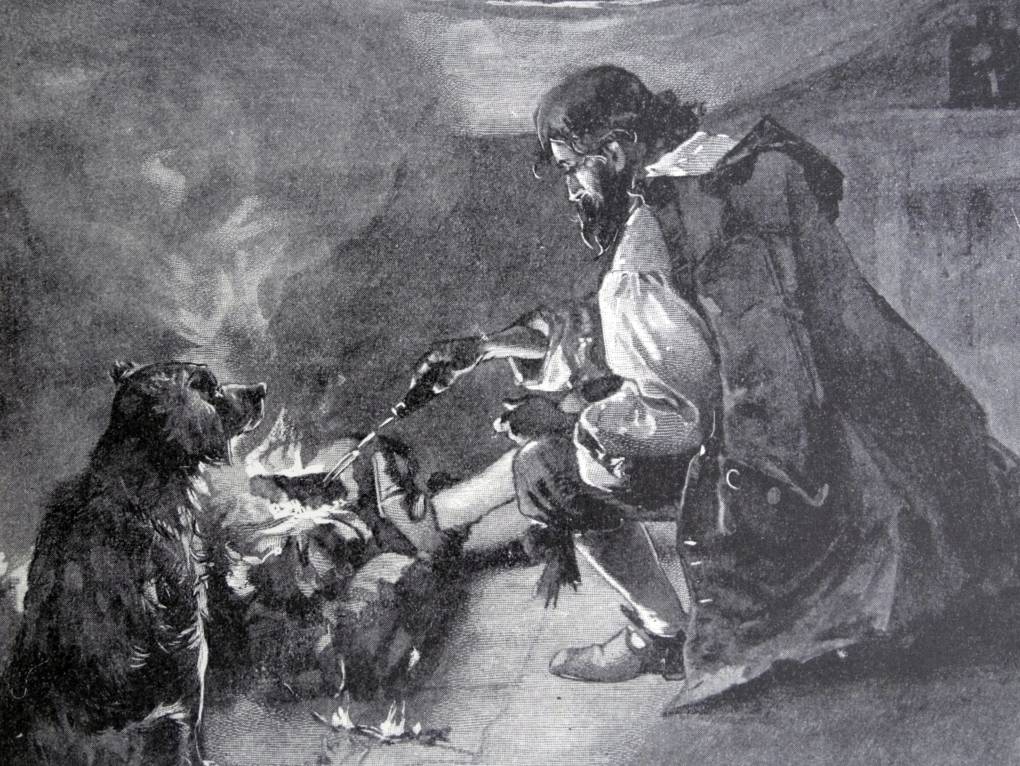
But this fascination with the desert-island story is neither a modern phenomenon nor a result of reality television. Looking back to the early 18th century and the publication of novels like Daniel Defoe’s Robinson Crusoe, it becomes clear that the idea of a man fighting for his life, stranded on an island far from the rest of humanity, has captivated audiences for centuries. Most people are familiar with the story of Crusoe, both his shipwreck and the lengthy, pedantic descriptions of every fort he builds and piece of wheat he grows. In my most recent re-read, I found myself fascinated by the moral narrative woven into the realism: the story seems to present a strict set of virtues which carry Crusoe to survival.
Most importantly, the survivor is defined by his hard-working determination.
Most importantly, the survivor is defined by his hard-working determination. After Crusoe discovers some wheat accidentally growing on his island and turns it into something edible, he remarks that “It might be truly said, that now I work’d for my bread; ‘tis a little wonderful, and what I believe few people have thought much upon the strange multitude of little things necessary in the providing, producing, curing, dressing, making, and finishing of this one article of bread” (Defoe 100). In painstakingly listing every piece of the process of making bread, Defoe draws attention to the effort put into making it and, significantly, highlights how Crusoe is rewarded for his hard efforts. Through this example of virtue-informed action, Defoe presents the moral trait of hardworkingness as one that culminates in survival.
The virtues of patience and level-headedness are also vital; this is demonstrated in the same wheat-centric set of musings. Reflecting on when he first noticed there were only a few stalks growing, Crusoe narrates that he “resolv’d not to taste any of this crop but instead to preserve it all for seed” (Defoe 100). When Crusoe grows an extra-large crop of wheat the next year, his success is a reward for his patience. Again, Defoe uses Crusoe’s survival to demonstrate a value being rewarded.
Alongside this moral code is another facet of the survivor character: his practical yet powerful faith in God. Once again in the wheat scene (I really liked this wheat scene, apparently) Crusoe acknowledges that “in time, it wou’d please God to supply me with bread” (Defoe 100). Defoe’s evocation of God here does not undo Crusoe’s hard work or patience; the protagonist has clear agency in saving wheat and making bread. He does not sit around waiting for God to save him—but even with all his productivity, Crusoe still credits God with his good luck. Thus, the wheat scene is notably an example of the Protestant Ethic, which suggests that both a specific set of virtues (hardworkingness and patience) plus a strong sense of faith ultimately contribute to the success of a Christian—or in this case, a survivor. While Robinson Crusoe is an exciting adventure, it also serves as evidence for Protestant readers that a moral code, rooted in hard work and practical Christianity, leads to survival.
While Robinson Crusoe is an exciting adventure, it also serves as evidence for Protestant readers that a moral code, rooted in hard work and practical Christianity, leads to survival.
And this pattern of survivalist stories rooted in Christian morality didn’t stop with Robinson Crusoe. A century after the publication of Defoe’s novel, a Swiss rector of Reformed Protestant Cathedral wrote The Swiss Family Robinson, a reimagination of the classic story this time centered on a family stranded alone, together—intentionally written to show his sons how to act like good men and good Christians. Like Defoe’s story, this book also begins with a shipwreck, and the characters spend hundreds of pages building elaborate tree-houses and root cellars so they can not only survive but live in an adventurous kind of comfort—like Robinson Crusoe, this novel is satisfying to read. The clever inventions and family hijinks are delightful (their ostrich racing has forever changed my views on birds), and it’s hard not to admire the life that the Robinson family manages to carve out for themselves.
Even more baldly displayed than in Robinson Crusoe, though, are the Protestant morals and virtues in this reimagination. In one scene in the fifth chapter, the father of the family narrates a productive day. It is clear the Robinsons are extremely hardworking, and describing the task of moving supplies from a boat to their treehouse, he states that “by dint of downright hard work, we accomplished this” (Wyss). The structure of a complex task, satisfyingly completed thanks to considerable effort, appears again and again in the novel, reinforcing the idea that hard work results in achievement.
God also plays an integral part in the novel, just like it does in Robinson Crusoe. While the family never thinks their faith itself will save them, it remains a part of their daily life, including in the same scene as the father’s reflection on his hard work: “‘So now for prayers and breakfast,’ I continued, ‘and then off to work’” (Wyss). God does not replace hard work, but religion augments the family’s productive morality, and together the two philosophies result in survival and satisfaction, along with the “high spirits” the Robinson family displays throughout the novel.
Interestingly, with both men and women on the island in The Swiss Family Robinson, the story also reflects typical Christian gender roles. At one point in the novel, the family’s mother (the only woman in the story) announces that while her husband and sons were off hunting, she found and planted some potatoes. Her husband responds: “‘Well done, you wise little woman!’ […] ‘Why, you are a model of prudence and industry.’” (Wyss). A complement to the hard physical labor that men use to achieve success and survival, here Wyss outlines the feminine equivalent. (Unfortunately, we have to just ignore the “wise little woman” comment; male authors were not known for their feminism in 1816). By fulfilling her role of staying home, cooking, and planting, a woman can provide for her family, and the Robinson patriarch’s excited reaction bluntly highlights how “prudence and industry” lead to survival, success, and familial joy. By including the success of a woman’s virtue, Wyss opens up the moral message to a wider audience: not only are men who work hard and pray rewarded with survival, but women who prudently provide for those men from the safety of the home are also recognized and praised. Hard work, The Swiss Family Robinson tells readers—and faith in God, and a loving family with rugged men and nurturing women—leads to survival and a fulfilling life.
More recently (if we can count the 1940s as recent), this tactic of Christian morality underlying a survivalist adventure story abandoned the desert island for a more modern equivalent, making the survivalist story more accessible to younger audiences. One example: the beloved Middle Grade classic The Boxcar Children. Though she substituted a shipwreck for a parent’s death, and an island for a boxcar in the middle of the woods, author Gertrude Chandler Warner beautifully reproduced the feeling of a family building a life from nothing. From pine-needle beds to little Benny’s favorite cup, everything about the boxcar home that siblings Henry, Jessie, Violet, and Benny build is cozy and welcoming, inviting the same admirable fascination that The Swiss Family Robinson did in 1816, and that Robinson Crusoe did before that.
The moral and social themes in The Boxcar Children are more subtle than those in its survivalist precursors. I clearly remember being a first grader and reading the novel with absolute delight; the underlying Protestant themes definitely went over my head then—yet reading the novel again through a more critical lens, I discovered that many of those themes can still be found in the novel. Like its precursors, hard work is highlighted and valorized in the story. Henry, the oldest boy, works hard and without complaint: “And it made no difference to the industrious boy what the job was. Nothing was too hard or too dirty for him to attempt” (Warner). His effort earns him money, and the admiration of the doctor in town—which ends up serving him very well, since the doctor eventually saves his sister’s life. For young readers, more than capable of making the connection between hard work and earning a helpful doctor’s favor, this situation reinforces the idea that hard work reaps rewards.
For young readers, more than capable of making the connection between hard work and earning a helpful doctor’s favor, this situation reinforces the idea that hard work reaps rewards.
Notably, this division of labor is very gendered in this novel, just as it was in The Swiss Family Robinson. Throughout the story, Henry does hard labor such as moving stones or working in the town while his two sisters cook and clean inside the boxcar, and Warner makes this division feel intrinsic and inevitable. The fundamental nature of this division is especially noticeable in the chapter titled “Housekeeping,” which begins: “The next morning Jess was up before the others, as was fitting for a little housekeeper” (Warner). Later in the chapter, Henry goes to explore while Jess watches the younger children. The children do not debate who will go explore or who will clean; their genders have automatically assigned their roles in the family unit. This is an especially strong message for young girls who see themselves in Jess (suggesting they can’t go explore) or young boys who see themselves in Henry (suggesting there is no need for them to cook or clean).
The specifically Protestant aspect of this book is equally implicit and fundamental. The spirituality of the children is never directly mentioned, but prayer and resting on Sundays are. In one scene, Henry tells his family that “‘tomorrow’s Sunday, so I shan’t work down in the town’” (Warner). Here, the role of Christianity in survivalism is more as a representation of civilization and order, a rule of the real world that the children maintain even in their alternate survivalist world. Regardless, the casual inclusion of Christian etiquette presents faith as one of the virtues that leads to survival. Just like in Robinson Crusoe, the children’s perseverance, patience, and faith eventually lead to a happy ending; especially to young and impressionable readers, this pattern deeply reinforces the value of (a child-appropriate version of) the same Protestant morals that allowed Robinson Crusoe to survive his own ordeals.
Though a story of stranding and survival from the 1940s looks different from one written two centuries earlier, the idea of a survivalist novel with a Protestant moral backbone is nothing new. Of course, there is nothing wrong with books having religious morals—but I do think it’s important that we point them out. Especially for parents today, who want to introduce their children to belief systems that align with their own beliefs, it’s vital to be able to recognize the religious morality that underlies works of fiction so they can make informed choices about the stories they read to their children.

 Berkeley Fiction Review
Leave a comment