
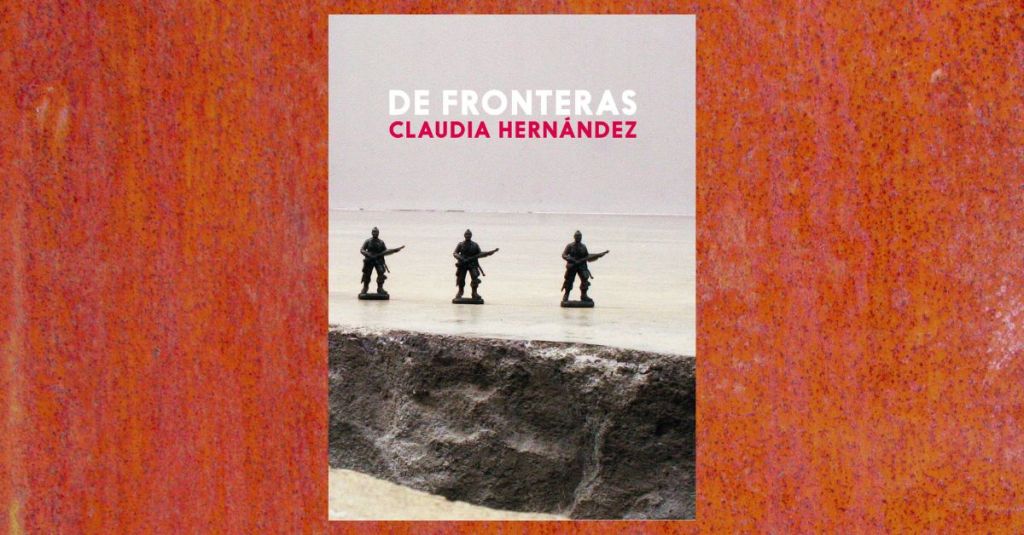
In the idle moments that exist—the restroom three minutes before lunchtime, or that extra glance at a grazing animal on the side of the road—there is a space for quiet, for silence, for ‘peace,’ that Claudia Hernández’ collection of short stories called “De Fronteras” expands on and breaks.
Claudia Hernández is a Salvadoran author whose stories in this collection experiment with her observations and experiences during the postwar period, or “el silencio,” as she puts it during an interview with Gabriela Alemán in 2019 for the Latin American Writers Series. Hernández describes growing up in the aftermath of the Salvadoran civil war with her nation’s anxious sentiment echoing through her head: “When you’re young, the first word you hear is ‘No’—no don’t go out, no don’t leave, no don’t look, no don’t hear, no don’t tell. Everything that you could do was in the negative,” says Hernández.
Even in a new time of ‘peace,’ histories are preserved by those who live through them
During this period, there were high amounts of censorship from the news media. A lot of undocumented trauma and fear, with nowhere for it to go. However, stories from neighbors or family or community members were a testament that violence did occur. When established conventions of exchanging information or histories are no longer reliable, storytelling does not stop. Even in a new time of ‘peace,’ histories are preserved by those who live through them. This is where “De Fronteras” takes its form. The structure of this collection is notable due to its use of short, bold, and brief sentences that nonchalantly tell the happenings of characters whose violent circumstances blur the lines between the real and the bizarre. Stories have a tone reminiscent of local gossip and can be understood by everyday people. The use of surreal violence in her work is necessary to explore the real violence that occurs even in idle moments. Through this exploration in her work, ‘el silencio’ is broken. Two short stories in this collection, “Carretera sin buey” and “Mediodía en la frontera,” show this best.
“Mediodía en frontera”—Midday at the Border
This story starts with a series of brief sentences such as, “It’s three minutes before midday” (Hernandez 2007 pg.1), which set the intriguing scene of a hungry dog moving through the restrooms licking up whatever’s available, only to find a woman holding a knife in one hand and her tongue in the other. Bewildered and afraid of what a woman capable of taking out her own tongue might do to him, he attempts to leave, but she begs him to stay. So he stays and asks what happened. She knows he knows. So instead she tells him why.
TW: The acts of violence in this are suicide, and self-mutilation.
Why does one commit such an act of violence? To commit another.
This story is three pages long, and there is never an indication of what drives this woman to this point. There is only a desire to die without causing trouble, and the implications of what it means to do it at your own hands. The violence in this story shows the complexities of isolation, misogyny, and kindness. This woman has reached the end, and the only thing she can think about is how “those who hang don’t look bad because they hang from the ceiling, it’s because their tongue hangs out. It’s the tongue that causes horror” (Hernandez 2007 pg.1). This horrific act of self-mutilation is justified as an act of kindness towards others, a way to die guilt-free. The dog stays at her request, because it’s true that those who sacrifice themselves in this way do it alone (Hernandez 2007 pg.2). She thanks him by cutting up her tongue into bite-sized pieces, so that at least when she is gone, he’ll have something left. Isn’t that what it means to be a woman? To sacrifice your tongue to please. Even in her final moments, she chooses an act of ‘kindness’ at the expense of herself. These loud acts of horror are juxtaposed by the silence of the scene, where the dog nods along to her reasoning not knowing much better, while the reader is internally screaming.
At the end of this story, a group of women walk in and scream at the sight of a dead woman in the restroom. But the reasons for her death, the ways it might’ve been prevented, and what or who drove her to a place of wanting to retake her agency through death, remain a mystery.
“Carretera sin buey”—A Road without an Ox
In this story, a car stops to take a better look at the ox on the side of the road. As they approach, they realize what they thought was a frail skinny animal is actually a human wracked with guilt. They decide to help turn him into a real Ox.
TW: The acts of violence in this are castration, and murder of an animal.
Who should be held accountable for acts of violence? When is ‘kindness’ violent?
In this story, violence is used as a mechanism to absolve guilt and to show innocence. The man in the story tells the strangers from the car how he accidentally ran over an Ox and stayed to take care of it during its death. He “[kept] him company and [spoke] to it during its trance of death” (Hernandez 2007 pg.10), and swatted the birds from its body until it was buried. The Ox was gone, but the man couldn’t help but feel haunted every time he looked at the empty space where it once stood. He took matters into his own hands. Over the span of ten attempts, he tried to stand in its place. But it never worked until now. He is flattered that the strangers mistook him for an Ox. The strangers, to appease any worries, say they would not have stopped to look at a person. Their apathy contrasts with his guilt. He asks what he can do to be a better Ox. These strangers show an interest in this extreme act of remorse, not by intervening but through encouragement. Maybe in a different circumstance, this would be an act of kindness, but it’s important to note the significance of the Ox here. ‘Buey’ in Spanish refers to both a castrated labor Ox and an insult for a very gullible person. The strangers are making fun of him when they say he’ll need to do four things: to lose the light in his eyes, to lose his clothes, to find some horns, and to castrate himself. There is no knife. Instead, they help him by breaking a bottle and handing him its sharp edge. Once everybody is satisfied with the result, they drive away, leaving the man to his earnest attempt at rectifying his mistake—by making another.
In both of these stories, the use of violence often seems grounded in the logic of the characters in the story. It occurs as a coping mechanism to the binaries in their life: a man wracked with seemingly foolish guilt and empathy, after accidentally killing an innocent, and a woman who even in a final selfish act, her worth feels tied only to her service to others. The use of violence in these stories breaks ‘el silencio’ by exploring the permeability of trauma.
The use of violence in these stories breaks ‘el silencio’ by exploring the permeability of trauma.
The war is over. Yet, here is what remains, the unspoken pain of a country still suffering from the memories of war
— Celia Ruiz, Fall 2023 Staff
De Fronteras can be found here.

 Berkeley Fiction Review
Leave a comment